
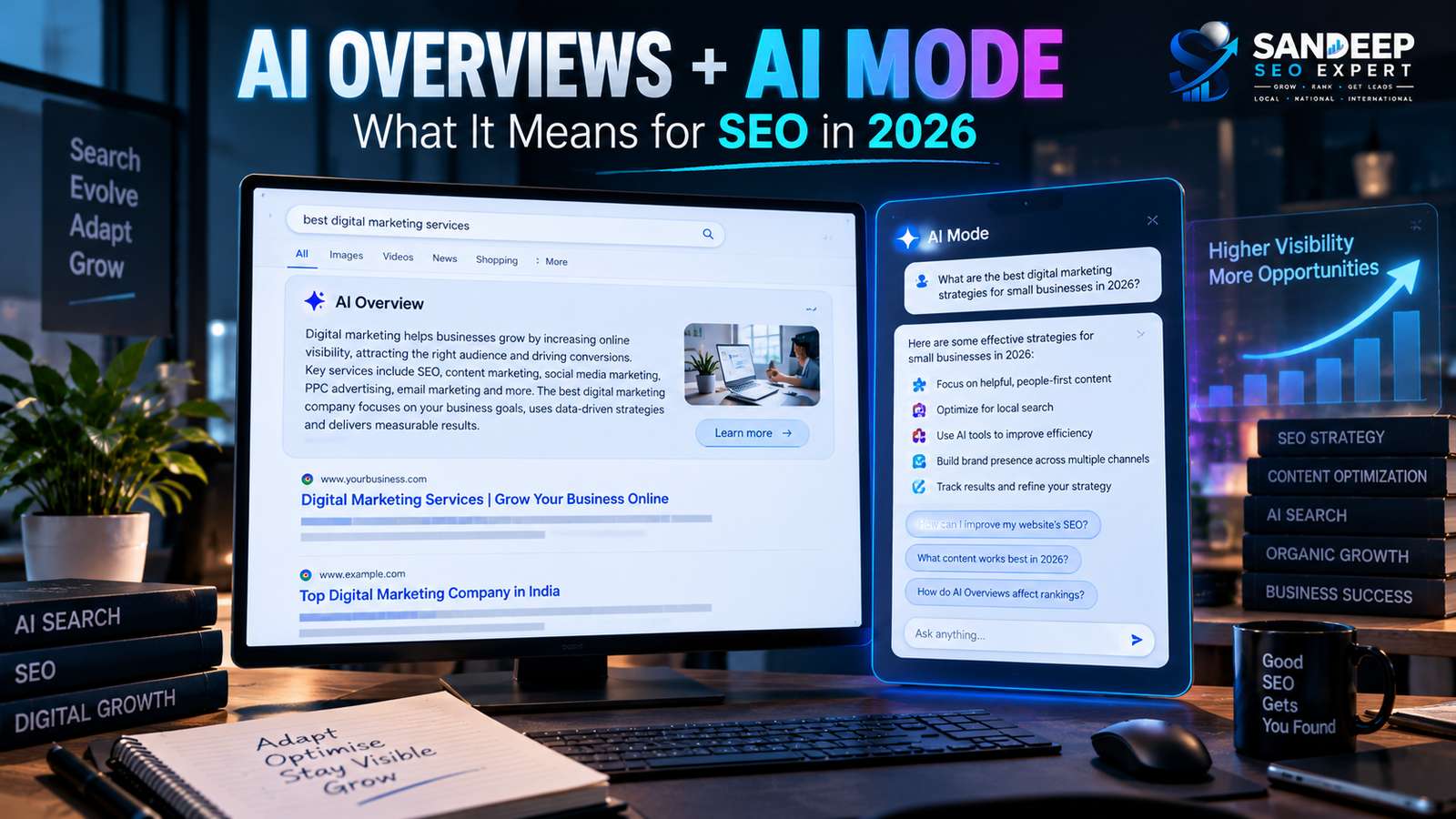
Google Search is changing quickly.
In 2026, users are no longer limited to typing a short keyword, scanning ten blue links and choosing one result. Google is increasingly combining traditional Search with AI-generated responses through AI Overviews and AI Mode.
For businesses, this creates a new SEO question:
If Google can answer more of the user's question directly, how does a website continue to earn visibility, clicks and customers?
The answer is not to abandon SEO.
Google's own guidance says that existing SEO best practices remain relevant for AI features in Search. Websites still need to be crawlable, indexable, useful, technically sound and built around helpful, reliable, people-first content. Google also says there are no additional technical requirements or special schema needed specifically to appear as a supporting link in AI Overviews or AI Mode.
But the way users discover information is changing.
That means businesses should rethink what they publish, how they structure information, how they build authority and how they measure search visibility.
Quick Answer: What Do AI Overviews and AI Mode Mean for SEO?
AI Overviews and AI Mode are Google's generative AI experiences inside Search.
AI Overviews can provide an AI-generated summary for searches where Google determines that the feature is useful, while providing links that allow users to explore the underlying web sources.
AI Mode provides a more conversational search experience where users can ask follow-up questions, explore topics in greater depth and interact with Search in a more iterative way. Google has been expanding the connection between AI Overviews and AI Mode into a more seamless Search experience.
For businesses, the important SEO implications are:
Traditional SEO still matters.
Being indexed and eligible for Search remains important.
Useful and unique content matters.
Clear site structure matters.
Internal linking matters.
First-hand expertise can make content more useful.
Images and videos can support content where appropriate.
Local and product information can become increasingly important.
Search visibility should be measured beyond traditional rankings.
There is no guaranteed way to appear in an AI-generated answer.
The goal should not be to “hack AI Overviews.”
The goal should be to build a website that Google can understand, retrieve and confidently surface when its content is relevant.
What Are Google AI Overviews?
AI Overviews are AI-generated responses that can appear within Google Search for certain queries.
Instead of showing only traditional search results, Google can provide an AI-generated explanation and links to supporting web content.
Google describes AI Overviews as a way to help people understand complicated topics more quickly and then explore supporting links across the web.
This changes the search experience.
For example, instead of searching:
“how does technical SEO work?”
and opening several individual pages, a user may receive an AI-generated overview that summarizes the topic and then decide which sources to explore further.
For businesses, this means the website needs to offer something worth discovering beyond a basic definition.
What Is Google AI Mode?
AI Mode takes the conversational approach further.
Instead of treating each search as an isolated query, users can ask a question, ask follow-up questions, refine the request and explore a subject through a longer conversation.
Google describes AI Mode as its more advanced AI Search experience, with deeper reasoning, multimodal capabilities and follow-up interactions.
In 2026, Google has continued expanding AI Mode.
At Google I/O 2026, Google said AI Mode had surpassed 1 billion monthly active users, while AI Mode queries had more than doubled every quarter since launch.
That does not mean every business will suddenly receive AI-driven traffic.
It does mean that businesses should understand how their content fits into this evolving Search environment.
Is Your Website Ready for AI Search?
Before chasing new AI SEO tactics, check whether your website has the technical foundation, content quality and internal structure needed for modern Google Search.
Get Your SEO Audit →AI Overviews vs AI Mode: What's the Difference?
The two experiences overlap, but they serve different search behaviours.
| AI Overviews | AI Mode |
|---|---|
| Can appear within regular Search | Dedicated conversational AI Search experience |
| Provides an AI-generated overview | Supports deeper conversational exploration |
| Useful for getting a quick understanding | Useful for follow-up questions and complex research |
| Links can lead users to supporting websites | Can surface web links throughout the conversation |
| Appears when Google's systems determine it adds value | Designed for more extensive AI-assisted searching |
Google also notes that AI Overviews and AI Mode can use different models and techniques, so the responses and links shown can vary.
This is important for SEO professionals.
There is not necessarily one fixed “AI ranking” that determines whether your website appears everywhere.
Does SEO Still Matter in the Age of AI Search?
Yes.
This is one of the clearest points in Google's 2026 guidance.
Google says that its generative AI Search features are rooted in its core Search ranking and quality systems. Its AI features can use information retrieved from Google's Search index to ground responses.
Google's dedicated AI Search documentation also says that existing SEO best practices remain relevant.
That includes:
Allowing crawling
Allowing indexing
Creating helpful content
Building useful internal links
Providing good page experience
Making important information available in text
Using high-quality images and videos where relevant
Keeping structured data consistent with visible content
Keeping Merchant Center information updated
Keeping Business Profile information updated
So the idea that “SEO is dead because of AI” does not match Google's own guidance.
SEO is changing, but the fundamentals remain important.
There Is No Special “AI SEO” Shortcut
A lot of businesses are now hearing terms such as:
AEO
GEO
Generative Engine Optimization
AI SEO
LLM SEO
AI Search Optimization
These terms can describe useful strategies or emerging industry practices.
But businesses should be careful about claims that suggest Google requires a completely separate technical system for AI Overviews or AI Mode.
Google's current guidance says there are no additional technical requirements specifically for appearing as a supporting link in AI Overviews or AI Mode. Google also says you do not need to create special AI files or add special AI-specific schema to qualify.
That means you should not spend your SEO budget chasing a supposed secret AI markup simply because someone calls it “GEO.”
The fundamentals still come first.
What Kind of Content Can Help in AI Search?
Google's 2026 generative AI guidance emphasizes valuable, unique and non-commodity content.
That has an important implication for businesses.
If your website says exactly the same thing as hundreds of other websites, there may be little reason for a search system to prefer your content.
Useful content can include:
Original research
First-hand experience
Detailed explanations
Product information
Local expertise
Expert opinions supported by evidence
Original examples
Case studies
Comparisons
Useful data
Clear processes
Practical solutions
The exact format depends on the topic.
For example, an SEO agency could publish:
Weak approach:
“What is SEO? SEO means Search Engine Optimization...”
More useful approach:
A detailed explanation of how a real business diagnosed its indexing problems, what was changed, what happened afterward and what other businesses can learn from the process.
The second type of content provides more original value.
Focus on Search Intent, Not Just Keywords
AI-powered Search makes conversational and complex queries more natural.
That means businesses should think beyond individual keywords.
Consider a user searching:
“best SEO company in Bhopal”
The user may want a shortlist.
Another user might ask:
“How much does SEO cost for a small business in Bhopal?”
That user wants pricing information.
Another may ask:
“Why is my website not ranking even though my pages are indexed?”
That user has a problem.
These are different intents.
A strong content strategy should create pages that address the underlying need rather than simply repeating the exact keyword.
Build Topic Depth Instead of One-Keyword Pages
AI Search can explore a topic through multiple related questions.
This makes topical depth increasingly useful.
Suppose you provide technical SEO services.
Instead of publishing one page targeting:
technical SEO
you could build a useful content ecosystem around:
What is technical SEO?
Technical SEO checklist
Website crawlability
Indexing problems
Canonical tags
XML sitemaps
Robots.txt
JavaScript SEO
Core Web Vitals
Technical SEO audit
Technical SEO for eCommerce
Technical SEO migration
These pages can then connect through meaningful internal links.
For example, an article discussing indexing problems can naturally link to an SEO audit when explaining how businesses can identify technical issues.
That creates a stronger relationship between informational content and commercial services.
Your SEO Strategy Needs to Evolve With Search
AI Search is changing how people discover information, but the foundation remains strong technical SEO, useful content, clear site architecture and a strategy connected to business goals.
Explore SEO Services →Internal Linking Matters More Than Ever
Google's AI Search documentation specifically recommends making content easily findable through internal links.
This is important because your website is not just a collection of independent pages.
Internal links help establish relationships between:
Topics
Services
Products
Supporting articles
Location pages
Category pages
For example:
A blog about ranking drops can link to an SEO audit.
An article about Google Maps can link to Local SEO.
A guide about website performance can link to technical SEO.
A product optimization article can connect to relevant SEO services.
The links should be useful to the reader, not inserted simply to increase the number of internal links.
Make Important Information Easy to Understand
Google's AI Search documentation recommends making important content available in textual form.
This does not mean every website needs to remove images or videos.
It means that important information should not exist only inside a format that makes it difficult for Search systems or users to understand.
For example, if your service page contains:
“We provide SEO audits, technical SEO, Local SEO and eCommerce SEO.”
that information should exist as readable page content.
Do not rely entirely on an image containing those words.
Use text, headings, lists and meaningful page structure.
Structured Data Still Has a Role, But Don't Abuse It
Structured data can help Google understand eligible content.
But AI Search does not require some new special “AI schema.”
Google specifically states that there is no special schema.org structured data required for AI Overviews or AI Mode.
The important principle remains:
Structured data should accurately describe the visible content.
Do not add markup simply because you believe it might make a page more likely to appear in AI responses.
Build Content That Gives Users a Reason to Visit Your Website
One of the biggest concerns businesses have about AI Search is simple:
“If Google answers the question, why would anyone visit my website?”
There is no universal answer.
Some searches can be satisfied by a short answer.
Others require deeper research, comparisons, product information, original opinions or an action that still happens on a website.
Google has also been making changes designed to connect users with original content and websites.
In May 2026, Google announced new ways for users to discover original content and sources in AI Search, including direct links, article suggestions and features such as Highly Cited sources and Preferred Sources.
That means businesses should not think only about being mentioned in an AI answer.
They should think about giving users a reason to continue to the website.
Examples include:
Detailed guides
Original research
Product pages
Pricing information
Calculators
Tools
Case studies
First-hand experience
Service comparisons
Local information
Booking or enquiry options
First-Hand Experience Can Make Content More Valuable
Generic information is increasingly easy to produce.
A business that has actually done the work has something more valuable to share.
For example, an SEO professional can explain:
What happened during an actual technical migration
How an indexing problem was diagnosed
How a local business improved its Business Profile
Which content types generated qualified leads
What happened after a site structure change
How an eCommerce website handled duplicate URLs
This type of information can make content more distinctive.
It also gives readers a reason to trust the source.
Local Businesses Should Not Ignore AI Search
AI Search does not make Local SEO irrelevant.
Google's AI Search guidance specifically mentions local content as one area website owners should consider.
For local businesses, that means maintaining accurate information across:
Website
Google Business Profile
Business information
Services
Locations
Reviews
Local content
A local business should also make its service area clear.
For example, a clinic in Bhopal should provide useful information about its services, location, practitioners and patient needs rather than simply repeating “clinic in Bhopal” throughout the website.
The same principle applies to restaurants, builders, lawyers, consultants, hospitals and other local businesses.
E-commerce Businesses Need More Than Product Keywords
Google's AI Search guidance also highlights shopping content as an opportunity.
For eCommerce websites, businesses should make product information easy to understand.
Important areas include:
Product descriptions
Specifications
Product attributes
Pricing
Availability
Images
Reviews
Category structure
Internal linking
Merchant Center information
Google's AI Search documentation also recommends keeping Merchant Center information up to date where applicable.
For an eCommerce brand, simply publishing hundreds of product pages is not enough.
The pages need to help users understand and compare products.
Images and Video Can Support AI Search Visibility
Google's 2026 guidance encourages website owners to provide high-quality images and videos where they are relevant.
This is particularly important for:
Product websites
Travel businesses
Healthcare
Education
Real estate
Food
How-to content
Demonstrations
Visual tutorials
The image should support the page.
Do not add random stock images simply because an article “needs an image.”
Use visuals that actually help explain the subject.
Don't Write for AI at the Expense of People
One of the easiest mistakes to make in the AI Search era is over-optimizing for machines.
You might see advice suggesting that every paragraph should be written in a particular format because “AI likes it.”
That is not a reliable long-term strategy.
Google's guidance continues to emphasize helpful, reliable, people-first content.
Write so that a real person can:
Understand the answer
Find the important information
Compare options
Trust the source
Take the next step
If the content is genuinely useful to people, it is also more likely to provide the kind of information Search systems are trying to surface.
How Search Console Is Changing for AI Search
This is one of the most important developments for SEO professionals in 2026.
Google introduced dedicated Search Generative AI performance reports in Search Console.
Google announced these reports in June 2026 and later stated that, as of August 31, 2026, the insights had rolled out to all websites worldwide.
These reports provide dedicated views of visibility from generative AI features in Search, including:
AI Overviews
AI Mode
Generative AI features in Discover
Google says this information is also included in the overall Performance report.
This gives businesses a new way to understand how their websites are appearing within Google's AI-powered Search experiences.
What Should Businesses Measure in 2026?
Traditional SEO metrics still matter.
But businesses can now expand the measurement framework.
Track:
Traditional Search Visibility
Organic clicks
Impressions
CTR
Average position
Ranking keywords
Landing pages
Business Outcomes
Leads
Calls
Enquiries
Bookings
Sales
Revenue
AI Search Visibility
Where available in Search Console, monitor:
Generative AI impressions
AI Search visibility
Pages appearing through generative AI features
Search and Discover generative AI performance
Do not treat AI visibility as the final business metric.
A mention that produces no useful engagement may be less valuable than a smaller amount of visibility that generates qualified customers.
Don't Chase AI Mentions as the Only Goal
It can be tempting to ask:
“How do I get ChatGPT or Google AI to mention my company?”
That is not the best starting point.
Instead ask:
“Why would an AI-powered Search system consider my website useful for this question?”
That question leads to better SEO decisions.
You may discover that the website needs:
Better content
Better internal linking
Stronger service pages
More original information
Better technical SEO
Stronger local relevance
Better product information
More trustworthy sources
Better page experience
The mention is the outcome.
The underlying website quality is the foundation.
Your SEO Strategy Needs to Evolve With Search
AI Search is changing how people discover information, but the foundation remains strong technical SEO, useful content, clear site architecture and a strategy connected to business goals.
Explore SEO Services →What Businesses Should Stop Doing
AI Search does not make old SEO mistakes safer.
Businesses should avoid:
Keyword Stuffing
Repeating a keyword unnaturally does not make content more authoritative.
Publishing Hundreds of Similar AI Articles
Quantity does not automatically create topical authority.
Creating Pages Only for Search Variations
If five pages say essentially the same thing, consider whether they need to exist separately.
Buying Low-Quality Links
AI Search does not make manipulative link building legitimate.
Creating Fake Location Pages
Do not create city pages for places where the business has no meaningful service relevance.
Adding Unnecessary Schema
There is no special AI schema required for AI Overviews or AI Mode.
Writing Robotic Content
If a page sounds like it was written only to satisfy a search engine, it is unlikely to create strong user value.
A Practical AI SEO Strategy for 2026
Businesses do not need a completely separate website for AI Search.
Instead, strengthen the existing SEO foundation.
Step 1: Fix Technical SEO
Make sure important pages can be crawled and indexed.
Check:
Robots.txt
XML sitemap
Canonicals
Indexing
Redirects
JavaScript
Mobile experience
Page performance
Step 2: Improve Important Pages
Start with pages that matter commercially.
Improve:
Service pages
Product pages
Category pages
Location pages
Key informational content
Step 3: Build Topic Clusters
Identify the questions customers ask before buying.
Create useful supporting content around those questions.
Step 4: Strengthen Internal Links
Connect related content so users and search engines can move naturally between topics.
Step 5: Add Original Value
Include:
Experience
Examples
Data
Research
Case studies
Expert explanations
Unique insights
Step 6: Improve Local and Product Information
If applicable, keep:
Business Profile
Merchant Center
Product information
Location information
accurate and updated.
Step 7: Monitor AI Search Visibility
Use the new Search Console generative AI reporting where available.
Compare it with:
Organic traffic
Leads
Sales
Rankings
Conversions
Step 8: Keep Improving
AI Search is still evolving.
Do not build your entire strategy around one feature or one prediction about how Google's AI works.
What About ChatGPT, Gemini and Other AI Search Platforms?
Google AI Search is only one part of the changing search ecosystem.
Users are also increasingly using conversational AI tools to research:
Products
Services
Businesses
Locations
Comparisons
Questions
Recommendations
This does not mean a business should create separate content for every AI platform.
A better approach is to create content that is:
Accurate
Useful
Original
Easy to understand
Well structured
Supported by evidence
Relevant to the intended audience
Those qualities can help across multiple discovery environments.
The Future of SEO Is Not Just About Rankings
For years, SEO reporting often revolved around one question:
“What position are we ranking at?”
That question still matters.
But the search journey is becoming more complicated.
A customer may now:
Search → Read an AI Overview → Open a source → Ask a follow-up question → Compare websites → Visit a brand → Search the brand again → Convert later
This makes brand visibility and content authority increasingly important.
SEO should therefore be connected with the broader customer journey.
A business should know:
Where people discover it
Which pages they visit
What information they need
Which searches generate leads
Which content assists conversions
Which channels create qualified customers
That is a more useful way to think about search visibility in 2026.
Final Thoughts
AI Overviews and AI Mode are changing how Google Search works, but they have not eliminated the fundamentals of SEO.
Google's own 2026 documentation makes this clear.
There is no special AI markup that guarantees visibility.
There is no secret AI ranking trick.
There is no replacement for making a website technically accessible, useful, trustworthy and relevant.
What is changing is the way users interact with Search.
People can ask longer questions, explore topics conversationally and move between AI-generated answers and web sources.
Businesses that continue to build genuinely useful content, strong websites, clear internal linking, relevant local and product information and measurable SEO strategies will be better positioned to adapt as Search evolves.
The question is no longer simply:
“How do I rank #1?”
A better question is:
“How do I become a useful and trusted source when my customers search?”
Want to Prepare Your Website for Modern Google Search?
If your website needs stronger technical SEO, content, Local SEO or search visibility, build the strategy around your actual business goals rather than chasing short-term AI SEO trends.
Contact Sandeep SEO Expert →Frequently Asked Questions
1. What are Google AI Overviews?
AI Overviews are AI-generated responses that can appear within Google Search for queries where Google's systems determine that an AI-generated overview can be useful. They can include links to supporting web sources.
2. What is Google AI Mode?
AI Mode is Google's more conversational AI Search experience. It allows users to explore questions through follow-up queries and deeper interactions while continuing to provide links to web content.
3. Does SEO still matter for AI Overviews and AI Mode?
Yes. Google says existing SEO best practices remain relevant for its generative AI Search features. Websites still need to meet technical requirements and follow Search policies while providing helpful, reliable, people-first content.
4. Is there special schema for AI Overviews?
No. Google says there is no special schema.org structured data required specifically for AI Overviews or AI Mode. Existing structured-data best practices still apply, including making sure the markup accurately represents visible page content.
5. Do I need a special AI file to appear in Google AI Search?
No. Google says website owners do not need to create new machine-readable files or AI-specific markup to appear in AI Overviews or AI Mode.
6. How can I optimize my website for AI Overviews?
Start with the same strong SEO foundation: crawlability, indexing, useful content, clear internal links, good page experience, accessible text and accurate structured data. Google also recommends valuable, unique and non-commodity content for generative AI Search.
7. Does AI-generated content hurt SEO?
AI-assisted content is not automatically a problem. The important issue is whether content provides useful value or is produced at scale primarily to manipulate Search. Google's scaled content abuse policy applies regardless of whether content was created manually, automatically or with generative AI.
8. Can small businesses benefit from AI Search?
Yes. Small businesses can strengthen their chances of being discovered by creating useful service information, answering customer questions, maintaining accurate local information and building a technically sound website. Local content and Business Profile information can also be relevant for local businesses.
9. Can eCommerce websites appear in AI Search?
Yes. Product and shopping information can be relevant to generative AI Search. Google recommends providing useful shopping content and keeping relevant Merchant Center information up to date.
10. How can I track AI Search visibility?
Google introduced dedicated Search Generative AI performance reports in Search Console for visibility within generative AI features such as AI Overviews and AI Mode. Google stated that these insights had rolled out to all websites worldwide by August 31, 2026.
11. Will appearing in an AI Overview guarantee website traffic?
No. AI visibility does not guarantee a click, lead or sale. Businesses should measure AI Search visibility alongside organic traffic, engagement, enquiries, conversions and revenue.
12. Will AI Mode replace traditional Google Search?
Google is integrating AI Overviews and AI Mode into a more seamless Search experience, but traditional web results remain part of Search. Google's current direction is to combine AI capabilities with links and access to the broader web rather than simply removing websites from Search.