
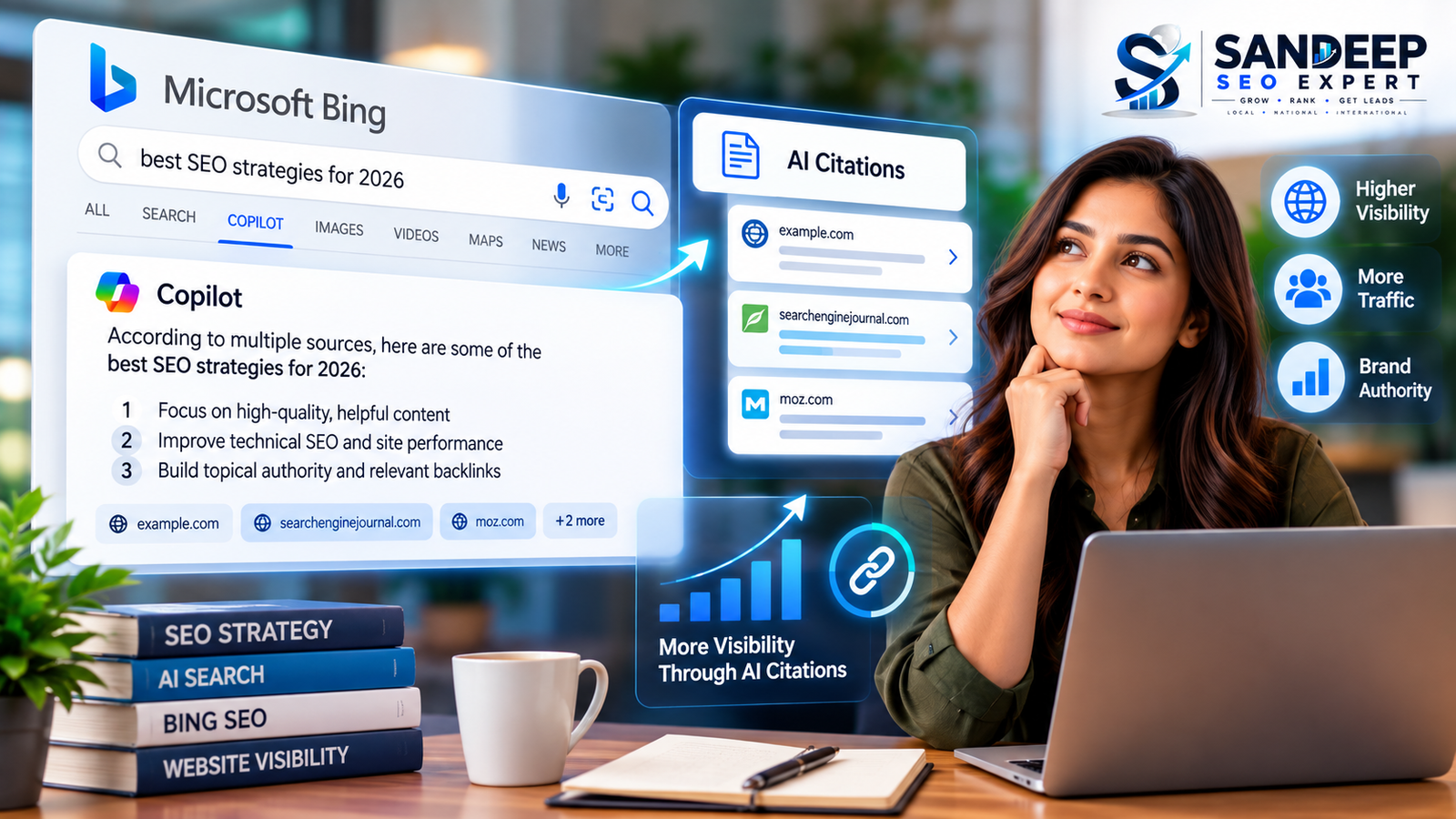
Search visibility is no longer limited to where a website appears in a traditional search results page.
Microsoft's search ecosystem now includes AI-generated experiences across Bing and Microsoft Copilot, where answers can be built from information gathered from multiple web sources. When a website's content is used in one of these answers, the page may appear as a citation or source.
For website owners, this introduces a new question:
Is my website being discovered and referenced by AI search systems, and can I measure it?
Microsoft has started making that question much easier to investigate.
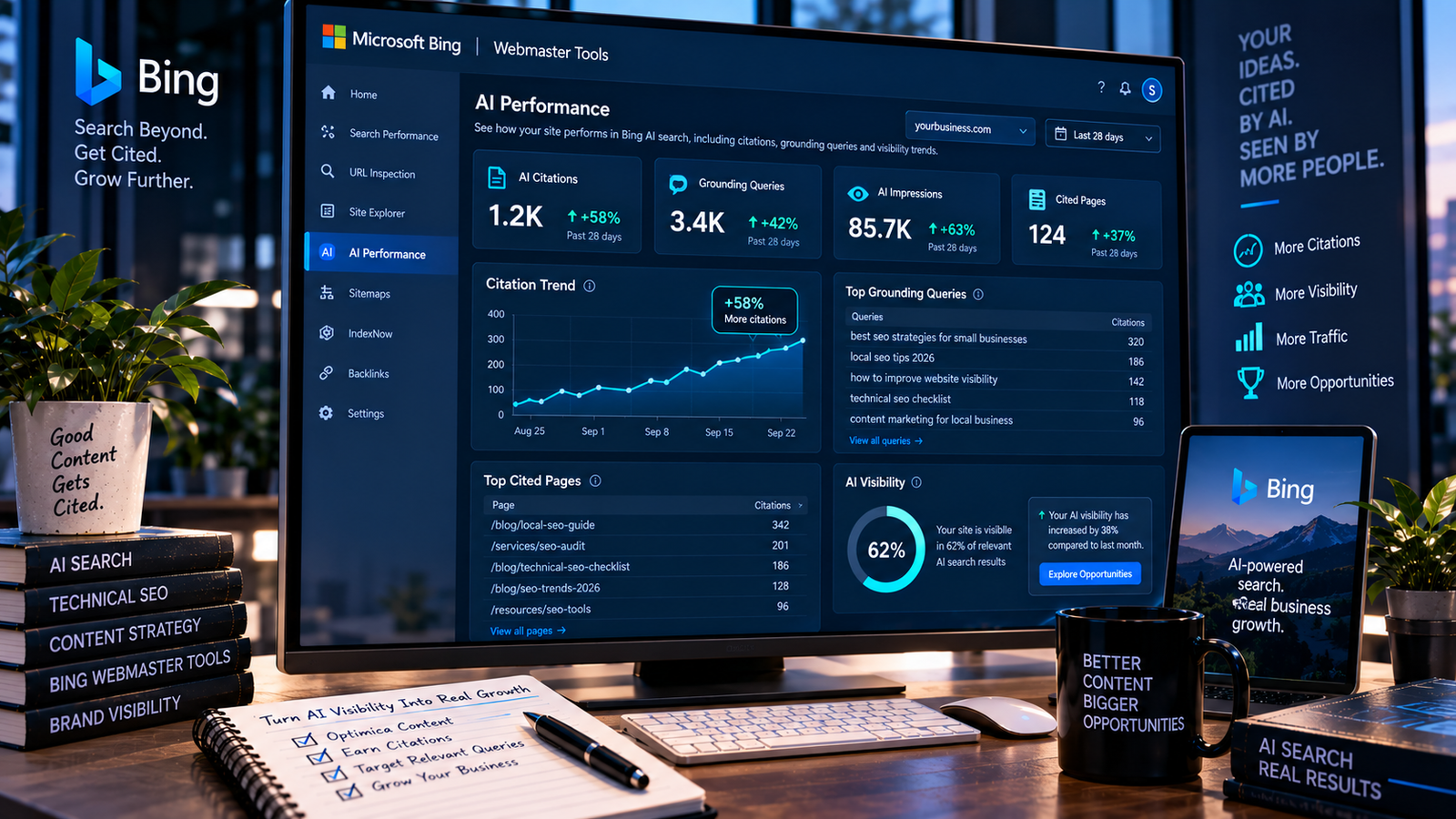
Bing Webmaster Tools now includes an AI Performance report that shows how a site's content is cited across supported AI experiences. It can show cited pages, citation activity, grounding queries and visibility trends. Microsoft has also introduced preview features such as Intents, Topics, Citation Share and Compare, giving publishers more context around where and how their content appears in AI-generated answers.
This does not mean AI citations are a new ranking score.
They are not.
A citation tells you that your content was referenced in an AI-generated answer. It does not automatically mean your website has a higher ranking, greater authority, more traffic or better overall SEO performance. Bing explicitly separates citation activity from rankings, authority and traffic.
That distinction is important.
This guide explains what Bing AI visibility actually means, how citations work, what the new metrics tell website owners, and how to use the data to improve content without turning your SEO strategy into a collection of AI-search tricks.
Quick Answer: What Do Bing AI Citations Mean?
A Bing AI citation means that content from your website was visibly referenced or shown as a source in an AI-generated answer across supported Microsoft AI experiences.
According to Bing's current AI Performance documentation, the report can show:
Total citations
Pages cited in AI answers
Average cited pages
Grounding queries associated with your content
Page-level citation activity
Citation trends over time
Intent classifications
Topic groupings
Citation Share
Comparison between time periods
The most important point is this:
A citation is evidence of AI-search visibility, not a traditional ranking position.
Bing says AI Performance does not measure rankings, authority, importance, traffic or user engagement. It shows citation activity.
For website owners, that makes AI Performance useful for answering questions such as:
Which pages of my website are being referenced?
What subjects are associated with those citations?
What types of search intent are generating visibility?
Is citation activity changing over time?
Those are much more actionable questions than simply asking whether a website is “optimized for AI.”
What Is Bing AI Search?
Bing has been incorporating AI-generated answers into its search experience, while Microsoft Copilot also uses web information to provide answers to users.
Instead of presenting only conventional organic listings, these experiences can synthesize information from multiple sources and provide citations back to the underlying websites.
This creates another path for users to discover content.
A simplified journey looks like this:
User question → Bing/Copilot retrieves web information → AI-generated answer → source citation → potential website visit
The important difference is that the website may not be the first thing the user sees.
The information from the website can become part of the answer itself.
That changes the meaning of visibility.
What Is an AI Citation?
An AI citation is a visible reference to a website or page used within an AI-generated answer.
Imagine someone asks:
“What should a small business consider before hiring an SEO agency?”
An AI-generated answer may combine information from several websites.
Your page might be one of the sources used to support part of that answer.
Bing's AI Performance report can then record citation activity associated with that page.
However, the citation does not tell you that your page was “ranked #1” inside the answer.
Microsoft specifically explains that page-level citation counts represent how often pages are cited, not their importance, ranking or role within a particular response.
That distinction should remain clear in any AI-search reporting.
Bing AI Performance: The Report Website Owners Should Know
The most significant development for publishers is that Bing has moved AI visibility measurement into its webmaster ecosystem.
The AI Performance report is designed to show how your content appears in AI-generated answers across:
Microsoft Copilot
AI-generated summaries in Bing
Select partner AI integrations
It provides aggregated information about how often your content is referenced and which pages are involved.
This is important because AI visibility has traditionally been difficult to measure.
A marketer could manually ask an AI system a few questions, record whether a brand appeared and call that an AI SEO report.
That approach is extremely limited.
Bing's first-party reporting provides a much broader view of citation activity over time.
What Does Total Citations Mean?
Total Citations represents the total number of times your website's content was visibly referenced or shown as a source in AI-generated answers during the selected period.
For example, if several pages from your website were cited across many AI answers, the total citation count represents that overall activity.
But don't interpret the number as:
Ranking position
Domain authority
Website quality score
Traffic
Conversion potential
Bing explicitly says AI Performance does not measure those things.
Think of total citations as a visibility volume metric.
It tells you that your content is participating in AI-generated answers.
It does not tell you everything about the quality or business value of that visibility.
What Are Cited Pages?
The Pages view shows which URLs from your website were cited.
This can be extremely useful.
Suppose you have 500 indexed pages but only 12 pages are consistently appearing as citations.
That tells you something about where your current AI-search visibility is concentrated.
You can then investigate:
What subjects those pages cover
How comprehensive they are
Their structure
Their internal links
Their freshness
Their supporting evidence
Their search intent
Their relationship with other pages on the website
This does not mean the other 488 pages are poor.
It simply gives you a starting point for analysis.
What Are Grounding Queries?
This is one of the more interesting parts of Bing's AI Performance reporting.
A grounding query represents a phrase associated with the content retrieval process that led to a citation in an AI-generated answer.
Bing explains that grounding queries help website owners understand which phrases are associated with their content being cited. However, these are aggregated phrases rather than a complete record of individual user prompts.
For example, a website about solar energy might see grounding phrases related to:
Solar panels
Solar energy efficiency
Residential solar installation
This can reveal broader areas where the website is already being used as a source.
The important word is broader.
A grounding query should not automatically be treated as an exact keyword that generated one specific AI answer.
Grounding Queries Are Not the Same as User Prompts
This distinction is important when analyzing the report.
Bing says grounding queries are aggregated and do not represent individual questions or exact prompts.
They can group related activity across AI answers.
Therefore, if the report shows a phrase such as:
“technical SEO audit”
you should not automatically conclude:
“Someone typed exactly technical SEO audit into Copilot.”
The data does not support that conclusion.
Instead, interpret it as evidence that your content is associated with AI retrieval activity around that broader phrase or theme.
That makes the data useful for content strategy, but not as a perfect log of individual user behavior.
Why Grounding Queries Matter for Content Strategy
Grounding queries can reveal subjects where your website already has some AI visibility.
Imagine an SEO website sees citation activity around:
Technical SEO audit
Website indexing problems
Google Search Console errors
Local SEO
Google Business Profile
That could indicate several areas of topical relevance.
The next step should not automatically be:
“Publish 100 more articles about these keywords.”
Instead, investigate the existing content.
Ask:
Is the topic already covered well?
Is there a strong dedicated page?
Are related pages connected?
Is the information current?
Are there unanswered questions?
Could the page use original examples?
Is the commercial journey clear?
The data should guide decisions.
It should not replace editorial judgment.
Bing's New Intents Feature
In June 2026, Microsoft introduced additional AI Performance insights in preview, including Intents.
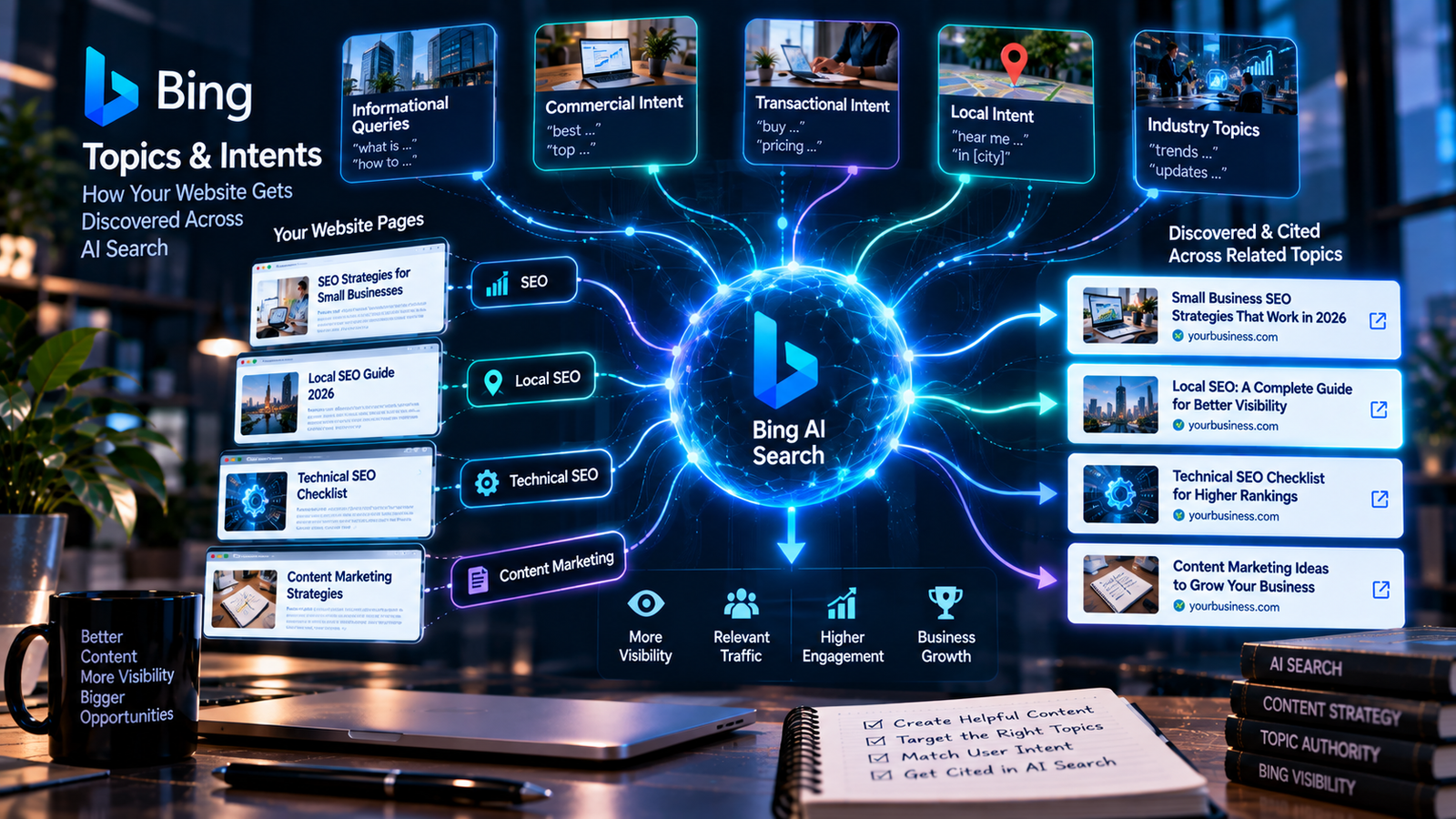
The Intents feature classifies grounding queries into broader categories such as:
Informational
Commercial
Navigational
Learn and Solve
Research
Local
Comparison
Planning
Utility
Creation
Conversational
Other
Microsoft explains that these classifications are generated by AI/ML systems and can occasionally be imperfect, particularly for ambiguous or multi-intent queries.
This is useful because traditional keyword reporting often focuses on the phrase itself.
AI search can require a broader question:
What was the user trying to accomplish?
Why Search Intent Matters Even More in AI Search
Consider two searches:
“SEO services India”
and
“How do I fix a sudden drop in organic traffic?”
Both relate to SEO.
But the underlying intent is different.
The first is commercially oriented.
The second is problem-solving.
A single generic article should not necessarily attempt to serve both.
When Bing's AI Performance data shows different intent patterns, it can help content teams understand where their website is gaining visibility and where gaps may exist.
For example, an e-commerce website may discover strong citation activity around informational searches but limited visibility around commercial or comparison-oriented topics.
That could suggest an opportunity to improve product comparison, buying guidance or commercial content.
It does not prove that a content change will increase citations.
It simply identifies an area worth investigating.
What Are Topics in Bing AI Performance?
Bing's Topics feature groups related grounding queries into broader subject areas.
This is particularly interesting because AI systems do not operate only around isolated keywords.
They work with concepts and relationships.
For example:
Topic: Solar Energy
could contain grounding queries related to:
Solar panels
Solar energy efficiency
Residential solar installation
Instead of looking at dozens of phrases individually, a content team can begin thinking about the larger subject.
This aligns closely with a modern topical SEO approach.
Topics Can Reveal Content Gaps
Suppose your website receives citations around a particular topic but has only one shallow article covering it.
That creates an opportunity.
You might need:
A stronger core guide
Supporting articles
A service page
A comparison page
A detailed FAQ
Original examples
Supporting data
Better internal links
The goal is not to create pages simply because a topic appears in the report.
The goal is to determine whether your website deserves deeper coverage of that subject.
Citation Share: A More Useful Metric Than Raw Citation Counts?
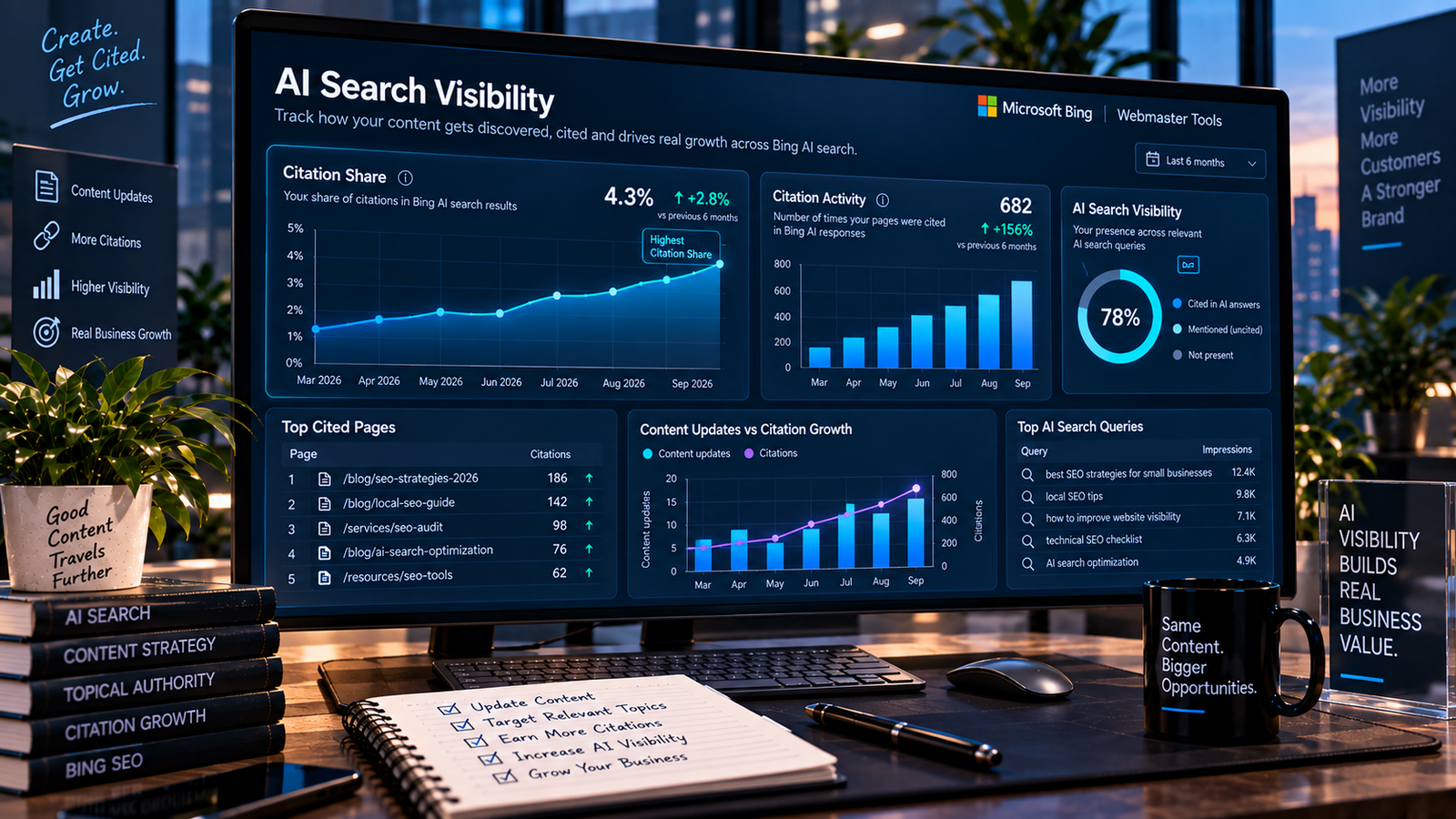
Bing's June 2026 preview also introduced Citation Share.
Citation Share measures the percentage of citations attributed to your website out of the citations shown for a particular grounding query.
For example, imagine a grounding query generates 100 visible citations across the participating sources and your website receives 15 of them.
Your Citation Share would represent 15% of that citation space.
But there is an important limitation.
Bing does not present Citation Share as a competitive ranking score.
It does not reveal which competitors received the remaining share, and it does not represent traffic or content quality.
How Should You Interpret Citation Share?
Think of Citation Share as a relative visibility indicator.
It can help answer:
“How much of the citation space associated with this grounding query is currently going to my website?”
That is different from:
“Am I better than my competitors?”
Bing explicitly cautions against interpreting Citation Share as a ranking or quality score. Citation patterns can change because of user demand, content freshness, model behavior, competing content and other factors.
So it is most useful for observing trends.
What Does a Rising Citation Share Tell You?
A rising share may indicate that your content is receiving a larger proportion of the visible citation activity associated with a particular grounding query.
That can be useful.
But do not automatically conclude:
“My SEO changes caused this increase.”
Bing specifically notes that citation patterns can be affected by multiple factors, including:
User demand
Content changes
Freshness
AI model changes
Partner refresh cycles
Changes across the wider web
Therefore, Citation Share is observational rather than causal.
What Is the Compare Feature?
The Compare capability allows publishers to compare citation activity across different periods.
For example:
Current 30 days vs previous 30 days
Current period vs an earlier period
Custom date ranges
This is useful because a single citation count has little context.
A trend is more meaningful.
Suppose citation activity was:
January: 80
February: 105
March: 140
That pattern deserves investigation.
But you still need to ask why.
Possible explanations could include:
New content
Updated content
Increased demand
Changes in AI systems
Seasonal interest
Competitor changes
Improved topical coverage
The report shows the pattern.
Your analysis needs to explain the possible reasons.
AI Citations Are Not Traffic
This deserves its own section because it is one of the easiest mistakes to make.
A citation is not a click.
Bing explicitly says AI Performance citations do not represent traffic, clicks or user engagement.
A website can receive:
100 citations and 10 visits
or:
20 citations and 50 highly engaged visitors
The second situation could potentially be more commercially useful, depending on the business.
That is why AI visibility should always be connected to broader analytics.
How Website Owners Should Measure AI Visibility
A practical measurement framework should contain at least four layers.
Layer 1: AI visibility
Measure:
Total citations
Cited pages
Grounding queries
Topics
Intents
Citation Share
Trends over time
Layer 2: Website traffic
Measure:
Sessions
Landing pages
Engaged sessions
New users
Returning users
Layer 3: Business engagement
Measure:
Contact form submissions
Calls
Enquiries
Bookings
Product interactions
Downloads
Layer 4: Revenue
Where possible, connect the traffic to:
Sales
Revenue
Qualified leads
Customer acquisition
Pipeline value
This gives a much more complete picture.
What Bing's AI Data Cannot Tell You
The limitations are just as important as the metrics.
AI Performance does not give you:
Every AI answer where your website may have appeared
Every exact user prompt
A traditional ranking position
A domain authority score
A quality score
Guaranteed traffic
A complete record of every citation
A causal explanation for every change
Bing says the AI Performance dataset is aggregated and represents a sample of overall citation activity. Very low or infrequent citation activity may not surface, and totals may differ across views.
This means you should use the data for trend analysis and strategic direction, not pretend it is a perfect log of every AI interaction.
How to Make Your Website More Eligible for Bing AI Search
The good news is that Bing's own guidance does not require a completely separate technical ecosystem for AI visibility.
Microsoft says the same core foundations that support traditional Bing search also support eligibility for AI-powered experiences.
These include:
Crawlability
Indexing accuracy
URL consolidation
Content clarity
Structure
Authority
Trust
Bing's current Webmaster Guidelines explicitly state that SEO fundamentals continue to support eligibility for grounding results and citations.
That means the first step is still solid SEO.
Want to Know Why Your Website Is Missing Search Visibility?
AI visibility starts with the same fundamentals that support strong organic search: crawlable pages, accurate indexing, clear site structure, useful content and strong technical foundations. Identify the issues before trying to optimize for AI citations.
Get Your SEO Audit →1. Make Sure Bing Can Crawl Your Important Pages
Review:
robots.txt
XML sitemap
Internal links
HTTP status codes
Canonicals
JavaScript rendering
Redirects
Crawl errors
Duplicate URLs
Bing specifically recommends clear discovery signals such as XML sitemaps, crawlable internal links, relevant external links and IndexNow.
A page that cannot be reliably discovered or rendered has limited potential as a source.
2. Use XML Sitemaps Properly
Your sitemap should contain the URLs you actually want Bing to discover and maintain.
Bing recommends:
Canonical URLs
Current site structure
Removal of deleted or redirected URLs
Accurate
lastmodinformation where applicable
A sitemap does not guarantee AI citation.
Its purpose is to improve discovery and indexing accuracy.
3. Consider IndexNow for Updated Content
Microsoft recommends IndexNow as a way to notify participating search engines when URLs are:
Added
Updated
Removed
This can help Bing discover changes more quickly.
For websites where information changes frequently, faster discovery can be useful because AI-generated answers depend on current web information.
Again, IndexNow is not a citation guarantee.
It is a discovery and freshness mechanism.
4. Strengthen Internal Links
Important pages should be reachable through standard crawlable links.
Bing's current guidelines specifically recommend crawlable internal links and relevant anchor text as part of discovery and authority signals.
For example, an article about technical website problems can naturally connect to your technical SEO service.
A guide about local visibility can link to Local SEO services.
A broader website problem can lead to an SEO audit.
These links help both users and search systems understand how the website's information fits together.
5. Avoid Duplicate URLs
If the same content is available at multiple URLs, Bing may have difficulty determining which version should be selected.
Bing recommends using canonical URLs and addressing duplication at the source.
This becomes particularly important for:
Filtered e-commerce pages
URL parameters
Tracking URLs
Duplicate location pages
HTTP/HTTPS variations
Trailing slash variations
Old and new URL structures
A clean URL architecture creates a clearer foundation for search and AI retrieval.
6. Handle URL Changes Properly
If a page moves permanently, use a proper 301 redirect.
Do not rely on a canonical tag as a replacement for a redirect when the original URL should no longer serve users.
Bing's current guidance recommends 301 redirects for permanent moves and 302 redirects only for genuinely temporary situations.
This helps preserve continuity when URLs change.
7. Make Content Easy to Understand
Bing's AI guidance emphasizes content that is:
Clear
Focused
Accurate
Original
Authoritative
Useful
Aligned with user intent
It also notes that thin, ad-heavy or affiliate-only pages may lose visibility and grounding eligibility.
This is important because AI systems need to retrieve information and use it accurately.
If a page is vague, repetitive or poorly structured, there is less useful information to work with.
8. Support Important Claims With Evidence
If you make a factual claim, support it where appropriate.
Use:
Original data
Credible research
Official documentation
Industry statistics
Examples
Case studies
First-hand experience
Bing specifically recommends supporting claims with examples, data and cited sources as part of improving clarity and trust when content is reused in AI-generated answers.
This does not mean every sentence needs a citation.
It means important claims should be defensible.
9. Keep Content Fresh
Outdated information can become a problem in AI search.
Imagine a page about:
Software pricing
Google guidelines
SEO updates
Product specifications
Government regulations
Platform features
If the page is three years old, but the information has changed several times, it may no longer be the best source.
Bing recommends keeping content fresh and accurate, and its AI Performance documentation notes that citation volume can change because of content freshness and other ecosystem factors.
Do not update an article simply by changing the date.
Update the actual information.
10. Make Text, Images and Video Consistent
Bing's AI guidance also emphasizes consistency across different formats.
If your text describes one product specification but your images or video suggest another, the information becomes harder to interpret reliably.
Make sure:
Product names match
Specifications match
Service descriptions match
Locations match
Visual content supports the written content
Consistency is particularly important for businesses with complex products or services.
11. Avoid Keyword Stuffing
AI visibility is not improved by repeating the same phrase twenty times.
Bing's Webmaster Guidelines specifically warn against keyword stuffing and artificially engineered language.
Content should be created for users rather than designed to manipulate rankings or trigger AI responses.
For example, instead of writing:
SEO Company in Jabalpur provides SEO services in Jabalpur for businesses looking for an SEO company in Jabalpur...
write naturally.
Explain:
What the service does
Who it is for
What problems it solves
How it works
What makes the approach different
The topic will be clear without repetition.
12. Avoid Automatically Generated Content at Scale
Using AI tools is not automatically equivalent to producing bad content.
The issue is quality and purpose.
Bing's guidelines warn against large-scale automatically generated content that lacks oversight, accuracy or originality. It also warns against scraped or lightly rewritten content without added value.
If a website publishes hundreds of pages that say essentially the same thing, changing only the city or keyword, the result may create more URLs without creating more value.
Human review matters.
Original information matters.
Editorial judgment matters.
13. Do Not Try to Manipulate AI Responses
This is a newer area of search abuse.
Bing's guidelines specifically mention prompt injection and AI manipulation as practices that can reduce visibility or result in removal from search experiences.
That means businesses should not try to insert instructions into website content designed to manipulate an AI system into:
Recommending the company
Ignoring competitors
Giving the company a preferred position
Misrepresenting facts
Changing how the model evaluates sources
Write for users.
Provide useful information.
Let the content earn its visibility.
AI Search Does Not Replace Traditional SEO
This is perhaps the biggest strategic takeaway.
Bing explicitly says the same core crawling, indexing and ranking foundations support traditional search and AI-powered experiences.
That includes:
Technical SEO
Crawlability, indexing, rendering and URL management.
Content SEO
Useful, original and clearly structured information.
Internal linking
Logical relationships between pages.
Authority
Relevant links, references and trust signals.
Local SEO
Accurate business information and location relevance.
User experience
A website that is actually usable.
So the strategy should not be:
“Forget SEO. We need GEO now.”
A better approach is:
Strengthen SEO foundations and make the content useful enough to participate in AI-generated answers.
AI Citations Can Reveal What Your Website Is Known For
This is where the data becomes strategically interesting.
Suppose your business sells software.
Your website might have hundreds of pages, but Bing AI Performance shows repeated citations around:
CRM integrations
Sales automation
Small business CRM
Lead management
That pattern can tell you something.
Those may be subjects where your content is already being associated with useful information.
You can then investigate whether the website has enough depth around those themes.
Perhaps you need:
A stronger pillar page
Supporting guides
Comparison pages
Integration documentation
Case studies
Product pages
Better internal links
AI citation data can therefore become a content intelligence signal.
Not a ranking formula.
Want to Know Why Your Website Is Missing Search Visibility?
AI visibility starts with the same fundamentals that support strong organic search: crawlable pages, accurate indexing, clear site structure, useful content and strong technical foundations. Identify the issues before trying to optimize for AI citations.
Get Your SEO Audit →What If a Page Gets Impressions But No AI Citations?
That is not necessarily a problem.
Traditional search visibility and AI citation visibility are different measurements.
A page may:
Rank in Bing
Receive impressions
Generate clicks
Convert visitors
without being frequently cited in AI answers.
Likewise, a page can receive AI citations without producing significant direct traffic.
The correct response is not to delete or rewrite every page that lacks citations.
Look at the page's actual role.
What If Citation Activity Suddenly Falls?
Don't immediately assume that the page has been penalized.
Bing says citation activity can change because of:
User demand
Content freshness
Model updates
Partner refresh cycles
Changes across the wider web
Therefore, investigate before making major changes.
Check:
Did the content change?
Did competitors publish stronger resources?
Did demand change?
Did the topic become less popular?
Did the website experience indexing problems?
Did URLs change?
Did the AI Performance reporting change?
Did Bing or partner experiences change?
A citation decline is a signal to investigate.
It is not automatically a penalty.
How to Use Bing AI Performance Data in an SEO Strategy
A useful monthly workflow could look like this.
Step 1: Export the data
Review:
Pages
Grounding queries
Topics
Intents
Citation Share
Date comparisons
Step 2: Identify your strongest themes
Find subjects where your website consistently receives citations.
Step 3: Review the cited pages
Look at:
Content depth
Structure
Internal links
Sources
Freshness
Conversion path
Step 4: Find content gaps
Ask what related questions the website does not answer.
Step 5: Improve the existing resource
Do not automatically create a new URL.
Sometimes improving an existing page is the better choice.
Step 6: Build supporting content
Where there is a genuine information gap, create useful supporting resources.
Step 7: Connect the content
Use internal links to establish clear topical relationships.
Step 8: Compare later periods
Use Bing's Compare functionality to observe whether citation patterns change.
Step 9: Check business outcomes
Compare AI visibility with:
Organic traffic
Referral traffic
Leads
Sales
Engagement
This makes AI-search optimization part of a real SEO program rather than a separate vanity project.
Bing AI Search and Local Businesses
AI-generated answers can be particularly relevant for local businesses.
Imagine a user asking:
“Which dental clinics near me offer dental implants?”
or:
“Which builders in Jabalpur provide residential construction?”
The answer may depend on business information, location relevance and service information rather than a single blog post.
For these businesses, AI-search readiness should include:
Accurate business information
Relevant service pages
Local content
Consistent contact details
Google Business Profile
Bing Places information
Genuine reviews
Local authority
Clear service descriptions
Microsoft's AI Performance announcement specifically points local businesses toward maintaining accurate information through Bing Places for Business alongside webmaster tools.
For businesses that depend on local search, Local SEO should therefore remain part of the broader strategy.
Build an SEO Strategy for Modern Search
AI search is becoming another layer of website discovery, but strong technical SEO, content, local visibility and site architecture still form the foundation. Build a strategy around your actual business goals and search opportunities.
Explore SEO Services →Bing AI Search and E-commerce Websites
E-commerce websites have another opportunity.
AI systems may help users compare:
Products
Features
Prices
Materials
Use cases
Alternatives
Specifications
That makes product and category pages important sources of information.
An e-commerce website should avoid relying entirely on manufacturer descriptions.
Where possible, provide:
Original product information
Clear specifications
Real images
Usage information
Comparisons
FAQs
Shipping details
Returns
Customer considerations
Relevant reviews
The goal is to give the search system useful information while making the page valuable to the person who eventually visits it.
Bing AI Search and Service Businesses
Service businesses should pay particular attention to commercial pages.
Suppose someone asks:
“What does technical SEO include?”
An educational article may answer the question.
But if the person then asks:
“Who provides technical SEO services?”
the service page becomes more relevant.
This is why content and commercial pages should work together.
A website can move the user through:
Problem → Education → Evaluation → Service → Enquiry
A strong SEO services structure should make that transition natural rather than forcing every visitor to return to the homepage.
What Bing AI Visibility Does Not Mean
It is worth removing a few common misunderstandings.
A citation is not a ranking
Bing does not describe AI citations as conventional ranking positions.
More citations do not automatically mean more traffic
Citations and clicks are separate measurements.
Citation Share is not a quality score
It measures relative citation presence for a grounding query.
One citation does not prove authority
A page being referenced once does not establish overall expertise.
No citation does not mean bad SEO
Traditional search and AI citation visibility can differ.
AI visibility is not guaranteed
Search systems can change, and citation patterns are dynamic.
More content is not automatically better
Bing warns against thin, repetitive and automatically generated content at scale.
These distinctions prevent AI-search reporting from becoming misleading.
The Role of Technical SEO in Bing AI Visibility
Technical SEO may not sound exciting compared with AI citations, but it remains foundational.
A page cannot provide value as a source if the search engine cannot reliably:
Discover it
Crawl it
Render it
Index it
Understand the preferred URL
Refresh it when it changes
Review:
Robots.txt
XML sitemap
Canonicals
Redirects
Internal links
JavaScript rendering
HTTP status codes
Duplicate URLs
Page accessibility
If technical problems are affecting the website, improving technical SEO should come before publishing another batch of AI-focused articles.
The Future of AI Visibility Measurement
The direction of Bing's reporting is significant.
The initial question was:
“Was my website cited?”
Now the reporting is moving toward:
“What types of queries are associated with my citations?”
“Which broader topics are driving visibility?”
“How much citation share do I have for a grounding query?”
“How has that changed over time?”
This is a more useful direction for SEO teams.
AI visibility is difficult to reduce to one universal ranking position because AI-generated answers are dynamic and can draw from multiple sources.
Instead, visibility needs to be understood through patterns.
Bing's new Intents, Topics, Citation Share and Compare capabilities are designed around exactly that idea.
A Practical Bing AI Search Checklist
Before considering your website ready for Bing's AI-powered search experiences, review the following.
Technical
Important pages are crawlable
Bingbot is not unnecessarily blocked
XML sitemap is accurate
Canonicals are correct
Redirects are handled properly
Duplicate URLs are controlled
Important content can be rendered
Internal links are crawlable
IndexNow is considered where appropriate
Content
Content satisfies user intent
Important pages are comprehensive
Information is original
Claims are supported
Headings are descriptive
Pages are easy to understand
Content is kept current
Text, images and video are consistent
Site architecture
Important pages are linked
Related topics are connected
Commercial pages are accessible
Service and product pages provide sufficient detail
Location pages contain genuine local value
AI visibility
AI Performance is monitored
Cited pages are reviewed
Grounding queries are analyzed
Topics are examined
Intents are considered
Citation Share is tracked where useful
Time periods are compared
Business outcomes
Referral traffic is measured
Leads are tracked
Conversions are tracked
Qualified traffic is evaluated
Revenue is measured where possible
Final Thoughts
Bing AI Search is changing what website visibility can look like.
A website is no longer visible only when it occupies a traditional organic position.
Its information can also become part of an AI-generated answer.
That makes citations worth monitoring.
But citations should not become another vanity metric.
The real value of Bing's AI Performance reporting is that it gives website owners more information about where their content is being used, which pages are being referenced, what themes are associated with those citations and how those patterns change over time.
The new Intents, Topics, Citation Share and Compare capabilities make that analysis more useful by adding context around the raw citation count.
The technical foundation remains familiar.
Make the website accessible.
Keep indexing clean.
Use clear internal links.
Maintain accurate URLs.
Create useful and original content.
Support important claims.
Keep information current.
Avoid manipulation.
Then use AI-search data as another layer of insight.
The goal should not be to manufacture citations.
It should be to build a website that has enough relevance, clarity, depth and genuine value to become a useful source when people ask questions related to your business.
That is a much more durable way to approach Bing AI visibility.
Build an SEO Strategy for Modern Search
AI search is becoming another layer of website discovery, but strong technical SEO, content, local visibility and site architecture still form the foundation. Build a strategy around your actual business goals and search opportunities.
Explore SEO Services →Frequently Asked Questions
1. What is Bing AI Search visibility?
Bing AI Search visibility refers to how a website's content appears or is referenced across Microsoft's AI-powered search experiences, including AI-generated summaries in Bing and Microsoft Copilot.
2. What is an AI citation in Bing?
An AI citation is a visible reference to content from a website within an AI-generated answer. Bing's AI Performance report records citation activity across supported AI experiences.
3. What is Bing AI Performance?
AI Performance is a reporting feature in Bing Webmaster Tools that shows how a website's content is cited across Microsoft Copilot, Bing AI-generated summaries and selected partner AI experiences. It includes metrics such as total citations, cited pages, grounding queries and citation trends.
4. What are grounding queries in Bing Webmaster Tools?
Grounding queries are grouped phrases associated with the retrieval of content that was cited in AI-generated answers. They are aggregated and should not be treated as a complete record of individual user prompts.
5. What is Citation Share?
Citation Share shows the percentage of citation activity attributed to your website for a particular grounding query relative to the total citations shown for that query. It is a visibility indicator, not a ranking, authority or traffic score.
6. Does a higher Citation Share mean my website ranks higher?
No. Bing explicitly says Citation Share does not represent ranking, traffic, quality or authority. It measures relative citation presence for a grounding query.
7. Do Bing AI citations generate website traffic?
Not necessarily. A citation is not a click. Bing specifically states that AI Performance citation metrics do not represent traffic, clicks or engagement.
8. How can I improve my chances of being cited in Bing AI answers?
Focus on crawlability, indexing, clear site architecture, useful and original content, strong topical coverage, evidence, accurate information and good internal linking. Bing's current guidelines state that these SEO fundamentals also support eligibility for AI-powered experiences and citations.
9. Does traditional SEO still matter for Bing AI Search?
Yes. Microsoft states that Bing and Copilot AI experiences rely on the same core crawling, indexing and ranking foundations as traditional search.
10. Should I create separate pages for every AI-search query?
No. Creating large numbers of near-duplicate or low-value pages simply to target different queries can weaken content quality. Build pages when they provide a genuine and distinct user benefit.
11. Does IndexNow guarantee AI citations?
No. IndexNow helps participating search engines discover changes more quickly. It does not guarantee rankings, AI citations or traffic.
12. Can keyword stuffing improve AI visibility?
No. Bing explicitly warns against keyword stuffing and artificially engineered language intended to manipulate ranking systems or AI responses.
13. Does AI-generated content automatically prevent a website from being cited?
Not automatically. The important issue is whether the content is useful, accurate, original and properly reviewed. Bing specifically warns against large-scale automatically generated content that lacks quality control, usefulness or originality.
14. How often should I check Bing AI Performance?
For most businesses, monthly analysis is a practical starting point, while larger websites or frequently changing publishers may review the data more often. Focus on trends rather than reacting to individual fluctuations.
15. What should I do if my AI citations decrease?
First investigate rather than assuming a penalty. Review content freshness, indexing, technical changes, demand, competing content and broader changes in AI systems. Bing notes that citation patterns can change for several reasons, including user demand, freshness, model updates and partner refresh cycles.