People are changing the way they search for information.
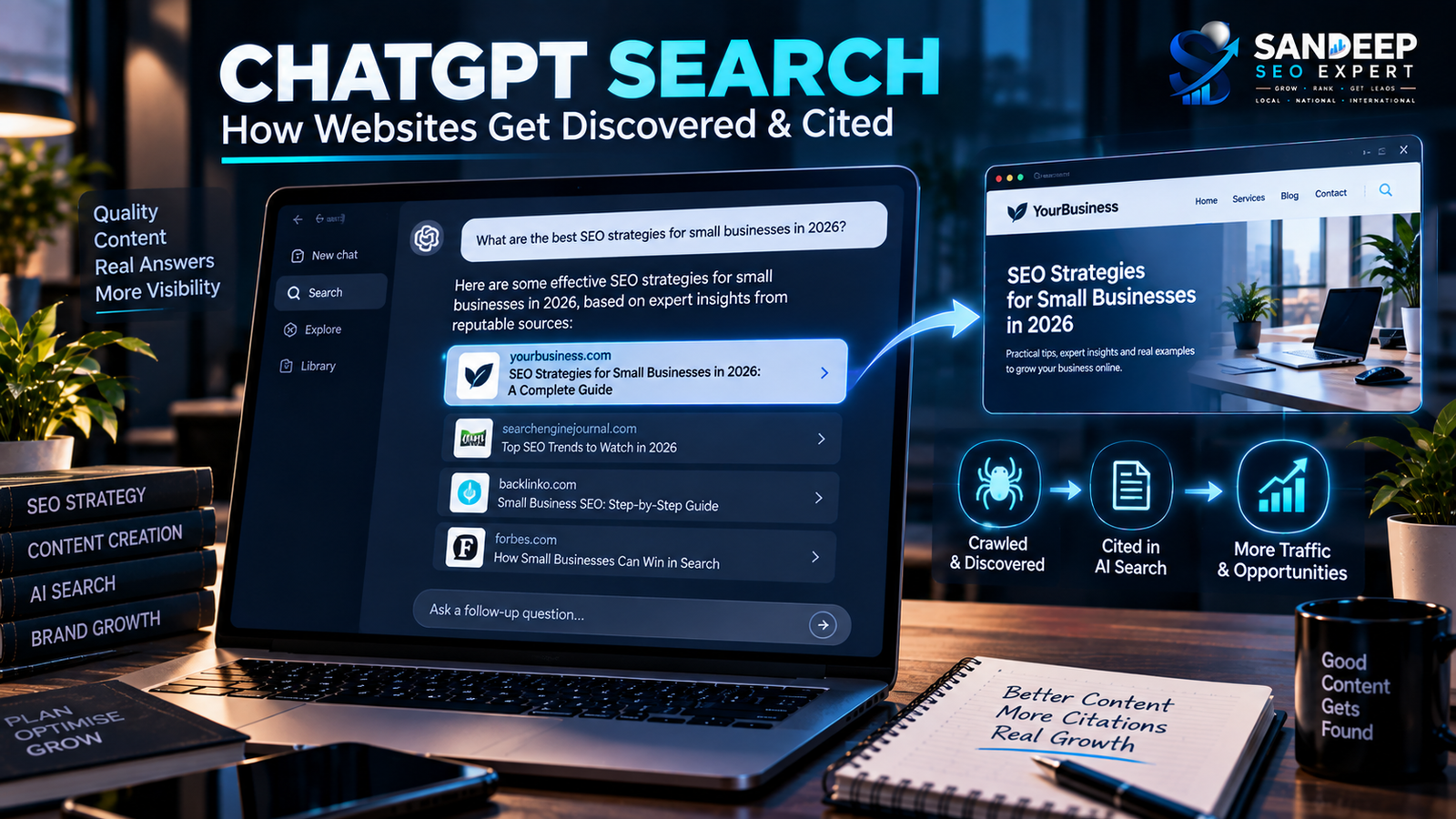
Instead of opening a search engine, scanning several pages and comparing the results themselves, users can now ask ChatGPT a complete question and receive an answer that brings together information from the web. When ChatGPT Search is used, the response may include citations and links to the websites that provided relevant information.
For website owners, this creates a new form of search visibility.
The important question is no longer simply:
“Can my website rank in Google?”
It is also:
“Can ChatGPT discover my website, understand its content and use it as a source when answering relevant questions?”
That does not mean websites need to abandon traditional SEO and start following a completely separate set of “ChatGPT SEO tricks.”
The fundamentals still matter.
Technical accessibility, useful content, clear website structure, relevance, authority, accurate information and a strong user experience all influence whether your website can become a useful source.
But ChatGPT Search introduces another layer worth understanding: discovery and citation.
This guide explains how that process works, what website owners can control, what they cannot control, and how to build a website that is better prepared for ChatGPT Search.
Quick Answer: How Can a Website Appear in ChatGPT Search?
There is no guaranteed way to make a website appear or receive a citation in ChatGPT Search.
However, businesses can improve their eligibility and discoverability by making sure that:
Important pages are publicly accessible.
OAI-SearchBotis not blocked from pages you want ChatGPT Search to discover.Robots.txt and website security systems do not unintentionally prevent crawling.
Important pages can be found through normal internal links.
Content clearly answers real user questions.
Pages contain useful, original and trustworthy information.
Titles and headings accurately describe the content.
Important business and product information is easy to understand.
The website has a logical information architecture.
Content is maintained when information changes.
Commercial pages provide enough detail to support a buying or decision-making journey.
Local businesses maintain accurate website and Business Profile information.
Website analytics are configured so ChatGPT referrals can be identified.
OpenAI says public websites can appear in ChatGPT Search, and publishers who want their content to be included in ChatGPT summaries and snippets should make sure they do not block OAI-SearchBot. OpenAI also states that search placement is not guaranteed.
That distinction is important.
Being technically eligible is not the same as being selected as a source.
What Is ChatGPT Search?
ChatGPT Search allows ChatGPT to use information from the web when responding to questions that benefit from current or web-based information.
Instead of giving the user only a conventional list of search results, ChatGPT can use web sources to construct a conversational answer.
The response can include citations that allow the user to inspect the sources behind the answer. OpenAI describes ChatGPT Search as a way to connect users with original web content while providing links to relevant sources.
For publishers and businesses, that creates a different discovery path:
User question → ChatGPT Search → web retrieval → relevant source → citation → website visit
The website is therefore not necessarily the destination the user sees first.
It can become part of the answer-generation process.
ChatGPT Search Visibility Is Not the Same as Google Rankings
This distinction is easy to miss.
A page can rank well in Google and still not be cited in a particular ChatGPT response.
Likewise, a page that does not rank first for an exact keyword could potentially be discovered or cited when its information is relevant to a specific question.
This is because conversational search is not simply a traditional ten-blue-links experience.
A user might ask:
“What should a small business check before hiring an SEO company?”
A conventional search may return pages targeting phrases such as “how to choose an SEO company.”
ChatGPT can interpret the broader question and retrieve sources that help answer different parts of it.
That means businesses should think beyond exact keyword matching.
The content needs to be relevant to the underlying information need.
How Does Website Discovery Work?
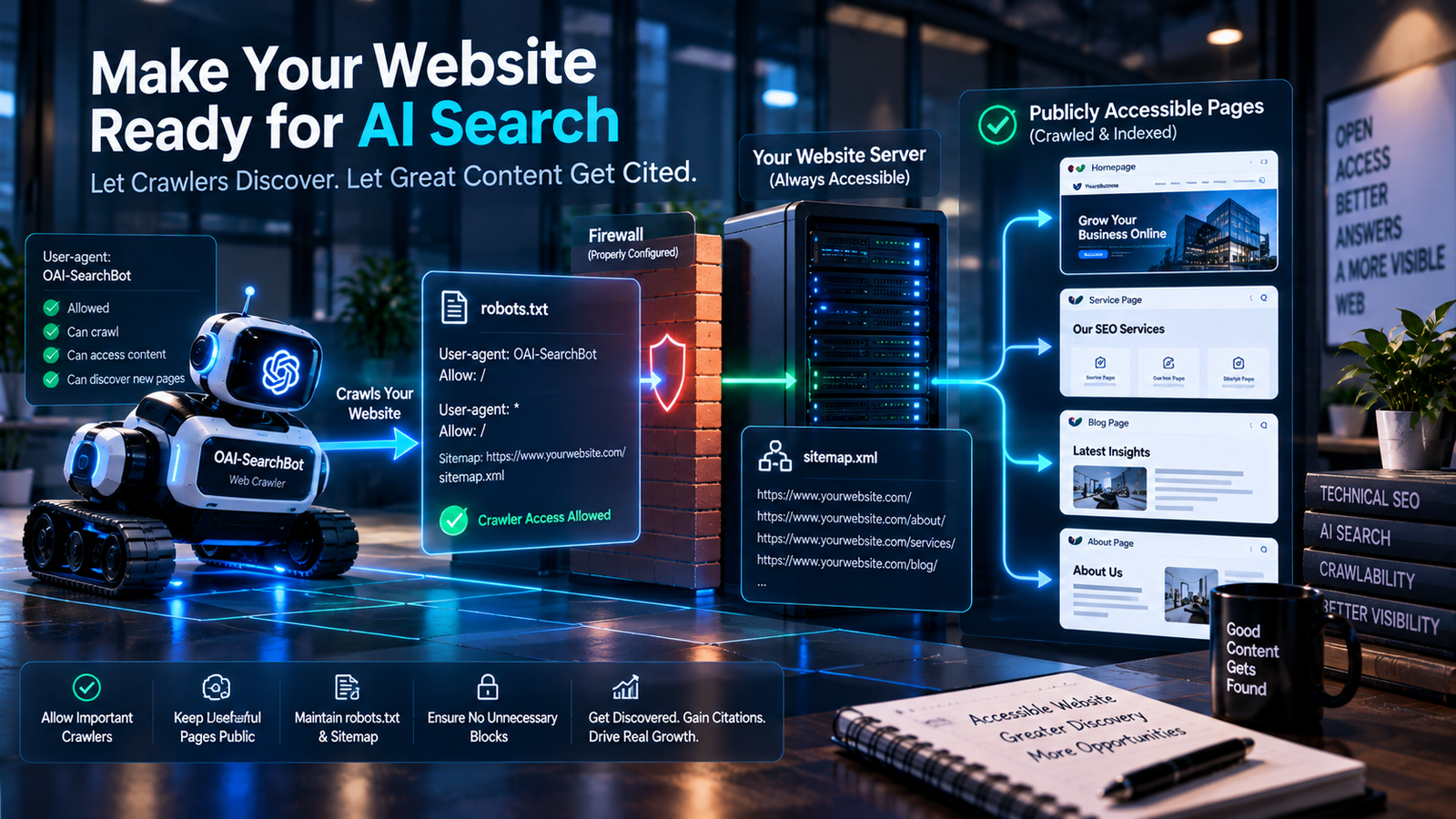
Before ChatGPT can use your website as a source, the content needs to be discoverable.
OpenAI's current publisher guidance identifies OAI-SearchBot as the crawler used to discover and retrieve public web content for ChatGPT Search.
If you intentionally block this crawler, your content may not be available for inclusion in ChatGPT's summaries and snippets.
That makes crawler accessibility one of the first technical checks for businesses interested in ChatGPT Search visibility.
Check Your robots.txt
Start with your robots.txt file.
Look for rules that could prevent OAI-SearchBot from accessing important sections of your website.
For example, a website may unintentionally have restrictive crawler rules after:
A website migration
A redesign
A security implementation
A staging-site configuration
A CMS change
A robots.txt update
A developer deployment
Do not blindly open every part of your website.
The goal is to make the content you actually want discovered accessible while continuing to protect private or restricted areas appropriately.
Check Your Firewall and CDN
Robots.txt is not the only possible barrier.
Websites often use:
Cloudflare
CDN security
WAF rules
Bot protection
Rate limiting
Server-level restrictions
CAPTCHA systems
These systems can sometimes block legitimate crawlers.
OpenAI's current crawler guidance specifically notes that web protection systems can return 403 errors or otherwise prevent OpenAI crawlers from accessing pages.
If OAI-SearchBot is allowed in robots.txt but your server still blocks the request, the robots.txt setting alone will not solve the problem.
OAI-SearchBot and GPTBot Are Not the Same Thing
This is an important distinction for website owners.
OpenAI uses different crawlers for different purposes.
OAI-SearchBot is associated with search discovery and retrieval.
GPTBot is associated with content that may be used for training purposes.
OpenAI's publisher guidance says publishers who want to exclude their content from potential training should disallow GPTBot, while OAI-SearchBot relates to ChatGPT Search discovery.
So a business should not assume that blocking one automatically means the same thing for the other.
Crawler directives should be reviewed according to the actual objective.
What Happens After ChatGPT Finds a Page?
Discovery does not automatically mean citation.
This is one of the most important concepts in ChatGPT Search SEO.
Think about the process as several separate stages:
Stage 1: Accessibility
Can the crawler access the page?
Stage 2: Discovery
Can the page be found and retrieved?
Stage 3: Relevance
Does the page actually help answer the user's question?
Stage 4: Selection
Is the content useful enough to be included among the sources considered for the answer?
Stage 5: Citation
Does ChatGPT actually cite or link to the page in the response?
Stage 6: Visit
Does the user click the citation and visit your website?
Stage 7: Conversion
Does that visitor become a lead, customer, subscriber or another meaningful business outcome?
These are different stages.
A website can succeed at one and fail at another.
Being Crawlable Does Not Guarantee a Citation
This is where many “AI SEO” claims become misleading.
Allowing OAI-SearchBot gives ChatGPT Search access to your content.
It does not mean:
Your page will rank for every relevant question.
Your page will always be cited.
Your page will be the first citation.
Your page will appear in every response.
Your competitors will not be cited.
Every page on your website will receive visibility.
OpenAI states that ChatGPT Search ranks search results using multiple factors intended to help users find relevant and reliable information, and that placement is not guaranteed.
So crawler access should be viewed as an eligibility and accessibility requirement, not a ranking shortcut.
What Makes a Website Useful as a ChatGPT Source?
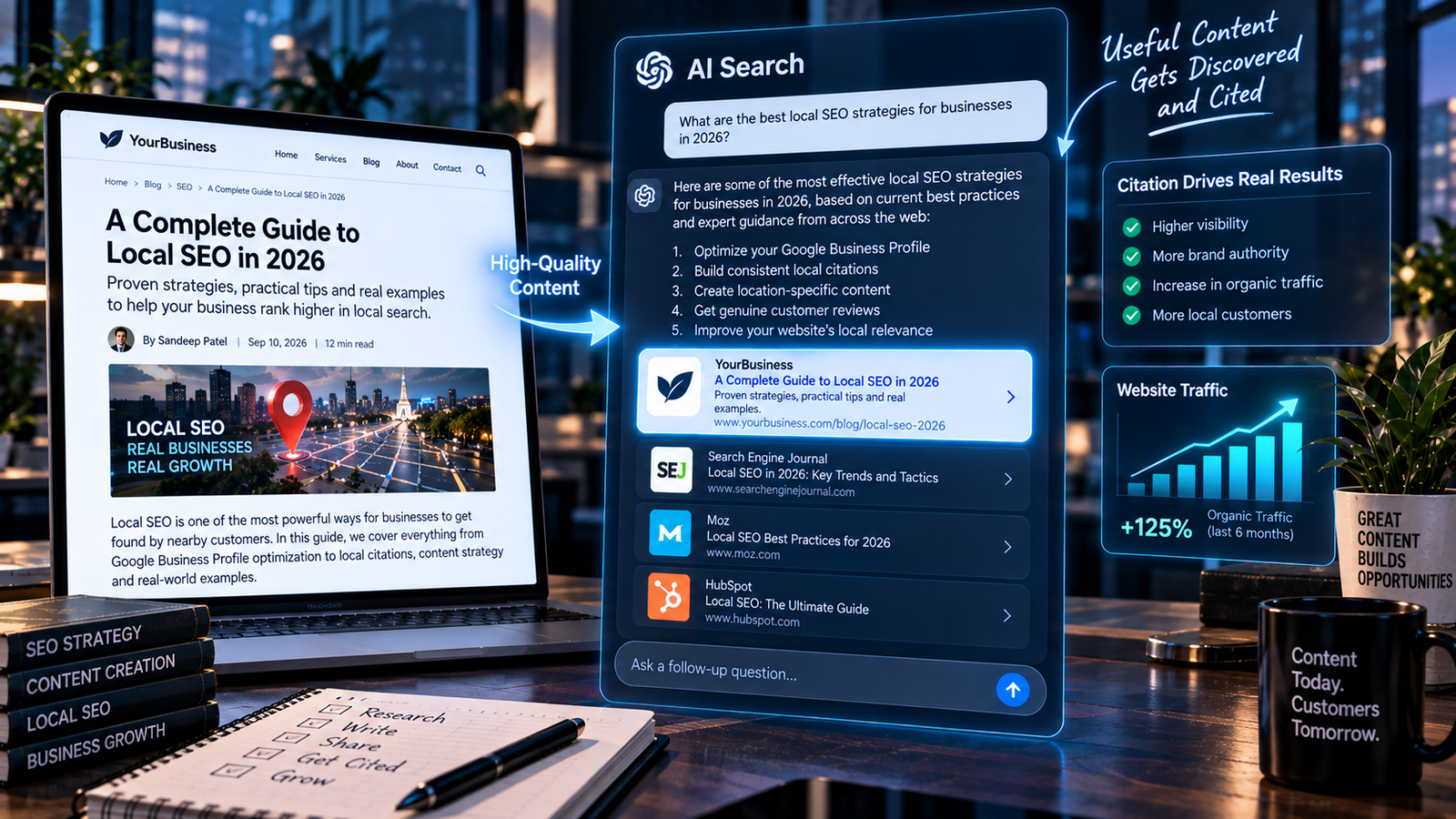
Once technical accessibility is handled, the bigger question becomes content quality.
A page is more useful when it clearly addresses the subject it claims to cover.
That sounds obvious, but many websites are built around keywords rather than information.
For example, consider two pages about:
“SEO cost in India.”
One page simply repeats:
SEO packages start at ₹10,000. Contact us for more information.
Another explains:
Different SEO pricing models
Local SEO requirements
E-commerce SEO requirements
Technical SEO scope
Content requirements
Competition
Website size
Deliverables
Agency vs freelancer considerations
What cheap SEO packages may exclude
How to evaluate an SEO proposal
The second page gives a much stronger information resource.
It answers the question instead of merely mentioning the keyword.
Is Your Website Ready to Be Discovered in AI Search?
ChatGPT visibility starts with the fundamentals: crawlable pages, strong technical SEO, useful content, clear information architecture and trustworthy business information. Find the issues that may be limiting your website before chasing AI-search shortcuts.
Get Your SEO Audit →ChatGPT Search vs Traditional Search: W
Write for the Question Behind the Question
ChatGPT users often ask complete questions.
That means your content strategy should also consider the questions that naturally follow a topic.
For example:
Primary question:
How much does SEO cost?
Follow-up questions:
What does the monthly fee include?
Does local SEO cost less?
How much does e-commerce SEO cost?
What affects pricing?
How long should I pay for SEO?
How do I compare two SEO agencies?
What should an SEO proposal contain?
A strong resource can address these connected questions without creating seven nearly identical pages.
This is useful for traditional search as well as conversational discovery.
Build Topic Depth Instead of Keyword Variations
A website that wants to become a useful source should demonstrate genuine coverage of its subject.
For an SEO company, that could include connected resources around:
Technical SEO
Local SEO
Google Business Profile
Content strategy
Keyword research
E-commerce SEO
International SEO
SEO audits
Search Console
Google algorithm updates
AI Search
SEO pricing
The pages should not exist simply to increase URL count.
They should have distinct purposes.
A strong internal structure can then connect them naturally.
For example, a technical SEO article may lead readers to a dedicated technical SEO service when they need implementation support.
A local search guide can naturally connect to Local SEO services.
A broader SEO problem can lead to an SEO audit before recommending a specific solution.
This creates a useful information system rather than a collection of disconnected articles.
Original Information Gives Your Website More Value
AI systems can summarize common information very easily.
That creates a challenge for websites that publish nothing beyond generic explanations.
Ask yourself:
What does this page provide that another website does not?
That could be:
Original research
First-hand experience
Proprietary data
Case studies
Detailed examples
Expert analysis
Original screenshots
Calculations
Industry-specific observations
Practical implementation details
A unique comparison
A real process
For example, instead of writing:
“Technical SEO is important.”
Show the reader what technical SEO problems actually look like.
Explain:
How the issue was discovered
Which pages were affected
What caused it
How it was fixed
What changed afterward
What should be monitored next
That turns generic information into useful expertise.
Make Important Pages Easy to Understand
ChatGPT Search does not mean that every page needs to be written in tiny fragments.
You still need natural, readable content.
But important information should be organized clearly.
Use:
Descriptive headings
Headings should tell the reader what the section is actually about.
Direct explanations
Do not make users search through five paragraphs to find the main answer.
Tables
Use them when the reader genuinely needs comparison.
Lists
Use lists when information naturally belongs in list form.
Examples
Examples often explain complicated concepts better than definitions alone.
Relevant FAQs
FAQs can address real questions that are not fully covered elsewhere on the page.
The purpose is clarity.
Not formatting for an AI system.
Internal Linking Can Strengthen Context
Internal links do more than pass authority between pages.
They help establish relationships.
Imagine an article discussing:
“Why is my website not getting organic traffic?”
Within that article, you might explain:
If the problem involves crawling, indexing or technical accessibility, a technical SEO review can help identify the underlying issues.
Later:
If several problems are affecting the website and you are unsure where to begin, an SEO audit can provide a broader diagnosis.
Those links make sense because they continue the user's journey.
This is much more useful than adding a sidebar containing twenty unrelated service links.
Your Commercial Pages Matter Too
A common mistake is to focus entirely on blog content.
Suppose ChatGPT helps a user understand:
“What should I look for when choosing an SEO company?”
The user may eventually want to compare actual providers.
At that point, your service page needs to explain what your business actually offers.
A strong commercial page should answer:
What service is provided?
Who is it for?
What problems does it solve?
What is included?
How does the process work?
What industries or business types are relevant?
How is performance measured?
What should the customer expect?
How can the customer get started?
Your SEO services page should therefore work as an important destination from informational content.
Local Businesses Have Another Layer of Information
For a local business, ChatGPT may need information about the actual business rather than only educational content.
Consider a query such as:
“Which fertility centres in Jabalpur provide IVF?”
Or:
“Which construction companies in Jabalpur build residential homes?”
A useful business presence may depend on information distributed across:
Website
Service pages
Location pages
Google Business Profile
Reviews
Business directories
Contact information
Business categories
Opening hours
Service descriptions
This is why Google Business Profile optimization should be considered alongside website SEO for businesses that rely on local discovery.
The website should accurately describe the business.
The Business Profile should accurately describe the same business.
And the information should not contradict itself across important sources.
Keep Your Business Information Accurate
Review important details regularly:
Business name
Address
Phone number
Website
Opening hours
Service areas
Services
Product information
Company description
Contact information
This is particularly important for businesses where users may make decisions based on current information.
A page that says a service is available when it is no longer offered creates a poor user experience.
Likewise, outdated pricing or old product information can reduce trust.
Want to Improve Your Website's Search Visibility?
Whether the opportunity is technical SEO, content, Local SEO or broader organic search, the right strategy starts with understanding what is actually limiting your website.
Explore SEO Services →What About Structured Data?
Structured data can help search engines understand specific types of content.
For example, depending on the page, relevant structured data may describe:
Products
Organizations
Local businesses
Articles
Events
Breadcrumbs
But structured data should not be treated as a special ChatGPT citation mechanism.
There is no reliable “ChatGPT schema” that guarantees citation.
Use structured data where it accurately describes the page and follows the relevant platform guidelines.
The visible content still matters.
What About llms.txt?
This is another area where businesses should separate discussion from documented support.
There has been significant interest in llms.txt as a proposed way of giving AI systems a simplified overview of a website.
But it should not be presented as a guaranteed requirement for ChatGPT Search.
For ChatGPT Search, OpenAI's documented publisher guidance focuses on crawler accessibility, particularly OAI-SearchBot, rather than claiming that an llms.txt file is required for search visibility.
So if someone tells you:
“Just add llms.txt and ChatGPT will start citing your website.”
that is an unsupported simplification.
Your time is generally better spent first checking whether important content is crawlable, useful, well-structured and genuinely relevant.
Can a Website Block ChatGPT Search?
Yes.
Website owners can control crawler access through technical mechanisms such as robots.txt.
OpenAI's current guidance explains that if OAI-SearchBot is blocked, content may not be included in ChatGPT Search summaries and snippets.
However, there is an important nuance.
OpenAI notes that if a URL is obtained through another search provider or through crawling other pages and there are signals that the page is relevant, ChatGPT Atlas may still surface the link and page title even when the page itself is disallowed for crawling. A noindex directive can be used when the publisher wants to prevent that type of surfacing, subject to crawler access for the directive to be read.
That is another reason to understand the difference between:
blocking crawling
and
controlling indexing/surfacing.
Can You Track Traffic From ChatGPT?
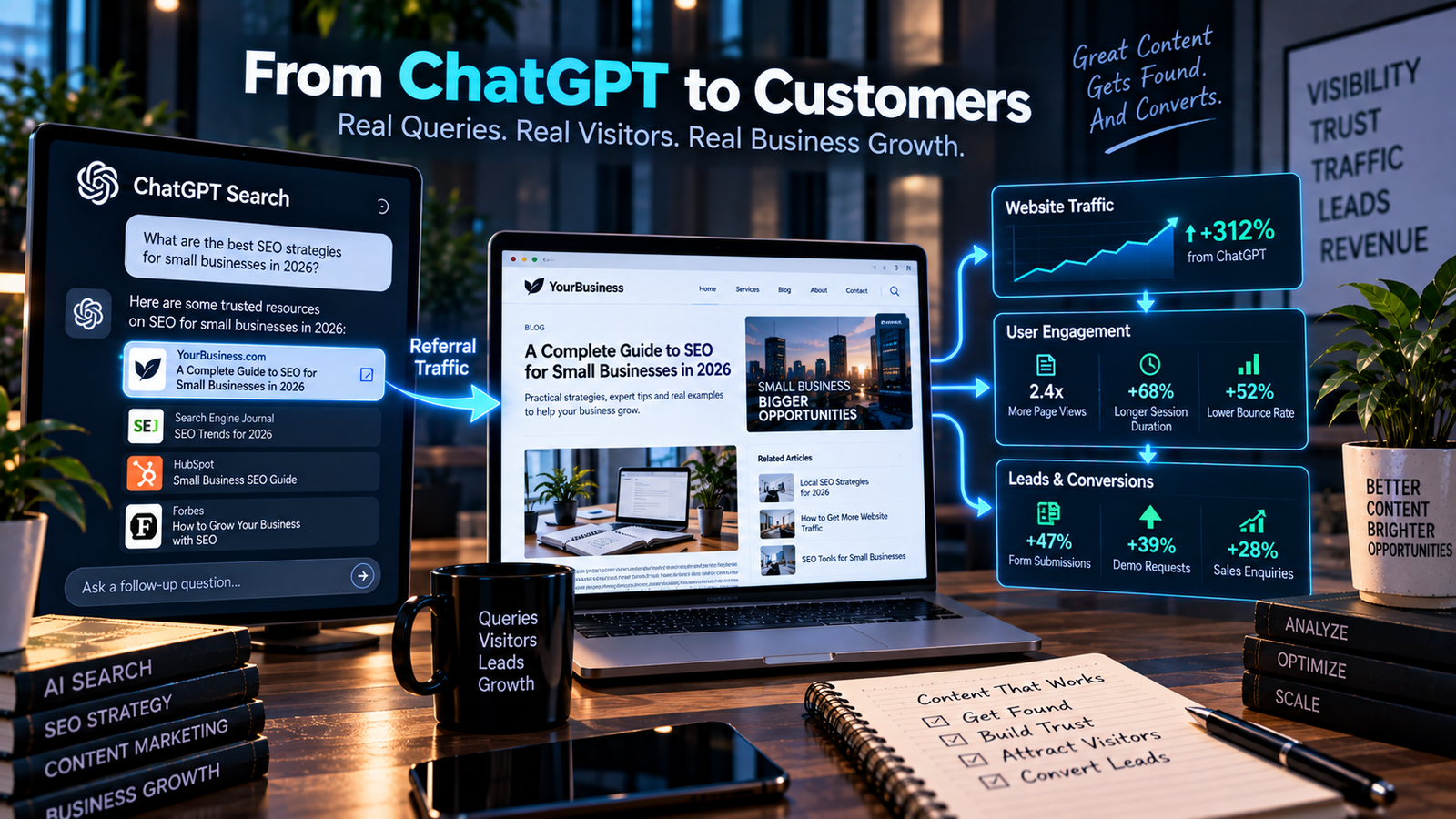
Yes.
This is one of the most practical parts of ChatGPT Search visibility.
OpenAI's current publisher FAQ says publishers that allow OAI-SearchBot to access their content can track referral traffic from ChatGPT using analytics platforms such as Google Analytics.
OpenAI also says ChatGPT automatically includes the UTM parameter:
utm_source=chatgpt.com
in referral URLs from ChatGPT search results.
That gives website owners a way to separate ChatGPT referrals from other traffic sources.
In analytics, look beyond the number of sessions.
Check:
Landing pages
Sessions
Engaged sessions
Engagement rate
Conversions
Leads
Purchases
Form submissions
Calls
Revenue where available
The important question is not simply:
“Did ChatGPT send traffic?”
It is:
“Did ChatGPT send relevant traffic?”
Citation and Traffic Are Two Different Things
A page can be cited without receiving a large amount of traffic.
A user may read the AI answer, see the citation and never click.
Likewise, a page can receive a click from ChatGPT even when the user does not remember which part of the answer led them there.
So separate your measurement into different layers.
Visibility
Was your content cited?
Referral
Did someone click through?
Engagement
Did they actually use the website?
Conversion
Did they become a customer or lead?
These should not be treated as the same metric.
How Should You Measure ChatGPT Search Performance?
Start with analytics.
Create a segment or report for traffic where the source identifies ChatGPT referrals.
Then compare:
Number of visitors
Landing pages
New vs returning visitors
Engagement
Conversion rate
Lead quality
Revenue where measurable
Over time, patterns may emerge.
Perhaps a detailed pricing guide receives more ChatGPT referrals than short blog posts.
Perhaps a service comparison generates highly engaged visitors.
Perhaps local service pages receive visitors who convert better than informational articles.
Those observations are much more useful than simply counting mentions.
Don't Manually Test One Prompt and Call It SEO Data
Suppose you ask ChatGPT:
“Who is the best SEO expert in India?”
and your website is not mentioned.
That does not prove your website has no ChatGPT visibility.
The result can vary based on:
Query wording
Location
Search context
Current web results
Freshness
Available sources
Search provider data
User intent
ChatGPT itself advises users that search results and citations can sometimes be incomplete, outdated or incorrect and recommends checking cited sources when accuracy matters.
So businesses should avoid treating a handful of manual prompts as a complete visibility report.
Citation Does Not Mean Endorsement
Another important distinction:
If ChatGPT cites your website, that does not mean OpenAI is endorsing your company.
It means the page was used or shown as a relevant source for that response.
This is similar to being listed among sources in other search experiences.
Businesses should therefore avoid claims such as:
“ChatGPT recommends us.”
unless the actual response clearly supports that wording and the context is accurately represented.
A citation is a source reference, not necessarily a product endorsement.
What Kind of Content Has a Better Chance of Being Cited?
There is no guaranteed content formula.
But some characteristics make information more useful as a source.
Specific information
Generic statements are easy to replace.
Specific explanations are more useful.
Original analysis
Explain what you found, not only what everyone else says.
Evidence
Support important claims with credible sources, data or first-hand information.
Clear structure
Make the subject and relationships between ideas understandable.
Strong topical relevance
A page should stay focused on the subject it claims to cover.
Freshness
Update information when the subject changes.
Practical usefulness
Give the reader something they can actually do with the information.
These are not “ChatGPT hacks.”
They are good publishing practices.
Don't Write Content Just to Get Cited
This is one of the most important strategic points.
If every paragraph is written around the assumption:
“Will ChatGPT quote this?”
the content can become unnatural.
Instead, start with:
What does the reader need to understand?
Then ask:
What information would make this page genuinely useful?
Then:
What evidence or experience can we provide?
Only after that should you consider how the page can be discovered through search.
The strongest AI-search strategy is usually a strong information strategy first.
A Practical ChatGPT Search Optimization Checklist
Before publishing an important page, review the following.
Technical accessibility
Is the page publicly accessible?
Is
OAI-SearchBotblocked?Does robots.txt prevent access?
Does the firewall block legitimate crawlers?
Does the page return a successful HTTP response?
Is the important content available without a login?
Is the page indexable where appropriate?
Content quality
Does the page answer a genuine question?
Is the information accurate?
Is it original?
Does it provide meaningful depth?
Does it include useful examples?
Are important claims supported?
Is outdated information removed?
Structure
Is the title descriptive?
Are headings meaningful?
Is the content logically organized?
Are related pages linked?
Can a reader quickly find the main answer?
Are tables or lists used where they actually help?
Business information
Is the company information accurate?
Are services clearly described?
Are location details consistent?
Are important commercial pages detailed enough?
Measurement
Can ChatGPT referrals be identified?
Are conversions tracked?
Are important landing pages monitored?
Are leads attributed where possible?
A Better Workflow for Preparing a Website for ChatGPT Search
If you are serious about improving visibility, do not start by publishing dozens of AI-focused articles.
Start with the website.
Step 1: Audit crawler accessibility
Review robots.txt, firewall rules, CDN settings and server responses.
Step 2: Audit important pages
Identify your:
Main service pages
Product pages
Category pages
Location pages
High-value informational resources
Step 3: Improve the information
Remove generic filler.
Add original information, examples, evidence and practical detail.
Step 4: Build topical relationships
Connect related pages with useful internal links.
Step 5: Improve commercial pages
Make it easy to understand what you offer, who it is for and what happens next.
Step 6: Strengthen local information
For local businesses, align website information with Google Business Profile and other important business sources.
Step 7: Configure measurement
Track ChatGPT referral traffic and business outcomes.
Step 8: Review actual data
Use analytics and available AI-search reporting rather than relying entirely on manual prompt testing.
Step 9: Update what performs
If certain pages consistently attract relevant visitors or citations, examine why.
Then apply those lessons to other genuinely relevant pages.
ChatGPT Search vs Traditional Search: What Changes for Businesses?
The biggest change is the interface.
Traditional search often asks the user to:
Search → Compare results → Open pages → Read → Decide
ChatGPT Search can make the journey more conversational:
Ask → Receive synthesized answer → Review sources → Explore relevant websites → Decide
That changes how users may discover information.
But the underlying requirement remains familiar:
Your website needs to provide information worth discovering.
The difference is that the first interaction with that information may now happen inside an AI-generated answer rather than on a conventional search-results page.
What Businesses Should Focus on in 2026
A sensible strategy is to treat ChatGPT Search as another discovery environment rather than a completely separate SEO ecosystem.
Focus on:
Technical accessibility
Make important content discoverable.
Useful information
Answer genuine questions thoroughly.
Original expertise
Provide something beyond a generic rewrite.
Strong architecture
Connect related pages logically.
Commercial clarity
Make products and services easy to understand.
Local consistency
Keep business information accurate across important sources.
Measurement
Track citations where available, referral traffic and actual business outcomes.
Continuous improvement
Use real data instead of assumptions.
This approach can support your website across multiple search environments rather than tying the entire strategy to one platform.
The Bigger Opportunity: Becoming a Useful Source
The most valuable way to think about ChatGPT Search is not:
“How do I make ChatGPT mention my business?”
Instead, think:
“What information does my business have that people genuinely need?”
If you can answer that question well, you have the foundation for a strong content strategy.
A healthcare provider can publish useful patient education.
An e-commerce company can explain products, ingredients, usage and comparisons.
A software company can publish implementation guides and original technical resources.
An SEO company can explain search problems using practical examples and real experience.
A local business can make its services, locations and customer information clear.
The objective is not to manufacture citations.
It is to build a website that deserves to be discovered.
Final Thoughts
ChatGPT Search creates another path through which people can discover websites.
For publishers and businesses, the process is worth understanding:
Discovery comes first.
Your content needs to be accessible to the relevant crawler.
Relevance comes next.
The page needs to genuinely help answer the user's question.
Citation is another step.
Being crawlable does not guarantee that ChatGPT will cite your page.
Traffic comes after that.
A citation may or may not result in a website visit.
Business value comes last.
The real measure is whether that visibility contributes to meaningful engagement, leads, sales or other outcomes.
OpenAI's current guidance makes the technical starting point relatively clear: if you want your public website content to be discoverable and potentially included in ChatGPT Search responses, do not block OAI-SearchBot, and make sure your infrastructure allows legitimate crawler access. But no crawler setting can guarantee citation or placement.
The bigger opportunity is therefore not a secret ChatGPT optimization trick.
It is building a website with strong technical foundations, original information, clear structure, genuine expertise and a useful reason for people to visit.
That is the kind of website that can remain valuable as search continues to evolve.
Want to Improve Your Website's Search Visibility?
Whether the opportunity is technical SEO, content, Local SEO or broader organic search, the right strategy starts with understanding what is actually limiting your website.
Explore SEO Services →Frequently Asked Questions
1. Can my website appear in ChatGPT Search?
Yes. OpenAI says any public website can appear in ChatGPT Search, although search placement is not guaranteed. Websites should avoid blocking OAI-SearchBot if they want their content to be available for discovery and potential inclusion in summaries and citations.
2. What is OAI-SearchBot?
OAI-SearchBot is OpenAI's crawler associated with discovering and retrieving public web content for ChatGPT Search. Website owners can control its access through crawler directives and website infrastructure.
3. Does allowing OAI-SearchBot guarantee a citation?
No. Allowing the crawler makes content accessible for search discovery, but it does not guarantee ranking, inclusion or citation in a particular ChatGPT response.
4. Does ChatGPT Search use Google?
ChatGPT Search can use search providers and web sources to provide relevant information. The exact retrieval process can vary, so businesses should not assume that optimizing only for one traditional search engine guarantees ChatGPT visibility.
5. How can I track traffic from ChatGPT?
OpenAI says publishers can track ChatGPT referral traffic through analytics platforms such as Google Analytics. ChatGPT search referral URLs include the utm_source=chatgpt.com parameter, which can help identify that traffic.
6. Does a ChatGPT citation mean ChatGPT recommends my business?
No. A citation indicates that a source was referenced or linked in the response. It should not automatically be interpreted as an endorsement or recommendation.
7. Should I create content specifically for ChatGPT?
You can consider how conversational questions affect content planning, but the content should still be created for people. Useful, accurate, original and well-structured information is a stronger foundation than writing pages solely to trigger AI citations.
8. Is traditional SEO still important for ChatGPT Search?
Yes. Crawlability, clear content, internal links, technical accessibility, relevance and website quality remain important parts of making information discoverable. ChatGPT Search should be considered alongside, rather than as a replacement for, broader SEO.
9. Do I need special schema to appear in ChatGPT Search?
There is no guaranteed special schema that makes a website appear in ChatGPT Search. Structured data can still help search engines understand eligible content when implemented accurately, but it should not be treated as a citation shortcut.
10. Does llms.txt guarantee ChatGPT visibility?
No. There is no documented guarantee that adding an llms.txt file will make a website appear or receive citations in ChatGPT Search. Crawler accessibility and the quality and relevance of the actual website content are more fundamental considerations.
11. Can I block ChatGPT from crawling my website?
Website owners can use crawler directives such as robots.txt to control crawler access. If a business wants its content to be discoverable in ChatGPT Search, it should understand the implications before blocking OAI-SearchBot. OpenAI separately documents controls for GPTBot in relation to potential training use.
12. What is the difference between ChatGPT citation and website traffic?
A citation means your content was referenced or shown as a source. Traffic means a user actually visited your website. These are different outcomes and should be measured separately.
13. How can I improve the chances of my content being cited?
There is no guaranteed formula. Focus on making important pages technically accessible, highly relevant, accurate, original, well-structured, evidence-based and genuinely useful for the questions your target audience asks.