
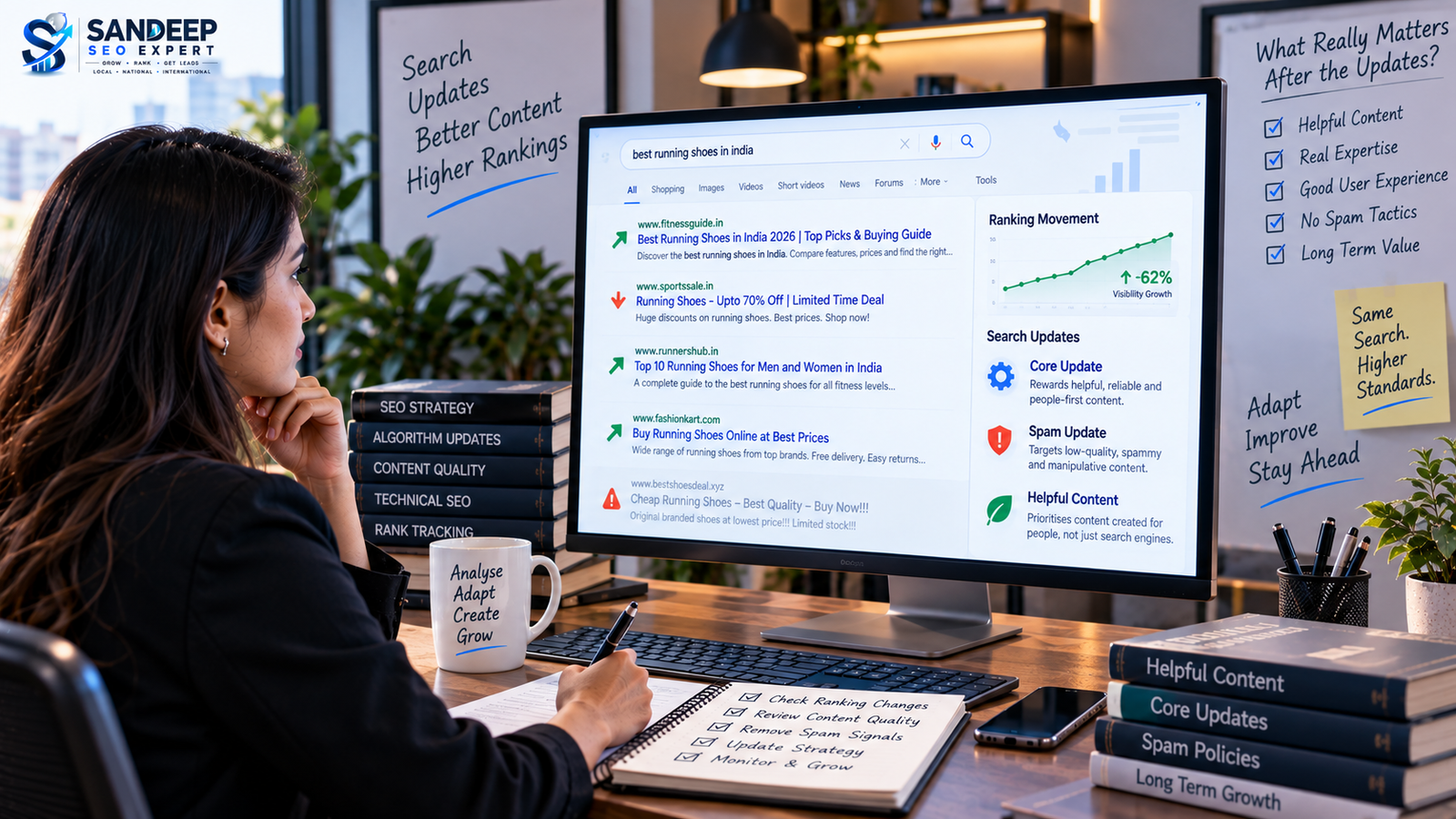
When Google rankings suddenly move, the first reaction is usually:
“Which Google update hit my website?”
That is a reasonable question, but there is a bigger problem behind it.
Not every Google Search update works the same way.
A core update is different from a spam update. And what many SEOs still call the “Helpful Content Update” is no longer a separate recurring update. Google moved the Helpful Content System into its core ranking systems in March 2024.
That distinction matters because the wrong diagnosis can lead to the wrong SEO response.
If your rankings fall during a core update, immediately deleting pages may not solve anything.
If your site is affected by spam systems, simply rewriting content may not address the underlying problem.
And if your traffic dropped for reasons unrelated to a confirmed update, changing your entire website can make the situation harder to understand.
This guide explains how Google's ranking updates work, the difference between core and spam updates, where Helpful Content fits in today, what happened in 2026, and how to investigate a ranking drop without reacting blindly.
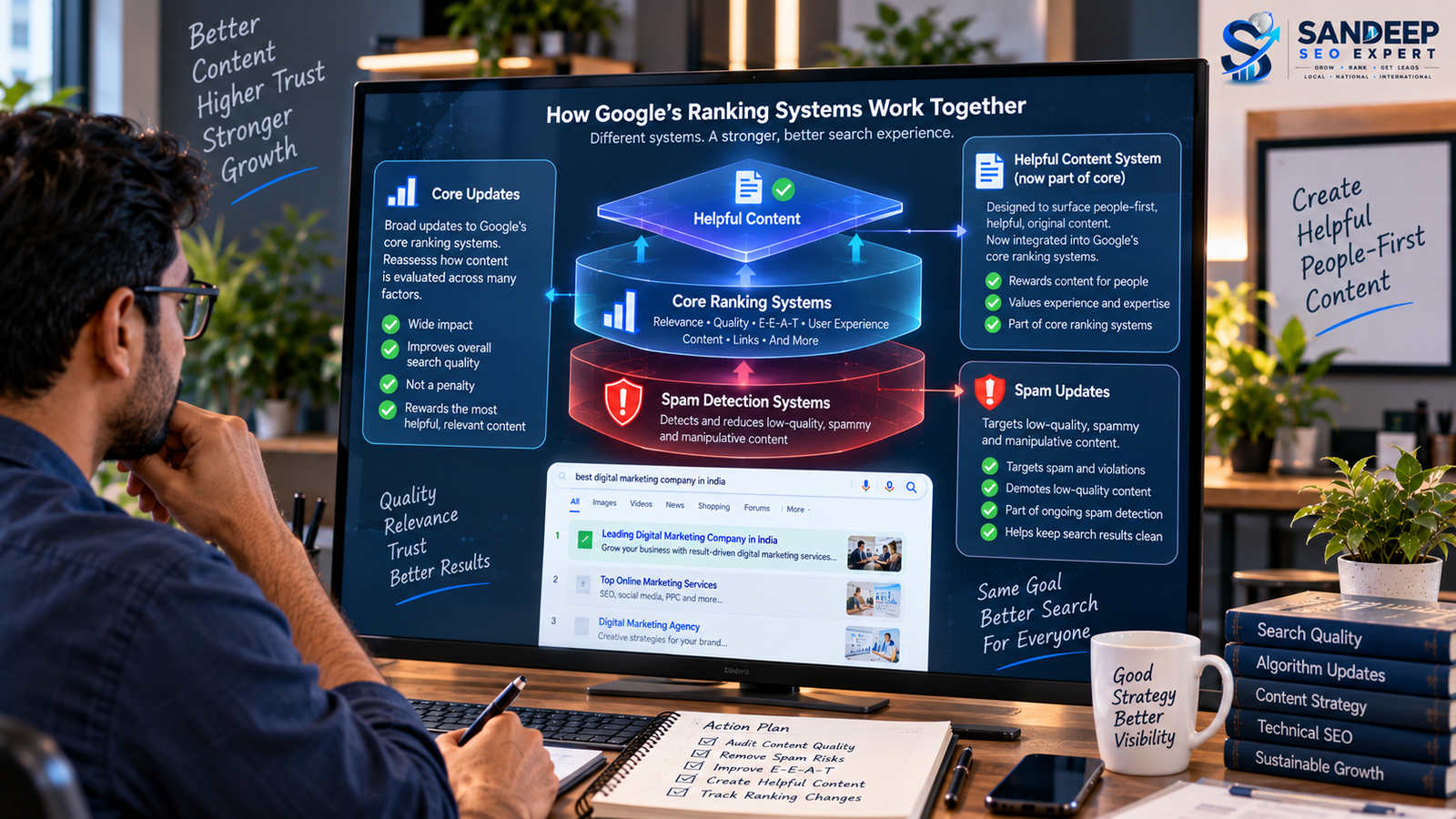
Quick Answer: What Is the Difference Between Core, Spam and Helpful Content?
The simplest way to understand them is:
| Type | What It Means | What You Should Investigate |
|---|---|---|
| Core update | Broad changes to Google's ranking systems | Relevance, content quality, usefulness and how your pages compare with other results |
| Spam update | Improvements to Google's spam-detection systems | Whether your website violates Google's spam policies |
| Helpful Content System | A system designed to surface original, helpful, people-first content; now part of core | Whether your content genuinely helps users rather than being created primarily for search traffic |
Google says core updates are broad changes to its search algorithms and systems, while spam updates improve automated systems that detect search spam.
The Helpful Content System is now part of Google's core ranking systems rather than a separate update category.
What Is a Google Core Update?
Google makes significant, broad changes to its Search algorithms and systems several times a year. These are called core updates.
Google describes them as broad changes designed to improve its ability to surface helpful and reliable results for searchers. They are not designed to target specific websites or individual pages.
This is an important point.
A core update is not necessarily Google saying:
“Your website broke a rule.”
Instead, the way Google's systems evaluate and rank content has changed.
As a result, some pages can move down while other pages move up.
Why Can Rankings Drop During a Core Update?
Imagine that your page was ranking #3 for a keyword.
You did not change anything.
Then a core update rolls out and your page moves to #8.
That does not automatically mean Google found a technical error or penalty on your website.
It can mean that Google's updated systems are evaluating the available results differently and other pages now appear more relevant or satisfying for the query.
Google's own core update guidance recommends looking at the website as a whole and evaluating whether the content is helpful, reliable and people-first.
Core Updates Are Not the Same as Penalties
This is one of the most important concepts to understand.
A ranking drop during a core update does not automatically mean you received a penalty.
Google specifically advises site owners to avoid assuming that a core update means something specific was penalized.
Instead, compare how your important pages and queries performed before and after the update and assess whether other pages may now be doing a better job for searchers.
That changes how you should respond.
Instead of asking:
“What single SEO setting did Google penalize?”
Ask:
“Where is the current search result better satisfying the user than my page?”
What Is a Google Spam Update?
Spam updates are different.
Google's automated spam-detection systems operate continuously. Occasionally, Google makes notable improvements to those systems and announces them as spam updates.
Google's SpamBrain system is one example of Google's AI-based spam-prevention technology.
Spam updates can improve Google's ability to detect practices that violate its spam policies.
Google says sites that violate spam policies may rank lower or may not appear in Search at all.
Examples of Search Spam
Google's spam policies cover a wide range of abusive practices.
Some examples include:
Keyword stuffing
Link spam
Cloaking
Scraped content
Scaled content abuse
Doorway abuse
Hacked content
Misleading functionality
Expired domain abuse
Site reputation abuse
User-generated spam
Google's current spam documentation also states that scaled content abuse can involve creating many pages primarily to manipulate rankings, including using AI or other automated systems to generate large amounts of low-value, unoriginal content.
The important distinction is that using AI is not automatically the same as spam.
The problem is when content is generated at scale primarily to manipulate Search without providing meaningful value to users.
Did Your Rankings Drop After a Google Update?
Before changing dozens of pages, identify whether the problem is related to content quality, technical SEO, search demand, competitors or a potential spam issue.
Get Your SEO Audit →What Is the Helpful Content System Now?
This is where older SEO articles can become confusing.
You may still see websites talking about:
“The next Helpful Content Update.”
That terminology is outdated.
Google's Helpful Content System was introduced as a standalone system and had named updates in 2022 and 2023.
In March 2024, Google evolved the system and made it part of its core ranking systems. Google's current ranking systems documentation lists the Helpful Content System under retired systems because it is now incorporated into core ranking.
So in 2026, it is more accurate to think about helpfulness as part of Google's broader core ranking systems, rather than waiting for a separate Helpful Content Update.
What Does Helpful Content Mean?
Google's guidance focuses on content that is:
Helpful
Reliable
Original
Created for people
Relevant to the searcher's needs
Demonstrating appropriate knowledge or experience
The objective is not simply to produce a page containing the target keyword.
The page should actually solve the user's problem.
Core vs Spam vs Helpful Content: The Key Difference
A useful way to think about the three is:
Core = How Google evaluates search results more broadly
Spam = How Google detects manipulative or prohibited search practices
Helpful Content = A quality concept that is now integrated into core ranking systems
That means “helpful” is not really a third update type alongside core and spam anymore.
This distinction is especially important when diagnosing ranking changes in 2026.
Google's Confirmed Search Ranking Updates in 2026
As of September 18, 2026, Google's Search Status Dashboard records these ranking-related updates for 2026:
| Update | Start | Completion | Type |
|---|---|---|---|
| February 2026 Discover update | February 5 | February 27 | Discover |
| March 2026 spam update | March 24 | March 25 | Spam |
| March 2026 core update | March 27 | April 8 | Core |
| May 2026 core update | May 21 | June 2 | Core |
| June 2026 spam update | June 24 | June 26 | Spam |
| August 2026 spam update | August 18 | August 21 | Spam |
These dates come from Google's Search Status Dashboard.
Notice something important:
There was no standalone Helpful Content Update in 2026.
That is consistent with Google's current documentation because the Helpful Content System is now part of core ranking systems.
What Happened in the March 2026 Spam Update?
Google released the March 2026 spam update on March 24 and completed it on March 25.
It was a separate event from the March 2026 core update, which began on March 27.
The Google Search Status Dashboard records both updates separately.
This is a useful example of why timing matters.
If your traffic changed around late March 2026, you should not automatically assume that every movement came from the same ranking system.
You need to compare the timing of the changes against the actual rollout windows.
What Happened in the March 2026 Core Update?
The March 2026 core update started on March 27 and finished on April 8.
Google classifies it as a core update, meaning it was a broad change to its Search ranking systems rather than a specific spam-policy enforcement event.
If your website lost visibility during this period, the first step should be analysis rather than panic.
Look at:
Which pages lost traffic
Which queries lost clicks
Which queries lost impressions
How rankings changed
Which competitors replaced your pages
Whether the decline was sitewide or concentrated
Whether specific content types were affected
What Happened in the May 2026 Core Update?
Google's May 2026 core update began on May 21 and completed on June 2.
The official Search Status Dashboard records the rollout as a core update lasting nearly 12 days.
Again, the correct response to a core update is not automatically to delete content or change every title tag.
Start by identifying which pages and queries actually changed.
Then investigate why the pages now ranking above you may better satisfy the search intent.
What Happened in the June and August 2026 Spam Updates?
Google also confirmed spam updates in June and August 2026.
The June update ran from June 24 to June 26.
The August 2026 spam update began on August 18 and completed on August 21. Google said the August update applied globally and to all languages.
If a ranking drop aligns closely with a confirmed spam update, reviewing Google's spam policies becomes especially important.
That is different from a core-update diagnosis.
How to Tell If a Ranking Drop Was Caused by a Google Update
A traffic decline does not automatically mean Google released an algorithm update.
Your traffic can change because of:
Seasonality
Changing search demand
Competitor improvements
SERP feature changes
Website changes
Technical problems
Indexing problems
Migration issues
Manual actions
Spam-policy issues
Changes in user behaviour
Search-result layout changes
Google itself recommends checking other possible causes when investigating traffic drops.
Did Your Rankings Drop After a Google Update?
Before changing dozens of pages, identify whether the problem is related to content quality, technical SEO, search demand, competitors or a potential spam issue.
Get Your SEO Audit →Step 1: Check the Google Search Status Dashboard
This should be one of your first checks.
Google's Search Status Dashboard lists confirmed ranking updates and other Search incidents.
Do not rely only on SEO tool volatility graphs or social media discussions to decide that a Google update occurred.
Step 2: Compare the Dates
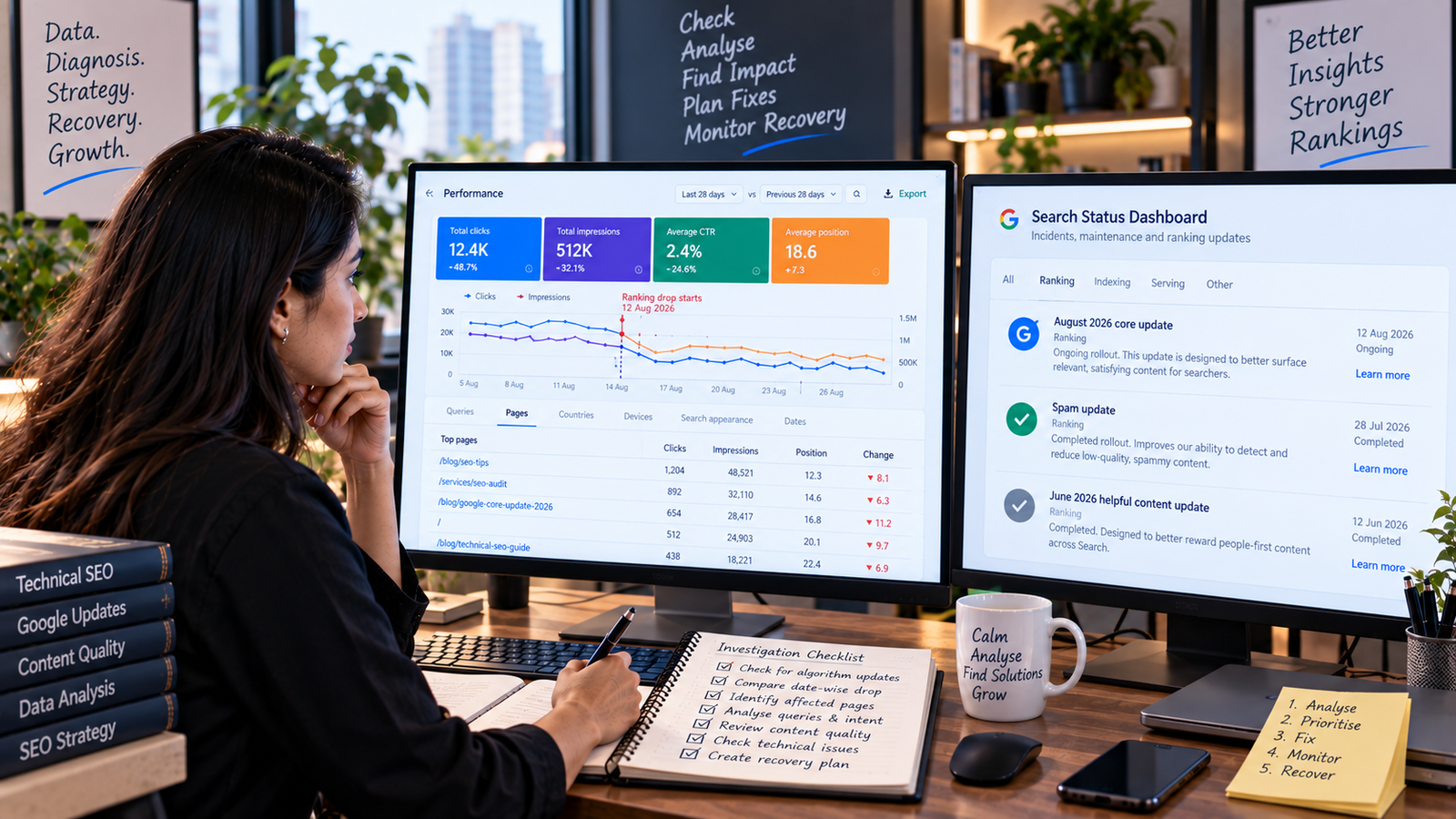
Look at your Search Console data.
Ask:
When did the decline begin?
Then compare that date with the start and end of confirmed updates.
A correlation does not prove causation, but it gives you a useful starting point for investigation.
Step 3: Separate Queries and Pages
Do not only look at total organic traffic.
Check:
Top losing pages
Top losing queries
Clicks
Impressions
Average position
CTR
Search appearance
A sitewide traffic decline can hide very different problems across individual pages.
Step 4: Check Search Console for Manual Actions
Spam systems and manual actions are not the same thing.
Google can detect spam automatically, while human reviewers can issue manual actions when they identify policy violations.
If you suspect a manual action, check the Manual Actions report in Search Console.
What Should You Do After a Core Update?
Google's advice is not to look for a single technical switch that will reverse a core-update-related decline.
Instead, evaluate the affected content carefully.
Google recommends asking whether your content is:
Helpful
Reliable
People-first
Original
Satisfying the user's need
Providing a good overall experience
Google also recommends avoiding quick-fix changes simply because you heard that a particular element is “bad for SEO.”
Compare Your Page With Current Competitors
Take one important query where your page lost visibility.
Compare your page with the pages now ranking above it.
Look at:
Search intent
Content depth
Original information
First-hand experience
Accuracy
Structure
Clarity
Supporting evidence
Internal linking
User experience
Completeness
Do not simply copy the competitor.
Identify what the searcher may be getting from those pages that your page does not provide.
What Should You Do After a Spam Update?
A spam update requires a different investigation.
Start with Google's spam policies.
Look for practices such as:
Keyword stuffing
Link schemes
Cloaking
Scraped content
Scaled content abuse
Doorway pages
Hacked content
Misleading functionality
Site reputation abuse
Expired domain abuse
Google says that sites violating spam policies may rank lower or disappear from Search.
If your site has been affected by spam systems, fixing the underlying violation matters more than simply publishing additional content.
Build an SEO Strategy That Can Adapt to Google Updates
Technical SEO, content quality, search intent and website authority all contribute to long-term organic visibility. Your strategy should address the actual weaknesses of your website instead of chasing every algorithm announcement.
Explore SEO Services →Do You Need to Wait for the Next Core Update?
Not necessarily.
Google's current documentation explains that it continually makes changes to its search algorithms, including smaller core updates that are not announced because they are not widely noticeable.
That means you should not stop improving your website simply because a named core update has finished.
At the same time, Google says some improvements can take several months for its systems to learn and confirm the site's overall improvement.
SEO recovery therefore should not be treated as an overnight process.
How Long Does It Take to Recover From a Google Update?
There is no fixed recovery timeline.
For core-related changes, Google says some improvements may take a few days to show an effect, while broader improvements can take several months for systems to learn and confirm.
For spam-related issues, Google says improvements may take months as its automated systems learn that the site complies with its spam policies.
This is why anyone promising:
“Recover your Google rankings in exactly 7 days”
should be treated cautiously.
Why You Should Not Panic During an Algorithm Update
One of the biggest SEO mistakes is making too many changes at once.
Suppose your rankings drop during a core update.
You then:
Rewrite every article
Change every title
Delete 100 pages
Change URLs
Add hundreds of backlinks
Change categories
Modify internal links
Publish dozens of new articles
If rankings later change, you have no idea which action had an effect.
A better approach is controlled analysis.
Identify the affected pages.
Study the changes.
Make meaningful improvements.
Document what you changed.
Then monitor performance.
What About AI-Generated Content?
AI-generated content deserves special attention in 2026.
Google's spam policies do not say that every piece of AI-assisted content is automatically spam.
The issue is whether content is being created primarily to manipulate Search and whether it provides value to users.
Google's current scaled content abuse policy specifically includes using generative AI or similar tools to create many pages without adding value.
That means the better question is not:
“Was AI used?”
It is:
“Does this content provide meaningful value that users actually need?”
AI can assist research, drafting, analysis and editing.
But simply generating hundreds of pages and publishing them without adding original value can create a spam-policy risk.
Does Helpful Content Still Matter in 2026?
Yes.
The terminology has changed, but the underlying goal has not disappeared.
Google's current ranking systems documentation explains that the Helpful Content System became part of core ranking systems in March 2024.
So businesses should continue creating content that:
Helps the intended audience
Demonstrates relevant knowledge
Provides original information
Satisfies search intent
Avoids unnecessary repetition
Is created primarily for people
The mistake is waiting for a future “Helpful Content Update” before taking these principles seriously.
Core Update vs Spam Update: A Practical Comparison
| Question | Core Update | Spam Update |
|---|---|---|
| Main purpose | Broadly improve ranking systems | Improve spam detection |
| Targets specific websites? | No, broad system change | Can affect sites using spam tactics |
| Is it automatically a penalty? | No | Spam violations can lead to lower visibility |
| First investigation | Content, relevance and quality | Spam policies and prohibited practices |
| Main tool | Search Console + content analysis | Search Console + spam policy review |
| Should you panic? | No | No, but investigate quickly |
| Main response | Meaningful site/content improvement | Remove or correct violating practices |
| Recovery | Can take time | Can take months |
The distinction follows Google's current documentation on core updates and spam updates.
A 7-Step Google Update Diagnosis Process
When your rankings fall, use this process.
1. Confirm the Date
Find the exact date when your traffic or rankings changed.
2. Check Confirmed Google Updates
Compare that date with Google's Search Status Dashboard.
3. Check Search Console
Identify the pages and queries responsible for the decline.
4. Check Manual Actions
Make sure there is no manual action or security issue.
5. Determine the Type of Problem
Ask whether the evidence points toward:
Core ranking changes
Spam-policy issues
Technical SEO
Search demand
Competition
Website changes
Seasonality
6. Compare With Current Search Results
Look at the pages that replaced yours.
Study what changed in the SERP, not just what changed on your website.
7. Make Controlled Improvements
Fix real problems instead of applying random SEO “quick fixes.”
Common Mistakes After Google Ranking Updates
Mistake 1: Assuming Every Traffic Drop Is an Algorithm Update
Traffic can fall for many reasons.
Always verify.
Mistake 2: Calling Every Update a Penalty
Core updates are not simply penalties.
They are broad changes to ranking systems.
Mistake 3: Treating Helpful Content as a Separate 2026 Update
The Helpful Content System is now part of core ranking systems.
Mistake 4: Deleting Large Amounts of Content Immediately
Google recommends treating deletion as a last resort when content cannot be salvaged, rather than using mass deletion as a quick fix.
Mistake 5: Publishing More Content Just Because Rankings Fell
More pages do not automatically solve a quality or relevance problem.
Mistake 6: Buying Backlinks After a Core Update
If the problem is content relevance, buying links does not address the underlying issue.
Mistake 7: Making Ten Changes at Once
You lose the ability to understand what actually helped.
How to Make Your Website More Resilient to Google Updates
There is no such thing as a website that is guaranteed to be unaffected by future Google updates.
But you can build a stronger foundation.
Focus on:
Helpful Content
Create pages that genuinely solve searchers' problems.
Original Information
Add experience, examples, analysis, data or insights instead of simply rewriting what already exists.
Strong Website Structure
Make important content easy to discover through logical architecture and internal links.
Technical Health
Ensure Google can crawl, render and understand your important pages.
Search Intent
Make sure each page actually matches what the searcher wants.
Trust and Accuracy
Especially for topics where incorrect information can have significant consequences, maintain appropriate expertise and reliability.
Sustainable SEO
Avoid tactics that depend on manipulating ranking systems.
Build an SEO Strategy That Can Adapt to Google Updates
Technical SEO, content quality, search intent and website authority all contribute to long-term organic visibility. Your strategy should address the actual weaknesses of your website instead of chasing every algorithm announcement.
Explore SEO Services →What Should You Monitor After a Google Update?
Do not look at rankings alone.
Monitor:
Organic clicks
Organic impressions
Average position
CTR
Top landing pages
Top losing queries
Top gaining queries
Conversions
Leads
Revenue where measurable
Indexing
Technical issues
For business websites, traffic without conversions is not enough.
A ranking change matters commercially only when it affects meaningful search visibility and business outcomes.
Where Should You Check Official Google Update Information?
The most reliable place to verify confirmed Google ranking updates is the Google Search Status Dashboard.
Google says the dashboard provides status information for Search systems and lists the latest ranking updates relevant to website owners.
This is more reliable than treating an SEO tool's volatility graph as proof that Google launched a named update.
SEO tools can help you identify unusual ranking movement.
But confirmation of a named Google update should come from Google.
Final Thoughts
Google Search ranking updates are easier to understand when you stop treating every ranking change as the same event.
Core updates are broad changes to Google's ranking systems.
Spam updates improve Google's systems for detecting search spam and policy violations.
Helpful Content still matters, but the Helpful Content System is no longer a separate recurring update. Google integrated it into its core ranking systems in March 2024.
In 2026, this distinction is especially important because Google has continued to release separate core and spam updates.
If your rankings fall, do not immediately rewrite your entire website.
First confirm what changed.
Check the dates.
Review Search Console.
Check Google's Search Status Dashboard.
Look at the affected pages and queries.
Check for manual actions and spam-policy issues.
Then compare your content with the current search results and make meaningful improvements.
The goal is not to “beat” the next Google update.
The goal is to build a website that remains useful as Google's systems continue to improve.
Build an SEO Strategy That Can Adapt to Google Updates
Technical SEO, content quality, search intent and website authority all contribute to long-term organic visibility. Your strategy should address the actual weaknesses of your website instead of chasing every algorithm announcement.
Explore SEO Services →Frequently Asked Questions
1. What is a Google core update?
A Google core update is a broad change to Google's core ranking systems. Google releases significant core updates several times a year to improve the relevance and helpfulness of Search results.
2. What is a Google spam update?
A spam update is a notable improvement to Google's automated spam-detection systems. Google's SpamBrain system is one part of its spam-prevention technology.
3. Is the Helpful Content Update still a separate Google update?
No. Google incorporated the Helpful Content System into its core ranking systems in March 2024. It is therefore not a separate recurring update category in 2026.
4. How do I know if a Google update affected my website?
Compare the date of your ranking or traffic change with confirmed updates in Google's Search Status Dashboard. Then analyze Search Console data to identify which pages and queries changed.
5. Is a core update a penalty?
Not necessarily. Google describes core updates as broad changes to its ranking systems rather than updates aimed at specific sites or individual pages. A ranking decline can occur because the systems now evaluate the search results differently.
6. What should I do after a core update?
Review the pages and queries that lost visibility, compare them with current competitors and evaluate whether your content is helpful, reliable, people-first and satisfying the searcher's needs. Avoid quick fixes.
7. What should I do after a spam update?
Review Google's spam policies and check whether your website uses practices that violate them. If a spam issue exists, correct the underlying practice rather than simply publishing more content.
8. Does AI-generated content violate Google's spam policies?
AI-generated content is not automatically classified as spam. Google's current policy focuses on scaled content abuse when many pages are generated primarily to manipulate rankings without providing value to users.
9. How long does Google update recovery take?
There is no fixed timeline. Google says some improvements can take a few days to show an effect, while broader improvements may take several months for its systems to learn and confirm. Spam-related improvements can also take months.
10. Where can I check Google's latest ranking updates?
Google's Search Status Dashboard is the primary place to check confirmed Search ranking updates and their rollout status.