

Choosing an SEO company is not a decision you should make based on a polished sales pitch or the lowest monthly price.
The company you hire may influence your website structure, content, technical SEO, internal linking, authority-building strategy and reporting for months or even years. The wrong provider can waste your budget and leave you with little to show for the investment. The right partner should help you build a sustainable search strategy connected to your actual business goals.
The difficult part is that most SEO companies sound similar when they are trying to win your business. They may all promise better rankings, more traffic and improved visibility. The real difference becomes clear when you examine how they work, what they measure, how transparent they are and whether their strategy makes sense for your business.
So, how do you choose the right SEO company?
Use this practical checklist before signing a contract.
Quick Answer: How to Choose the Right SEO Company
The right SEO company should understand your business, identify realistic opportunities, explain its strategy clearly, show relevant evidence of its work, provide transparent deliverables and reporting, use responsible SEO practices and set realistic expectations.
Before hiring an SEO company, evaluate these areas:
Your business goals
Relevant industry experience
Case studies and client references
Initial website analysis
SEO strategy
Keyword research
Content strategy
Technical SEO capabilities
Link-building methods
Reporting and KPIs
Communication
Pricing and deliverables
Contract terms
Account and asset ownership
Realistic timelines
SEO red flags
Do not choose an SEO company simply because it promises the fastest rankings or offers the cheapest package.
1. Start With Your Business Goal, Not SEO
Before contacting SEO companies, decide what you actually want SEO to accomplish.
“More traffic” is usually too vague to be a useful business objective.
You may actually want:
More qualified leads
More phone calls
More local customers
More ecommerce sales
More enquiries from specific service pages
More visibility in a particular market
More organic traffic to high-value pages
Better visibility for a new product or service
Your goal should influence the SEO strategy.
For example, a local service business may care more about qualified enquiries and local visibility than thousands of visitors from searches that never produce customers. An ecommerce business may care about category and product visibility, organic revenue and non-branded search growth.
A good SEO company should want to understand these goals before recommending a generic package.
A Simple Question to Ask Yourself
What business result should SEO contribute to over the next 6–12 months?
Once you know the answer, it becomes much easier to judge whether an SEO company's proposed work actually supports your business.
2. Check Whether They Understand Your Business
SEO strategy should not be identical for every company.
A local business, SaaS company, ecommerce store, healthcare organization, manufacturer and professional service firm can have completely different search behaviour, competition, customer journeys and conversion goals.
Ask the SEO company:
Have you worked with businesses similar to mine?
Who are my actual search competitors?
Which pages should attract organic traffic?
What types of searches matter to my customers?
What would you prioritize first?
How would you measure business impact?
You do not necessarily need an SEO company that has worked in your exact industry.
What matters is whether they can understand your business model, audience, market and competitive environment before recommending a strategy.
3. Ask for Relevant Case Studies
Case studies can help you understand whether an SEO company has experience producing meaningful results.
But do not be impressed by a screenshot showing that a keyword moved from position 40 to position 3 without asking what happened behind the number.
A useful case study should explain:
What type of business was involved
What problem existed initially
What SEO work was performed
Which pages or topics were prioritized
What changed over time
Which metrics improved
Whether leads, enquiries, sales or other business outcomes improved where measurable
The more clearly an agency can explain the work and the outcome, the easier it is for you to judge whether its experience is relevant.
Ask for Client References
If an agency can provide references from previous clients, speak with them.
Ask:
Was communication reliable?
Did the company deliver what it promised?
Did you understand what they were working on?
Were the reports useful?
Did the strategy change when the data suggested it should?
Would you hire the company again?
Google's own hiring guidance recommends asking potential SEOs for examples of previous work and checking business references.
A conversation with a previous client can reveal things that a sales presentation cannot.
4. Ask for an Initial Website Analysis
A serious SEO conversation should involve your website.
The company should be able to identify at least some opportunities or problems specific to your site rather than sending you a generic proposal that could belong to any business.
You do not necessarily need a complete free strategy before hiring an agency. But you should expect the company to have looked at your website and be able to explain what it sees.
Ask:
What problems did you identify?
Which pages have the biggest opportunities?
Are there technical issues?
Does the current content match search intent?
How does the website compare with relevant competitors?
What would you fix first?
If you need a structured diagnosis before deciding what type of SEO work is required, a professional SEO audit can be a useful starting point.
5. Understand the SEO Strategy Before You Sign
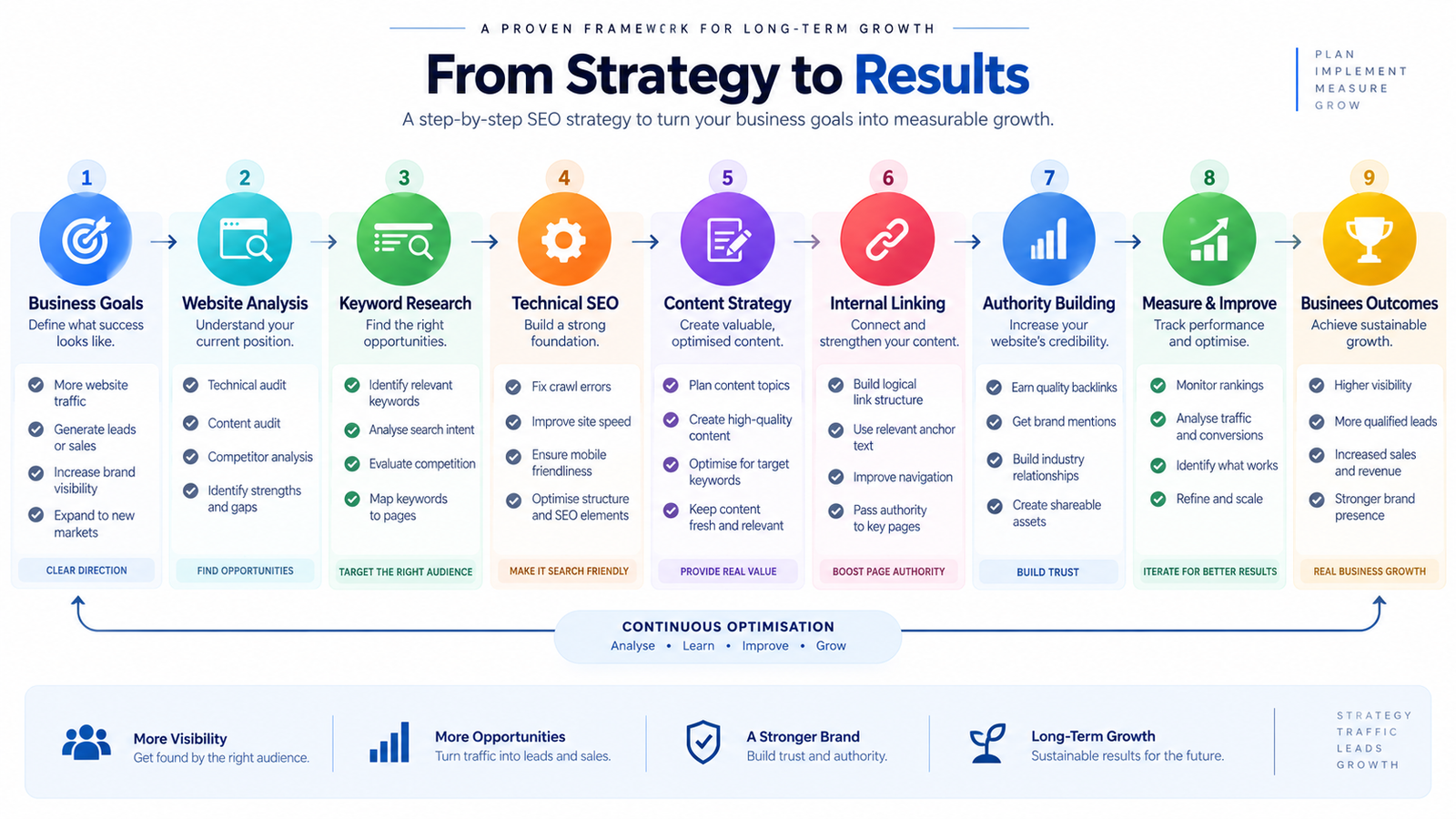
Do not hire an SEO company without understanding what it actually plans to do.
You do not need to understand every technical detail. You should, however, understand the logic behind the strategy.
Ask:
What will you work on first?
Why does that work matter?
What will the first 90 days look like?
How will priorities change when new data becomes available?
Depending on the business, an SEO strategy may include technical improvements, keyword research, content optimization, internal linking, content creation, digital PR, relevant authority building and conversion improvements.
The important part is that every activity should have a reason.
“Five blogs and twenty backlinks every month” is an activity list.
A strategy explains why those activities are appropriate for your website and what they are expected to accomplish.
6. Ask How They Choose Keywords
Keyword research should not simply be a list of phrases with high search volume.
The right keywords should connect with:
Your products or services
Your customers
Search intent
Your competitive position
Conversion opportunities
Pages you can realistically create or improve
Ask the company how it decides which keywords deserve attention.
A good answer should involve more than:
“We use a keyword research tool.”
SEO tools provide data. They do not automatically decide which searches are strategically valuable for your business.
A strong SEO company should be able to explain why a particular topic or keyword matters and which page should target it.
7. Evaluate Their Content Strategy
Content is often a major part of SEO, but more content does not automatically mean better SEO.
Ask:
What types of content will you create?
Who will write or review it?
How will topics be selected?
How will existing content be improved?
How will informational content support commercial pages?
How will you avoid repetitive or low-value articles?
How will content demonstrate genuine expertise?
Google's current guidance emphasizes people-first content that is useful, reliable and created to help users rather than content produced primarily to manipulate search rankings.
Be cautious if an agency's entire content strategy sounds like:
“We will publish 20 AI-generated blogs every month.”
The better question is whether each piece of content has a clear purpose, satisfies a real search need and adds value that helps the business.
8. Check Their Technical SEO Capabilities
Technical SEO can affect how search engines crawl, understand and index a website.
Depending on your website, an SEO company may need to work on:
Indexing problems
Crawlability
Canonical URLs
Redirects
XML sitemaps
Site architecture
Duplicate content
JavaScript-related issues
Mobile usability
Page performance
Structured data
Website migrations
Google's documentation recommends checking whether Google can access, crawl and understand important website content, including technical elements that affect indexing and rendering.
Ask how the agency identifies technical problems and, more importantly, how it decides which problems should be fixed first.
You should also find out whether the SEO team can work with your developer when implementation requires technical changes.
If your website has significant technical issues, make sure the provider has genuine technical SEO capability rather than simply running an automated audit tool and forwarding the report to you.
Mid-Article CTA: Not Sure What Your Website Needs?
Before comparing SEO packages or signing a long-term contract, it makes sense to understand what is actually holding your website back.
A practical SEO audit can help identify technical, content, structural and optimization opportunities so you can make a more informed decision.
9. Ask How They Build Links
Link building deserves careful attention because not every backlink is useful.
Ask the SEO company:
How do you build links?
Then listen carefully to the answer.
Be cautious if you hear about:
Private blog networks
Large quantities of cheap backlinks
Automated link-building software
Guaranteed numbers of backlinks every month
Links from unrelated websites simply because they have high metrics
Secret networks that the company refuses to explain
Google's Search Essentials identify spam policies and ranking manipulation as areas that can result in lower visibility or omission from search results.
You should therefore understand where links are coming from, why they are relevant and how the agency approaches link acquisition.
The objective should not simply be to increase the backlink count.
10. Ask What They Will Report Every Month
SEO reports can contain dozens of numbers.
That does not mean all of them matter to your business.
Ask what the agency will report and how those metrics connect with your objectives.
Depending on your goals, useful reporting may include:
Organic traffic
Search impressions
Clicks
Relevant keyword visibility
Important page performance
Leads and enquiries
Organic conversion rates
Revenue from organic search where measurable
Technical issues resolved
Content published or improved
Strategic actions completed
Priorities for the next period
A useful report should connect:
What was done → what changed → what happens next.
A dashboard full of ranking screenshots is not enough if you cannot understand whether the work is helping your business.
11. Find Out Who Will Actually Work on Your Account
The person selling the SEO service may not be the person managing your campaign.
Ask:
Who will be my main point of contact?
Who handles strategy?
Who handles technical SEO?
Who writes or reviews content?
Who manages link acquisition?
How often can I communicate with the team?
How quickly are questions normally answered?
This matters because SEO is an ongoing relationship.
A technically capable company can still become frustrating if communication is poor or responsibilities are unclear.
You should know who is responsible for your account before signing the contract.
12. Compare Pricing With Deliverables
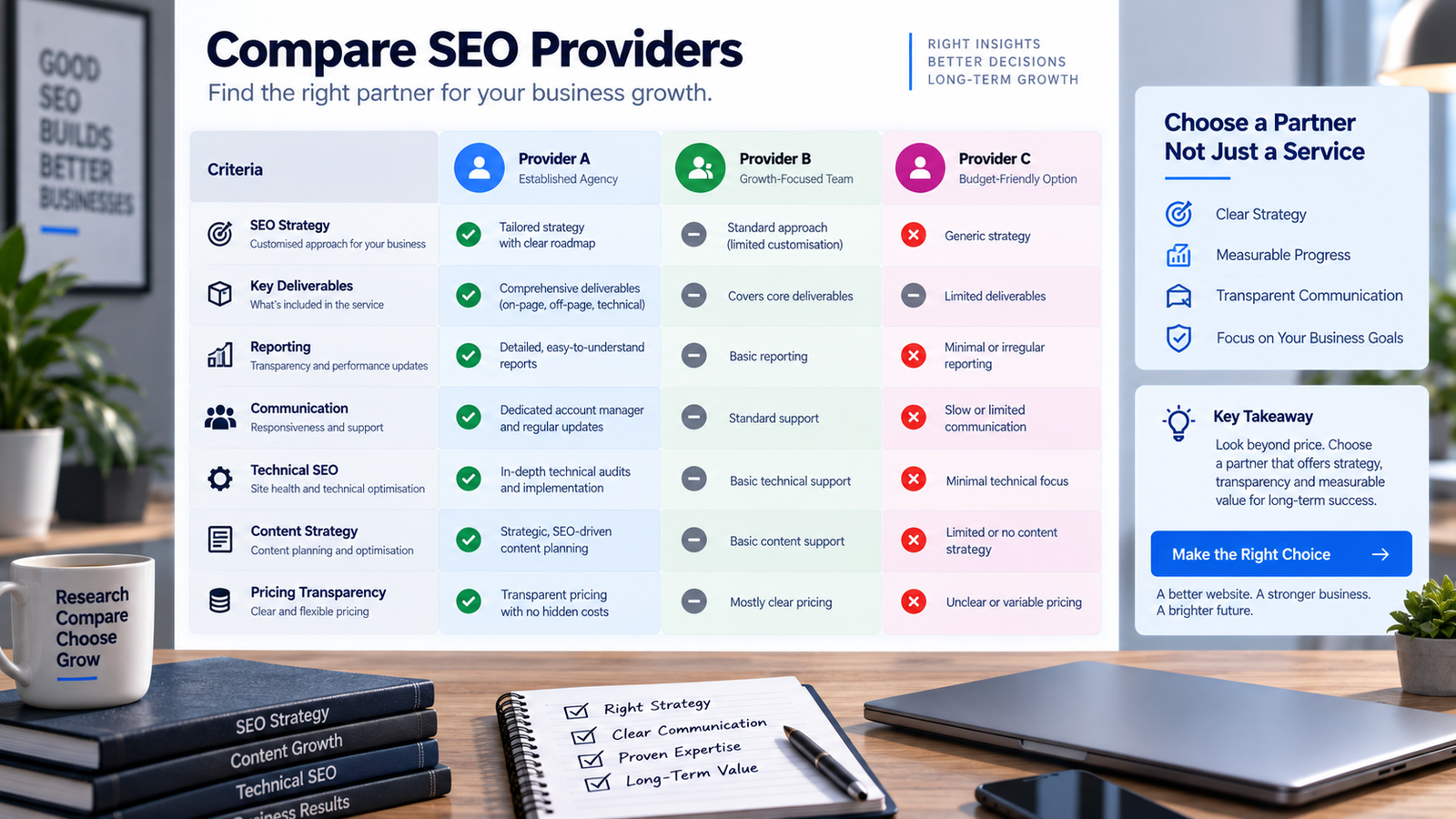
Do not compare SEO companies on monthly price alone.
Two companies charging different amounts may be offering completely different levels of strategy, expertise, execution, communication and reporting.
Instead, compare what you are actually receiving.
| What to Compare | Questions to Ask |
|---|---|
| Monthly fee | What exactly am I paying for? |
| Deliverables | What work will actually be completed? |
| Strategy | Is the plan customized to my website? |
| Content | What type and amount of content is included? |
| Technical SEO | Who identifies and handles technical improvements? |
| Link building | What type of link acquisition is included? |
| Reporting | What will I receive each month? |
| Communication | Who manages the account? |
| Contract | What are the terms and exit conditions? |
If the company publishes its SEO pricing, use it as one reference point, but compare the scope and quality of work rather than simply choosing the lowest number.
13. Read the Contract Carefully
Do not treat the contract as a formality.
Before signing, understand:
Contract duration
Monthly fee
Payment terms
Deliverables
Cancellation conditions
Notice period
Reporting commitments
Content ownership
Website access
Google Analytics and Search Console access
Link and asset ownership
What happens when the relationship ends
You should know what happens to your website, content, accounts and data if you stop working with the SEO company.
A professional SEO relationship should not depend on keeping you locked into systems you cannot access yourself.
14. Watch for SEO Red Flags
Some warning signs should make you slow down before signing anything.
Guaranteed #1 Rankings
No SEO company controls Google's algorithm or your competitors.
Google explicitly says that no one can guarantee a #1 ranking and advises website owners to be wary of SEOs making ranking guarantees or claiming a special relationship with Google.
Be cautious about promises such as:
“Guaranteed #1 on Google”
“Page 1 in 30 days”
“Guaranteed traffic”
“Secret Google ranking method”
“Special relationship with Google”
A credible SEO company can commit to a process, strategy and deliverables. It cannot honestly control Google's final ranking position.
Extremely Vague Proposals
If the proposal simply says:
“We will optimize your website and improve rankings.”
Ask for specifics.
What will they actually do?
Huge Backlink Promises
A promise of thousands of backlinks may sound impressive, but quantity alone does not establish quality or relevance.
Ask where those links will come from and why they make sense for your website.
No Clear Reporting
If the company cannot explain how it will demonstrate progress, think carefully before signing.
One-Size-Fits-All Packages
Your SEO strategy should reflect your website, market, audience and goals.
A package should not automatically be considered better because it contains more activities.
Pressure to Sign Immediately
You should have enough time to compare proposals, ask questions and understand the agreement.
A good SEO provider should be comfortable with an informed decision.
15. Ask These Questions Before Hiring an SEO Company
Before making your final decision, ask every shortlisted company the same core questions:
What do you think is currently limiting our organic growth?
What would you prioritize first?
What does your first 90 days look like?
How do you choose keywords?
How do you approach content?
How do you handle technical SEO?
How do you build links?
What will you report every month?
Who will actually work on our account?
How will you connect SEO performance with business outcomes?
What access will we retain to our accounts and assets?
What happens if we decide to stop working together?
Can you show relevant case studies?
What do you need from our team?
What can we realistically expect from SEO?
Do not judge the answers only by how impressive they sound.
Judge whether they are specific, transparent and relevant to your business.
16. Do Not Choose an SEO Company Based Only on Its Own Rankings
An SEO company's own Google visibility can be one useful signal, but it should not be your only filter.
A company may rank well for competitive SEO terms but still be a poor fit for your business.
Likewise, a specialist may have strong experience with your industry without ranking #1 for every SEO-related search.
Look at the complete picture:
Relevant experience
Strategy
Case studies
Communication
Transparency
Technical ability
Content quality
Reporting
Business understanding
Pricing and contract terms
The goal is to find the right partner, not simply the company that appears highest for one Google search.
17. Compare Shortlisted SEO Companies Side by Side
Once you have shortlisted two or three companies, put their answers side by side.
Score each company from 1 to 5 on:
| Criteria | Company A | Company B | Company C |
|---|---|---|---|
| Understands your business | |||
| Relevant experience | |||
| Case studies | |||
| Strategy quality | |||
| Technical SEO | |||
| Content approach | |||
| Link-building approach | |||
| Reporting | |||
| Communication | |||
| Pricing transparency | |||
| Contract clarity | |||
| Overall confidence |
This makes the decision less emotional.
It also prevents a polished presentation, impressive ranking screenshot or low monthly price from becoming the only deciding factor.
What Should a Good SEO Proposal Include?
A useful SEO proposal should make the relationship understandable before you sign.
At minimum, look for:
Current website observations
Business objectives
SEO opportunities
Proposed strategy
Priority areas
Expected deliverables
Reporting process
Communication process
Pricing
Contract terms
Roles and responsibilities
Measurement approach
The proposal does not need to predict your exact Google rankings.
It should explain what the company plans to do, why it matters and how progress will be evaluated.

Final SEO Company Checklist
Before hiring an SEO company, ask yourself:
Does this company understand my business?
Have they identified specific opportunities on my website?
Is the strategy customized?
Are the deliverables clearly defined?
Can they explain their SEO methods in plain language?
Do they have relevant case studies?
Can they explain how they build links?
Do they have a sensible content strategy?
Can they handle technical SEO?
Will I receive meaningful reports?
Do I know who will manage my account?
Are pricing and contract terms transparent?
Will I retain access to my website and important accounts?
Are they avoiding unrealistic ranking guarantees?
Do I trust their communication?
Can they explain how SEO contributes to my actual business goals?
If most of the answers are yes, you may have found a strong candidate.
If several answers are unclear, keep comparing.
Final Thoughts
The right SEO company is not necessarily the cheapest, the biggest or the one making the boldest promises.
It is the company that can understand your business, identify the right opportunities, explain its strategy clearly, execute responsibly and show you what is happening along the way.
Before you sign a contract, look beyond rankings and traffic.
Ask:
What problem are you solving?
What will you actually do?
How will we measure progress?
How does that work support the business?
And perhaps most importantly:
Would I still trust this company if the rankings take longer than expected?
That final question matters because good SEO is rarely about a quick promise. It is about having a sensible strategy, executing it consistently and making decisions based on evidence.
If you are looking for professional SEO services, review the actual services and approach before making a decision.
Ready to Choose the Right SEO Partner?
If you are unsure what your website needs or want to understand which SEO areas should be prioritized before committing to an SEO company, start with a practical website review.
Already know you need an SEO partner?
Frequently Asked Questions
1. How do I choose the right SEO company?
Start by defining your business goals, then compare SEO companies based on relevant experience, strategy, case studies, technical capability, content approach, reporting, communication, pricing and contract terms. Avoid choosing purely on price or ranking promises.
2. What questions should I ask an SEO company before hiring?
Ask about their strategy, first 90 days, keyword research, content process, technical SEO, link building, reporting, account management, case studies, pricing, contract terms and how they measure business outcomes.
3. How much should I pay an SEO company?
There is no single price that is right for every business. Cost depends on the website, competition, market, scope, expertise and amount of work required. Compare the actual strategy and deliverables rather than choosing based only on the lowest monthly fee.
4. Can an SEO company guarantee Google Page 1 rankings?
A responsible SEO company should not guarantee a specific Google ranking position. Google itself advises businesses to be cautious of SEOs making #1 ranking guarantees.
5. How long does SEO take to show results?
There is no universal timeline. Some improvements can become visible relatively quickly, while broader changes can take much longer. Google notes that some changes can take hours while others can take several months, and generally recommends waiting a few weeks before evaluating many SEO changes.
6. Should I hire an SEO agency or an SEO freelancer?
Either can be the right choice. The decision should depend on your business needs, website complexity, budget, communication requirements and the expertise available. A capable freelancer can be a strong fit for one business, while another may need a broader team.
7. What is the biggest red flag when choosing an SEO company?
Guaranteed rankings are one of the clearest warning signs. Other red flags include vague deliverables, secret methods, suspiciously cheap link packages, poor reporting, pressure to sign immediately and an inability to explain what work will actually be performed.
8. Should an SEO company provide a free audit?
Not necessarily. A brief initial analysis can be useful, but a detailed SEO audit can require significant expertise and time. Google recommends carefully considering what an audit involves and giving only appropriate access during an initial audit stage.
9. How can I compare two SEO companies?
Give both companies the same questions and compare their answers across strategy, experience, deliverables, technical SEO, content, link building, reporting, communication, pricing and contract terms. A simple comparison scorecard can make the decision easier.
10. What should a monthly SEO report include?
A useful report should connect SEO activity with meaningful outcomes. Depending on the campaign, it may include organic traffic, impressions, clicks, relevant keyword movement, important page performance, leads, conversions, technical improvements, content work and next steps.