
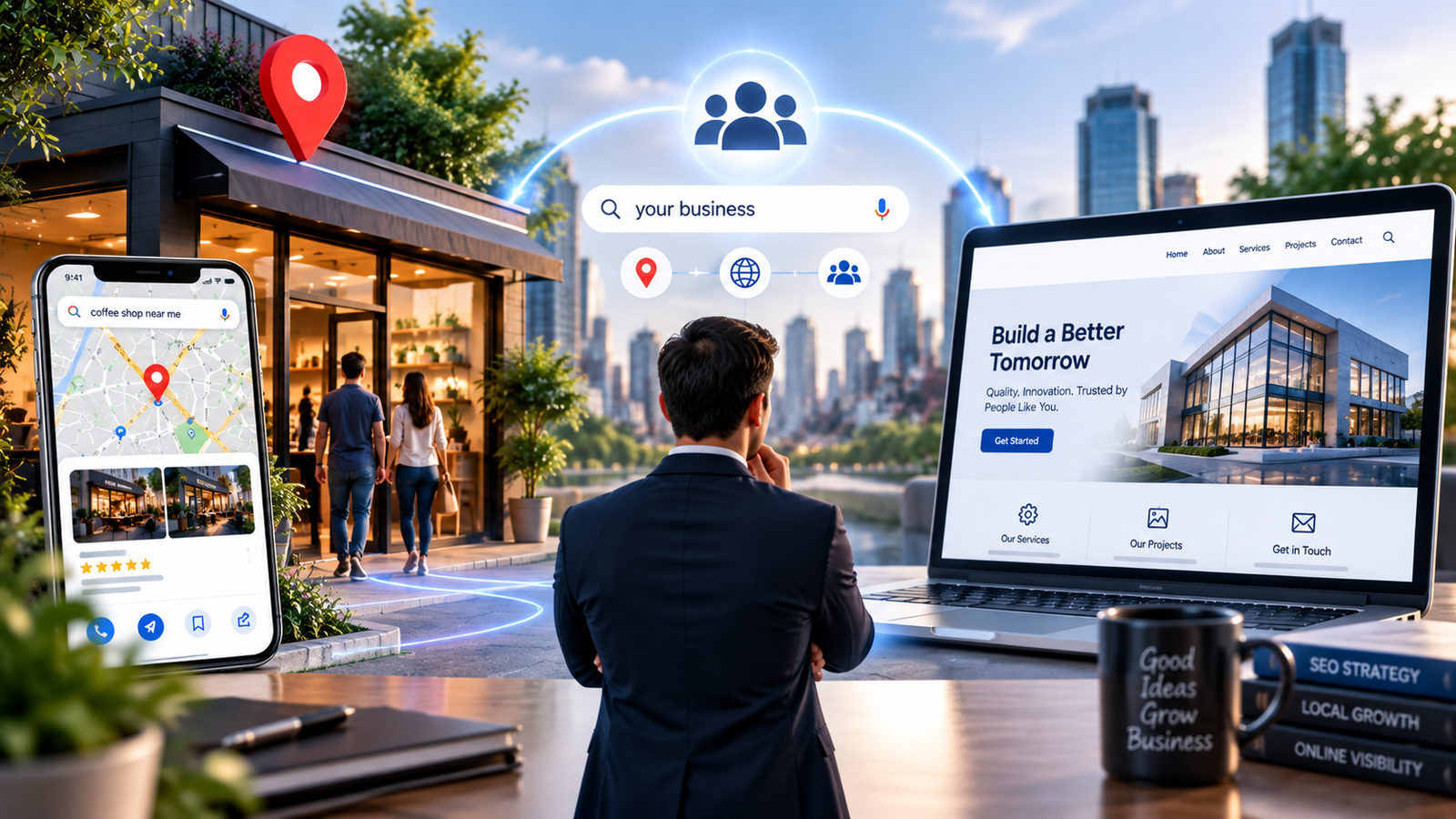
If your business depends on customers finding you in a specific city, town, neighborhood or service area, Local SEO should be part of your strategy.
If you want your website to attract people through broader organic searches, website SEO is essential.
For many businesses, the real answer is not Local SEO or website SEO.
It is Local SEO + website SEO working together.
The difference is mainly in the search visibility you are trying to build.
Local SEO focuses on helping a business become more visible for geographically relevant searches and local results across Google Search and Maps.
Website SEO focuses on improving the website so its pages can be discovered, understood and ranked for relevant organic searches.
Google explains that local results are primarily based on relevance, distance and prominence, while its broader Search systems consider factors such as query relevance, usability, source expertise, location and settings.
So the right question is not:
"Which type of SEO is better?"
It is:
"Where do my customers search, and what do I need my business to be visible for?"
What Is Local SEO?
Local SEO is the process of improving a business's visibility when people search for products or services with a local intent.
Examples include:
"dentist near me"
"SEO company in Jabalpur"
"best interior designer in Indore"
"restaurants near me"
"house construction company in Jabalpur"
"physiotherapist near me"
Local SEO is particularly important when the customer needs a business they can visit or a service provider operating in a defined geographic area.
Google Business Profile plays an important role in this ecosystem. Google describes a Business Profile as a way for eligible businesses to manage how they appear on Google Search and Maps, including information such as location, hours, website, photos, services and reviews.
But Local SEO is not simply "optimizing your Google Business Profile."
It can also involve:
Website optimization for local intent
Location and service pages
Local content
Internal linking
Reviews and reputation
Local citations and business information
Relevant links and mentions
Local keyword research
Local landing pages
Technical SEO
Conversion optimization
The goal is to build a consistent local presence rather than treating your Business Profile and website as two unrelated assets.
What Is Website SEO?
Website SEO is the broader process of improving a website's ability to appear in organic search results for relevant queries.
It can cover areas such as:
Technical SEO
Keyword and topic research
Search intent
On-page optimization
Content quality
Internal linking
Website architecture
Page speed and usability
Structured data where appropriate
Digital authority and relevant links
Image optimization
International or national search visibility
Conversion-focused landing pages
Website SEO is useful whether you target one city, multiple cities, an entire country or an international market.
For example, a website selling software might want to rank for:
"project management software"
A local construction company might want to rank for:
"house construction company in Jabalpur"
Both are website SEO opportunities.
The second also has a strong local SEO component.
Local SEO vs Website SEO: What's the Main Difference?
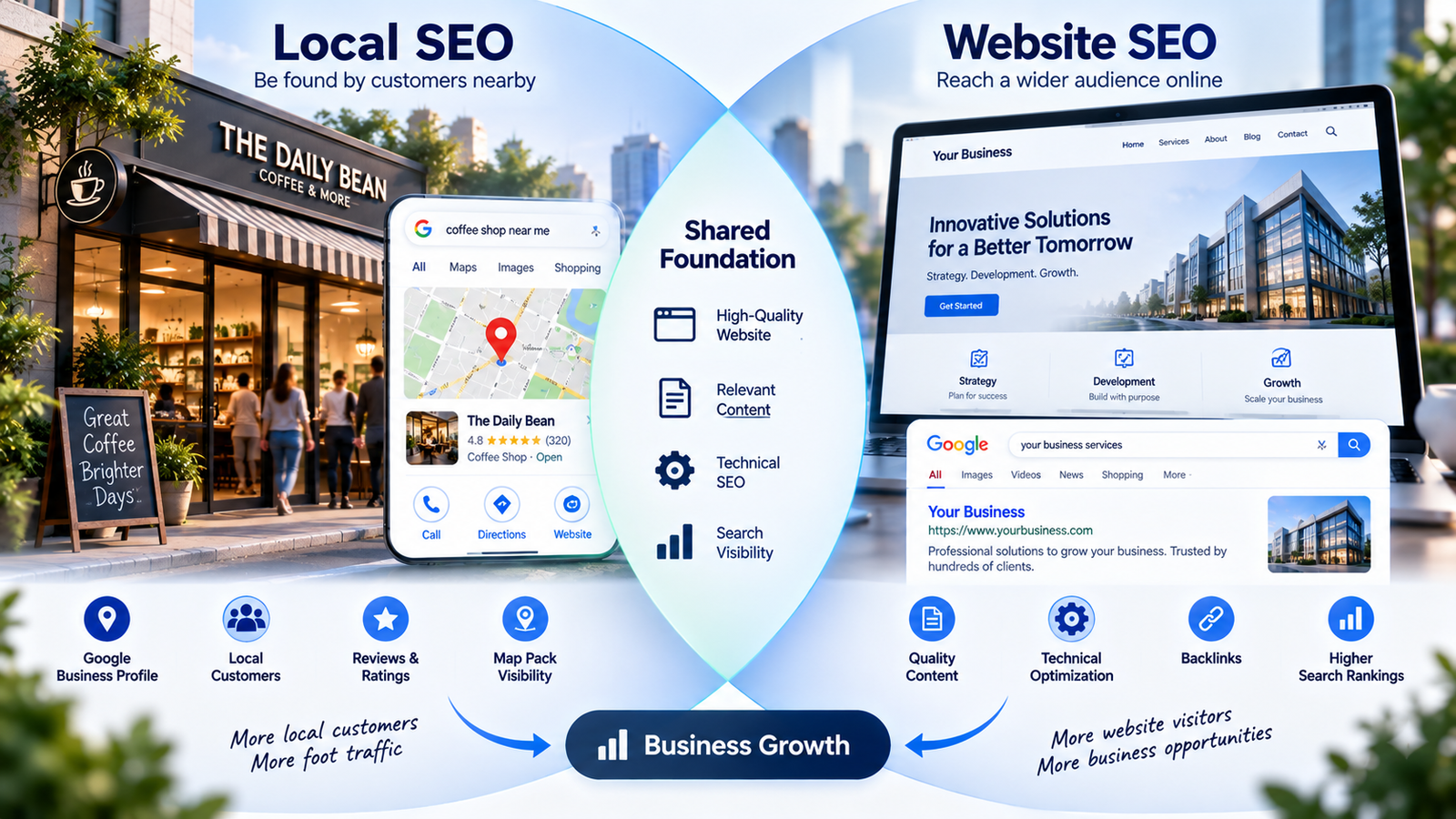
The easiest way to understand the difference is to look at the search context.
| Area | Local SEO | Website SEO |
|---|---|---|
| Primary focus | Local visibility | Organic website visibility |
| Main audience | People searching within a geographic market | Users searching for relevant information, products or services |
| Important platforms | Google Search and Google Maps | Search engines and the website itself |
| Geographic targeting | Central to the strategy | Optional depending on business |
| Google Business Profile | Highly important for eligible local businesses | May be less important or irrelevant for non-local businesses |
| Location pages | Often important | Useful when location is part of the search strategy |
| Reviews | Important local trust signal | Can support broader reputation and conversions |
| Technical SEO | Important | Important |
| Content | Local and service-focused where appropriate | Topic, service, product or informational content |
| Best suited for | Local and service-area businesses | Local, national and international websites |
| Main objective | Local discovery and customer actions | Organic visibility, traffic and business outcomes |
The important thing to notice is that technical SEO and website optimization are not exclusive to one side.
Local SEO and website SEO overlap significantly.
Why Local SEO Is Different From Regular Website SEO
Suppose you own a dental clinic.
Someone searches:
"dentist near me"
Google needs to consider geographic relevance.
A clinic located close to the searcher may be more useful than a clinic hundreds of kilometers away.
Google says distance is one of the main factors in local results, along with relevance and prominence.
Now imagine someone searches:
"how often should you get a dental cleaning?"
That is a very different query.
The person may not be looking for a nearby clinic at all.
They want information.
That search can be answered by a useful website article, regardless of whether the business has a physical location nearby.
This is why search intent matters before deciding which SEO strategy to prioritize.
What Does Local SEO Include?
A strong Local SEO strategy usually has several connected parts.
1. Google Business Profile Optimization
Your Business Profile should accurately represent your business.
That includes relevant information such as:
Business category
Business name
Address or service area
Hours
Website
Services
Photos
Business description
Other relevant attributes
Google recommends keeping Business Profile information complete, accurate and up to date to help customers find the business in local search.
2. Reviews and Reputation
Reviews can influence how customers perceive a business and are also among the information Google considers in local ranking.
Google specifically notes that review count and review score can contribute to local ranking.
That does not mean businesses should chase artificial reviews.
The better approach is to build a genuine review process around real customer experiences.
3. Local Website Optimization
Your website still matters.
Google's own documentation explains that information used in local search can come from publicly available sources, including content crawled from a business's official website.
Your website should therefore clearly communicate:
What you offer
Where you operate
Who you serve
Which services or products you provide
Why customers should consider your business
4. Location and Service Pages
A business serving multiple areas may need dedicated pages when those locations represent genuinely different customer markets.
For example:
SEO Company in Jabalpur
SEO Company in Indore
SEO Company in Bhopal
But creating dozens of nearly identical city pages simply by replacing the city name is not a strong strategy.
Each page should have a legitimate purpose and useful, location-relevant information.
5. Local Authority and Mentions
Local references, links, articles, directories and other relevant sources can contribute to how well-known a business appears online.
Google states that prominence can be influenced by information across the web, including links, articles and directories.
What Does Website SEO Include?
Website SEO is broader.
Technical SEO
Technical SEO helps search engines access, crawl, understand and process your website.
This can involve:
Crawlability
Indexability
Site architecture
Canonicalization
Redirects
XML sitemaps
JavaScript handling
Mobile usability
Structured data
Page performance
On-Page SEO
This involves improving individual pages around their actual search purpose.
It can include:
Page titles
Headings
Content structure
Search intent
Internal links
Images
Relevant terminology
Helpful supporting information
Content SEO
Content should answer the reason someone searched.
For example, a page targeting:
"SEO pricing in India"
should not simply repeat the phrase "SEO pricing in India."
It should actually explain pricing models, what affects cost, what services may be included, how businesses should compare proposals and what questions to ask.
Authority and Relevant Links
Website SEO can also involve earning relevant mentions and links that help establish the website's broader authority.
The goal should be quality and relevance rather than collecting large quantities of low-value links.
Which Businesses Need Local SEO?
Local SEO should usually be a priority when your customers are tied to a geographic market.
Local service businesses
Examples:
Plumbers
Electricians
Contractors
Interior designers
Lawyers
Accountants
Doctors
Dentists
Clinics
Repair services
Digital marketing agencies serving specific cities
Physical-location businesses
Examples:
Restaurants
Retail stores
Salons
Gyms
Hotels
Clinics
Educational institutes
Showrooms
Service-area businesses
Some businesses travel to customers rather than operating from a traditional storefront.
They can still have strong local search needs when they serve defined geographic areas and meet Google's eligibility requirements.
Google's Business Profile guidance distinguishes businesses that interact with customers in person, including businesses with a physical location customers can visit or businesses that meet customers in a local service area.
Which Businesses Need Website SEO?
Almost every business with a website can benefit from website SEO, but the strategy depends on the business model.
Website SEO becomes particularly important for:
National businesses
E-commerce websites
SaaS companies
Publishers
B2B companies
Online service providers
Educational websites
Affiliate or content businesses
Manufacturers
Businesses targeting multiple markets
Companies targeting international customers
For these businesses, organic website visibility may extend far beyond one city.
What If You Have a Local Business?
This is where many business owners make the wrong choice.
They think:
"I have a local business, so I only need Google Maps SEO."
Not necessarily.
Imagine a customer finds your Business Profile and clicks your website.
What happens next?
If the website has:
Poor service information
Weak landing pages
No clear location relevance
Slow or confusing navigation
Weak calls to action
Thin content
Technical problems
you can lose the customer even after winning the initial local search visibility.
Your Business Profile may get the click.
Your website often has to help turn that click into a lead.
That is why Local SEO and website SEO should usually support each other.
Can You Do Local SEO Without a Website?
In some cases, a business can establish local visibility through its Google Business Profile and other online information without relying heavily on a website.
But that does not mean a website is unnecessary.
A strong website can give customers more information about:
Services
Products
Pricing context
Areas served
Expertise
Frequently asked questions
Case studies
Contact options
Business credibility
It can also create additional opportunities to appear in organic search results.
For many service businesses, the strongest setup is therefore:
Google Business Profile + Website + Local SEO + Website SEO
rather than choosing only one.
Does Google Business Profile Replace Website SEO?
No.
A Business Profile and a website serve different purposes.
Google describes the Business Profile as a local storefront on Google Search and Maps, while the website provides additional business information and can also be used as a source of publicly available information for local search.
Think about the customer journey:
Google Search/Maps → Business Profile → Website → Service information → Enquiry
The website can also have its own journey:
Google Search → Service page → Content → Trust → Enquiry
Both paths can lead to the same business outcome.
Local SEO vs Website SEO: Which One Should You Prioritize?
Use this simple decision framework.
Choose Local SEO as the immediate priority if:
Most customers live nearby
You have a physical location
You serve defined local areas
Customers search for "near me" or city-based services
Google Maps generates meaningful business opportunities
Your Business Profile is incomplete or poorly optimized
You have strong local competitors appearing ahead of you
Prioritize Website SEO if:
You target customers nationally
You sell online
You target multiple countries
Your business depends heavily on informational searches
Your service pages are not generating organic traffic
Your website has technical problems
You have significant content opportunities
Your customers do not need a physical location
Prioritize both if:
You are a local service business with a serious website
Customers discover you through both Maps and Search
You have multiple services
You operate across multiple service areas
Your website needs to support local lead generation
Competitors are strong in both Maps and organic Search
For many established local businesses, this third category is the most realistic.
Example: A Construction Company
Consider a construction company serving Jabalpur.
A customer might search:
"house construction company in Jabalpur"
Local SEO can help the business compete for geographically relevant visibility.
But the same customer may then visit the website and look for:
House construction services
Construction process
Project examples
Construction cost information
Service areas
FAQs
Contact details
Website SEO helps those pages become useful destinations for both users and search engines.
The strongest strategy is therefore not:
Local SEO OR Website SEO
It is:
Local visibility + strong website experience + relevant organic content.
Example: An E-commerce Business
Now consider an online store selling fitness equipment across India.
Its customers do not necessarily need a nearby physical store.
The business may care more about searches such as:
Best adjustable dumbbells
Home gym equipment
Buy resistance bands online
Best treadmill for home
Adjustable dumbbell price
Here, website SEO is likely to be the bigger priority.
Local SEO may still have a role if the business has physical stores or location-specific operations, but it should not be the center of the strategy unless local customer acquisition is important.
Example: A Dental Clinic
A dental clinic is different.
Its customers usually care about:
Location
Services
Availability
Reviews
Reputation
Trust
Appointment convenience
Searches such as:
"dentist near me"
have strong local intent.
The clinic should therefore prioritize Local SEO.
But its website should also have useful pages such as:
Dental implants
Root canal treatment
Teeth cleaning
Pediatric dentistry
Emergency dental care
This allows the website to support both local discovery and service-specific organic searches.
Local SEO and Website SEO Work Better Together
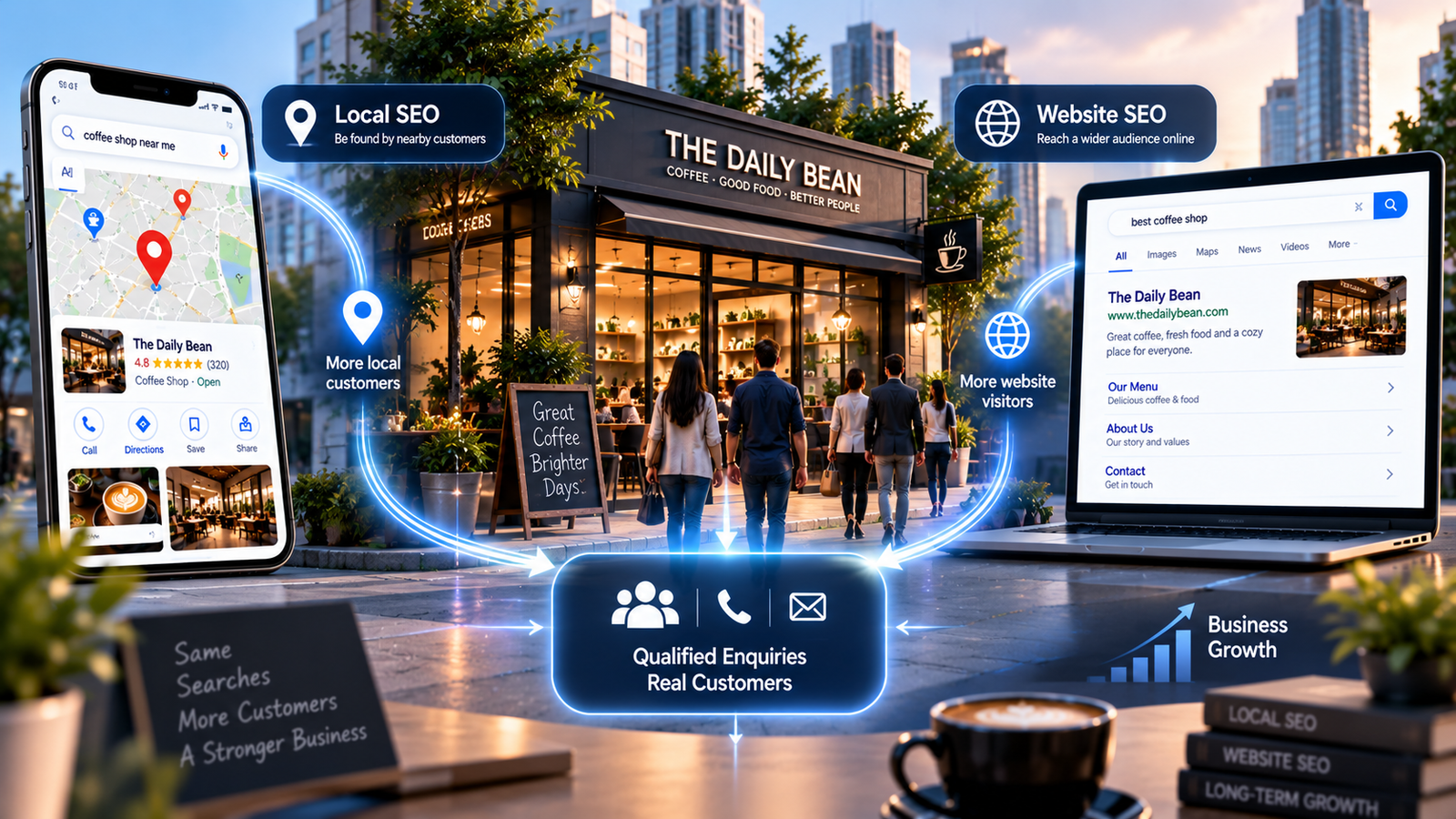
The biggest mistake is treating the two strategies as competitors.
They are better understood as two connected layers.
Local SEO helps answer:
"Which relevant business should appear for this local search?"
Website SEO helps answer:
"Which relevant webpage should appear for this search?"
A local business often needs both answers.
Your Business Profile can help Google understand:
Who you are
What you offer
Where you operate
Your website can provide deeper information about:
Services
Topics
Locations
Expertise
Products
Customer questions
Google also sources business information from multiple places, including publicly available web content, third-party data and user contributions.
That makes consistency across your digital presence important.
A Practical SEO Strategy for Local Businesses
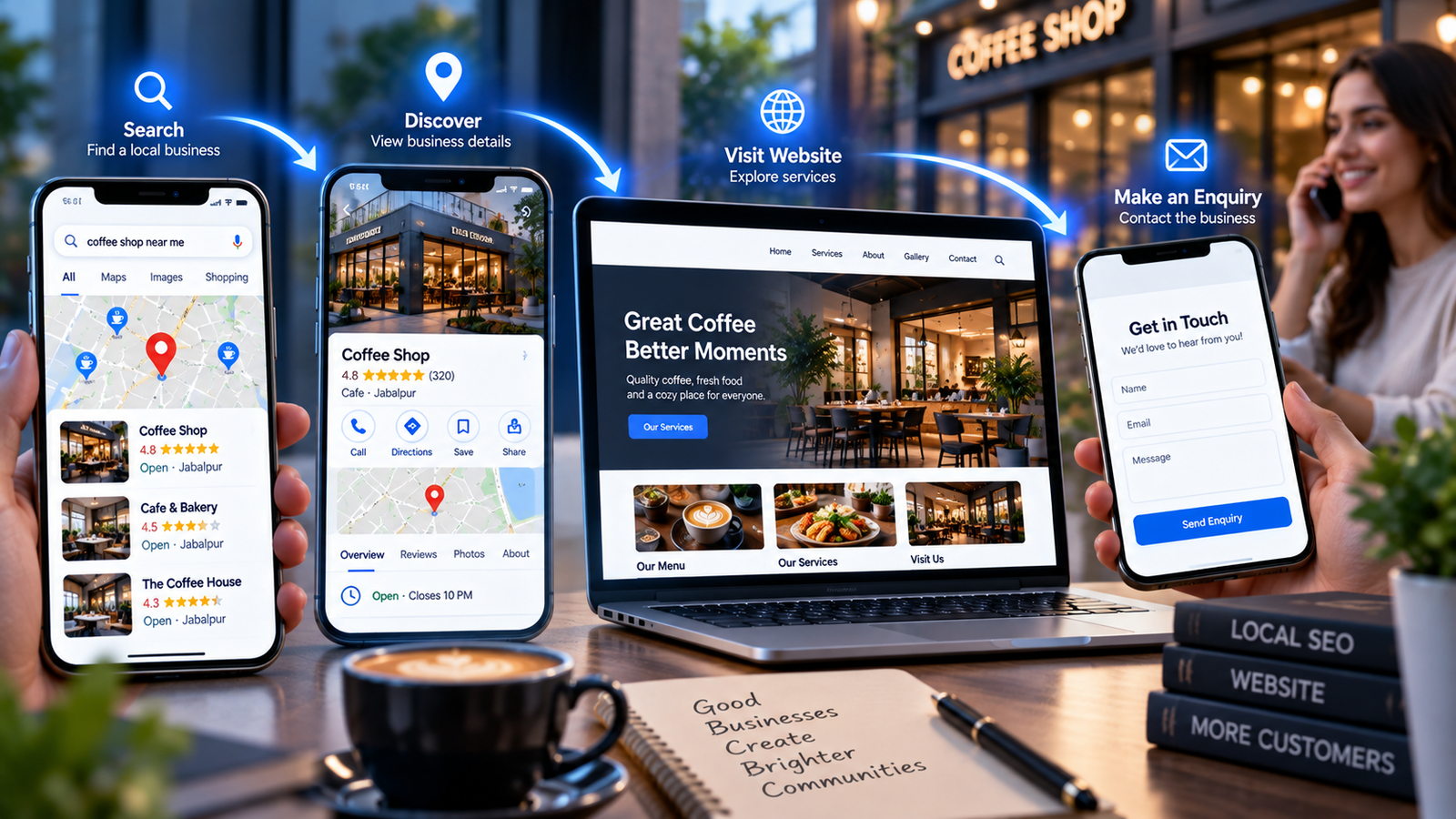
If you are a local business, start with this order.
1. Fix your Google Business Profile
Make sure your core business information is accurate and complete.
2. Make your website technically sound
Ensure important pages can be crawled, indexed and accessed properly.
3. Build strong service pages
Each important service should have a useful page rather than being buried on one generic services page.
4. Make location relevance clear
If geography matters to your business, clearly explain the areas you genuinely serve.
5. Build useful local content
Answer questions that customers in your market actually ask.
6. Develop a genuine review process
Encourage real customers to leave honest feedback and respond appropriately.
7. Build relevant local authority
Look for legitimate industry, community and local opportunities rather than low-quality directory spam.
8. Track both local and organic performance
Do not judge the entire SEO strategy using only one ranking position.
Google Business Profile performance can provide data about how customers discover and interact with the profile through Search and Maps.
What Should You Measure?
Your SEO reporting should match your business goals.
For Local SEO
Track metrics such as:
Local search visibility
Business Profile views
Search queries
Website clicks
Calls
Direction-related actions where available
Leads
Reviews
Local organic traffic
For Website SEO
Track:
Organic clicks
Impressions
Relevant keyword visibility
Organic landing pages
Leads
Conversions
Engagement
Indexed pages
Technical health
Revenue where measurable
The important word is relevant.
Ranking for a large-volume keyword that never produces customers may be less valuable than ranking for a smaller search that consistently generates qualified leads.
Common Mistakes Businesses Make
Mistake 1: Treating Local SEO as only Google Business Profile optimization
Your Business Profile is important, but local visibility can involve your website and broader web presence too.
Mistake 2: Ignoring the website because the Business Profile is ranking
A local customer may still visit the website before contacting you.
Mistake 3: Creating dozens of thin city pages
Changing only the city name does not create useful local content.
Mistake 4: Focusing only on rankings
The real goal is usually qualified customers, not an impressive screenshot of a ranking position.
Mistake 5: Using the same strategy for every business
A restaurant, SaaS company, dentist and national e-commerce store do not have the same search journey.
Mistake 6: Ignoring technical SEO
Local intent does not eliminate the need for a technically healthy website.
Mistake 7: Stuffing city names everywhere
Repeatedly adding city names to titles, paragraphs or Business Profile content does not create a better user experience.
Local relevance should be genuine and useful.
How Much Should You Spend on Local SEO vs Website SEO?
There is no universal percentage that every business should follow.
The right allocation depends on:
Business model
Service area
Competition
Current visibility
Website condition
Number of locations
Customer acquisition channels
Revenue per customer
Existing authority
Growth goals
A local dentist may reasonably invest heavily in Local SEO.
A national SaaS company may invest primarily in website SEO.
A multi-location healthcare company may need a combination of both.
The correct budget follows the customer acquisition opportunity, not the label of the SEO service.
A Simple Decision Tree
Ask yourself these five questions:
Question 1: Do customers need to find you in a specific geographic area?
Yes: Local SEO matters.
Question 2: Do customers search for your services without location-specific intent?
Yes: Website SEO matters.
Question 3: Do customers visit your website before contacting you?
Yes: Website SEO and conversion-focused optimization matter.
Question 4: Do you rely on Google Maps or local search discovery?
Yes: Local SEO should be a priority.
Question 5: Do you want customers from outside your immediate location?
Yes: Broader website SEO may become increasingly important.
If you answered "yes" to several of these, you probably need an integrated strategy rather than choosing one side.
The Best Approach for Most Local Service Businesses
For a typical local service business, a practical SEO system looks like this:
Google Business Profile
↓
Local Search Visibility
↓
Website Service Page
↓
Helpful Supporting Content
↓
Trust Signals
↓
Lead / Call / Enquiry
This is much stronger than treating Google Business Profile and the website as separate marketing projects.
Your Business Profile can help people discover you.
Your website can help them understand what you offer.
Your content can answer their questions.
Your reviews and reputation can strengthen trust.
And your conversion-focused pages can make it easier for the visitor to become a customer.
So, What Does Your Business Actually Need?
There is no universal answer.
You probably need Local SEO if:
Your customers are searching for businesses, services or products within a geographic area.
You probably need website SEO if:
Your website needs to attract and convert visitors from organic search.
You probably need both if:
Your local business depends on Google Search, Google Maps and your website to generate leads.
For many local businesses, the most effective strategy is therefore not to ask:
"Should I invest in Local SEO or website SEO?"
Instead, ask:
"How can my Business Profile, website and overall search presence work together to generate more qualified customers?"
That question leads to a much more useful SEO strategy.
Final Thoughts
Local SEO and website SEO overlap, but they are not identical.
Local SEO is primarily about local discovery and geographic relevance.
Website SEO is about making your website more visible and useful across relevant organic searches.
A business with a physical location or defined service area will often need strong Local SEO.
A business competing for broader informational, commercial or national searches will usually need stronger website SEO.
And when a local business wants sustainable organic visibility, the strongest answer is often both.
Google's own guidance makes the relationship clear: local results consider relevance, distance and prominence, while Google's broader Search systems evaluate many factors to determine which information is most useful for a particular query.
The goal is not to choose the SEO label that sounds better.
The goal is to build the search visibility your customers actually need.
Need to find out which SEO strategy fits your business?
If you are unsure whether your biggest opportunity is Local SEO, technical improvements, content, broader website SEO or a combination of these, start with an SEO audit to identify the actual gaps before investing blindly.
If you need broader support, evaluate your business requirements against the available SEO services rather than choosing a package based only on rankings or keyword counts.
FAQ
1. Is Local SEO the same as website SEO?
No. Local SEO focuses heavily on geographic search visibility and local customers, while website SEO covers the broader optimization of a website for organic search. They overlap in areas such as technical SEO, content and website optimization.
2. Is Local SEO only for businesses with a physical store?
Not necessarily. Eligible service-area businesses can also have local search needs. Google's Business Profile guidance includes businesses that meet customers in a local service area.
3. Do I need a website for Local SEO?
A business can have local visibility through its Business Profile, but a strong website can provide deeper service information, support organic visibility and help convert visitors into customers.
4. Which is better: Local SEO or website SEO?
Neither is universally better. The right choice depends on how customers search for your business. Local businesses often benefit from both.
5. Does Google Business Profile replace SEO?
No. A Business Profile supports local visibility on Google Search and Maps, while website SEO helps individual website pages compete for relevant organic searches.
6. Can a local business rank without doing website SEO?
It can appear in local results, but ignoring the website can limit opportunities to rank for service-specific and informational searches and can weaken the experience after a customer visits the site.
7. Are reviews part of Local SEO?
Reviews are relevant to local visibility and customer trust. Google states that review count and review score can contribute to local ranking.
8. Does location affect local rankings?
Yes. Google states that distance is one of the main factors used in local ranking, alongside relevance and prominence.
9. Should I create a separate page for every city I want to target?
Only when the location represents a genuine business market and the page can provide useful, distinct information. Creating large numbers of near-identical location pages purely to target city keywords is not a good substitute for useful local content.
10. How do I know whether my business needs Local SEO or website SEO?
Look at where your customers come from and how they search. If customers primarily search for nearby businesses or services, Local SEO should be important. If they search broader topics, products or services through organic results, website SEO may be the bigger opportunity. Many businesses need both.