
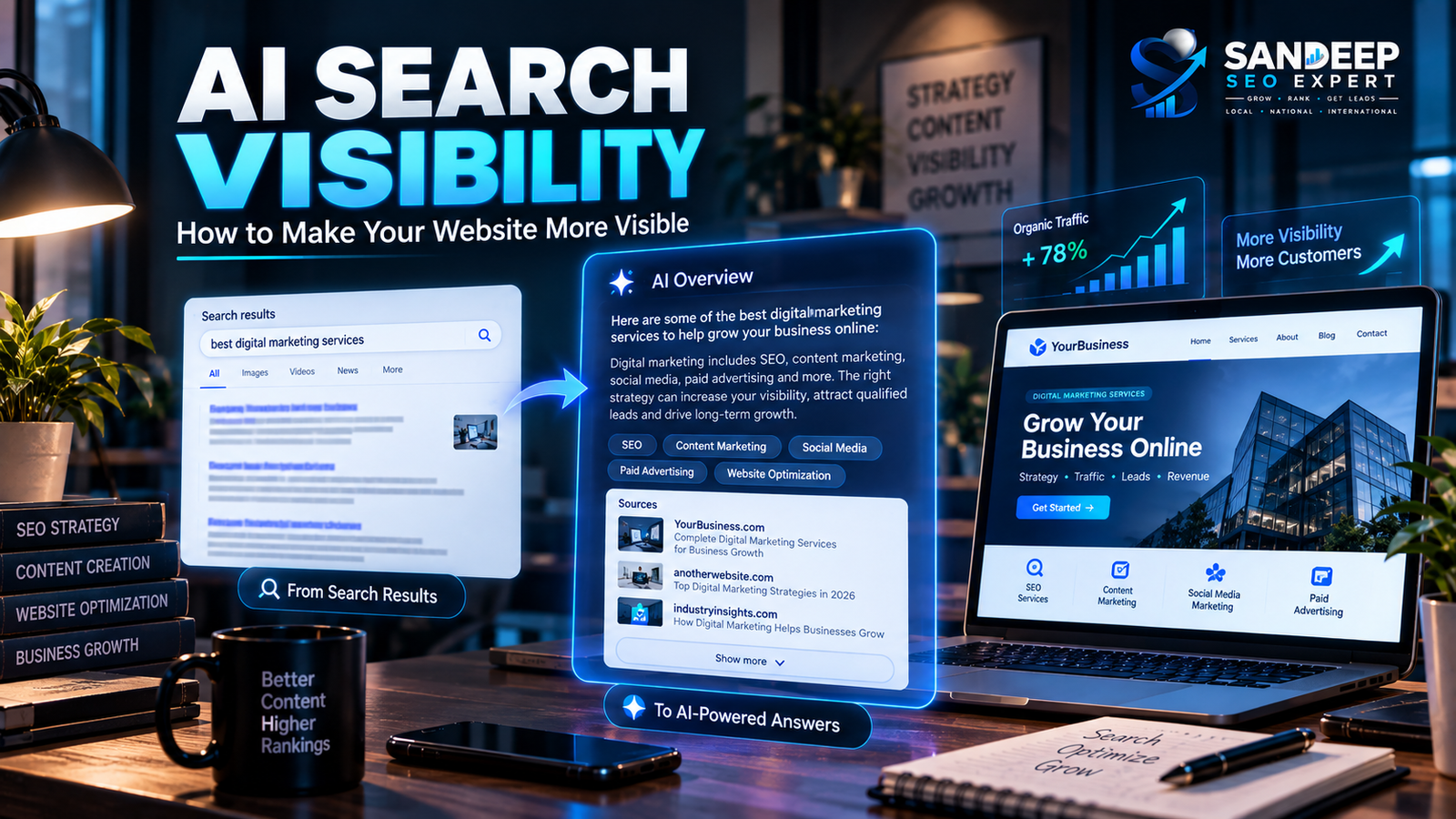
Search is changing. People are no longer relying only on a list of blue links to find information, compare businesses or decide what to buy. Google now uses AI Overviews and AI Mode, Microsoft is expanding AI answers through Bing and Copilot, and ChatGPT can search the web and cite websites in its responses.
For businesses, this creates a new visibility challenge.
It is no longer enough to ask, “Does my website rank on Google?”
A better question is:
Can search engines and AI systems discover, understand, trust and reference my website when someone asks a relevant question?
That does not mean traditional SEO has become irrelevant. In fact, the opposite is true. Google says its generative AI search experiences are built on its existing Search ranking and quality systems, while Bing says the same crawling, indexing, content clarity and authority foundations support both traditional search and AI-powered experiences.
The opportunity is to build a website that is genuinely useful to people and easy for search systems to understand.
This guide explains how to do that.
Quick Answer: How Do You Make a Website More Visible in AI Search?
To improve your chances of being discovered and referenced in AI search results:
Make sure search engines and relevant AI crawlers can access your important pages.
Keep important pages indexable and technically sound.
Create original content that adds information, experience or analysis rather than rewriting what everyone else has published.
Answer real customer questions completely instead of targeting isolated keywords.
Build strong topical coverage around the subjects your business actually serves.
Use clear headings, descriptive page titles and logical internal links.
Support important claims with evidence, examples, data or first-hand experience.
Keep business information consistent across your website and relevant platforms.
Use structured data where it genuinely applies, but do not treat schema as an AI-search shortcut.
Improve your Local SEO, Google Business Profile and other business information where local visibility matters.
Add useful images, videos and other supporting formats when they improve understanding.
Monitor AI-search visibility and citations where reporting tools are available.
Focus on qualified visitors, enquiries and conversions rather than chasing AI mentions alone.
The goal is not to “write for AI.”
The goal is to create a website that is so clear, useful, trustworthy and well-structured that both people and search systems can understand its value.
What Is AI Search Visibility?
Traditional search generally presents a set of results that a user can open and evaluate.
AI search can work differently.
Instead of simply returning ten links, an AI-powered search experience may interpret the question, retrieve information from multiple sources, generate an answer and provide links to websites that support or expand that answer.
Google's AI Overviews and AI Mode are examples of this approach. Microsoft also reports AI citations across Bing AI-generated summaries and Copilot. ChatGPT Search can likewise surface and link to public websites.
That changes what “visibility” can mean.
A website may be visible when:
Its page appears as a traditional organic result.
Its content is referenced in an AI-generated answer.
A page is cited as a source.
A business is mentioned in a locally relevant AI answer.
A product or service page is used as supporting information.
A website becomes part of the research journey even when the user does not initially search using the exact wording found on the page.
This is why AI search visibility should not be treated as a replacement for SEO.
It is better understood as an extension of search visibility.
AI Search Does Not Create a Separate SEO Universe
One of the biggest mistakes businesses make is assuming that they need an entirely new form of SEO for AI search.
Google's current documentation is much more straightforward.
For AI Overviews and AI Mode, Google says there are no additional technical requirements beyond the normal requirements for Search. A page needs to be indexed and eligible to appear in Google Search with a snippet. Existing SEO fundamentals such as crawlability, indexing, internal links, useful content and page experience remain relevant.
Google's 2026 guidance also specifically warns against over-focusing on so-called AI optimization hacks.
That matters because there is a lot of confusion around terms such as:
GEO
AEO
AI SEO
LLM SEO
Generative Engine Optimization
AI content optimization
These terms can be useful for describing a changing search environment, but they should not be treated as a secret ranking system.
The fundamentals still matter.
1. Make Sure Search Engines Can Actually Access Your Website
Before improving content, check whether search engines and AI systems can discover the content in the first place.
A page cannot become a useful source if the relevant system cannot access or index it.
Start with the basics:
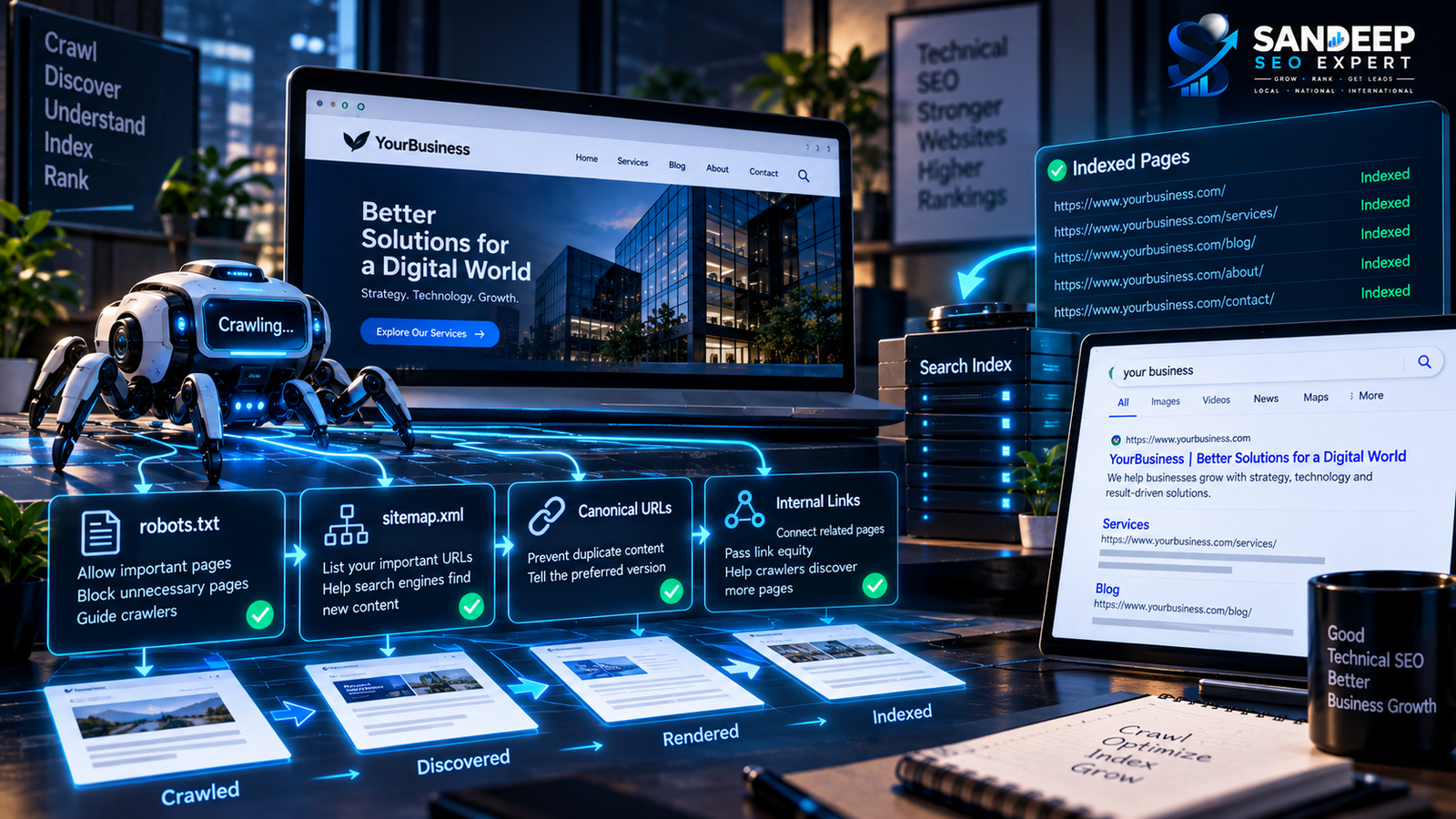
Check robots.txt
Make sure important sections of your website are not accidentally blocked.
A technical mistake in robots.txt can prevent crawlers from accessing pages that you actually want to appear in search.
Check noindex directives
Review important pages for accidental noindex directives.
This is particularly important after:
Website redesigns
Migration from one CMS to another
URL changes
Development-site launches
Plugin configuration changes
Staging-to-production deployments
Check canonical URLs
If several URLs contain similar or duplicate content, make sure the canonical version is clear.
This helps search engines understand which URL represents the primary page.
Check internal links
Important pages should be discoverable through normal crawlable links.
A page that exists but is effectively isolated from the rest of the website is harder for search systems to understand in context.
Check indexing
Use Google Search Console to determine whether important pages are indexed and whether there are technical problems preventing them from appearing in Search.
If technical problems are affecting your website, a proper technical SEO strategy should address the underlying issue rather than simply adding more content.
Is Your Website Ready for AI Search?
AI-search visibility starts with strong technical foundations, useful content and a website that search systems can properly discover and understand. Find the issues that may be limiting your organic visibility before chasing AI-search tactics.
Get Your SEO Audit →2. Create Content That Adds Something New
This is one of the most important areas for AI search visibility.
AI systems can summarize information that already exists across hundreds of websites.
So why would your page deserve to be referenced?
Because it provides something useful that is not merely a generic rewrite.
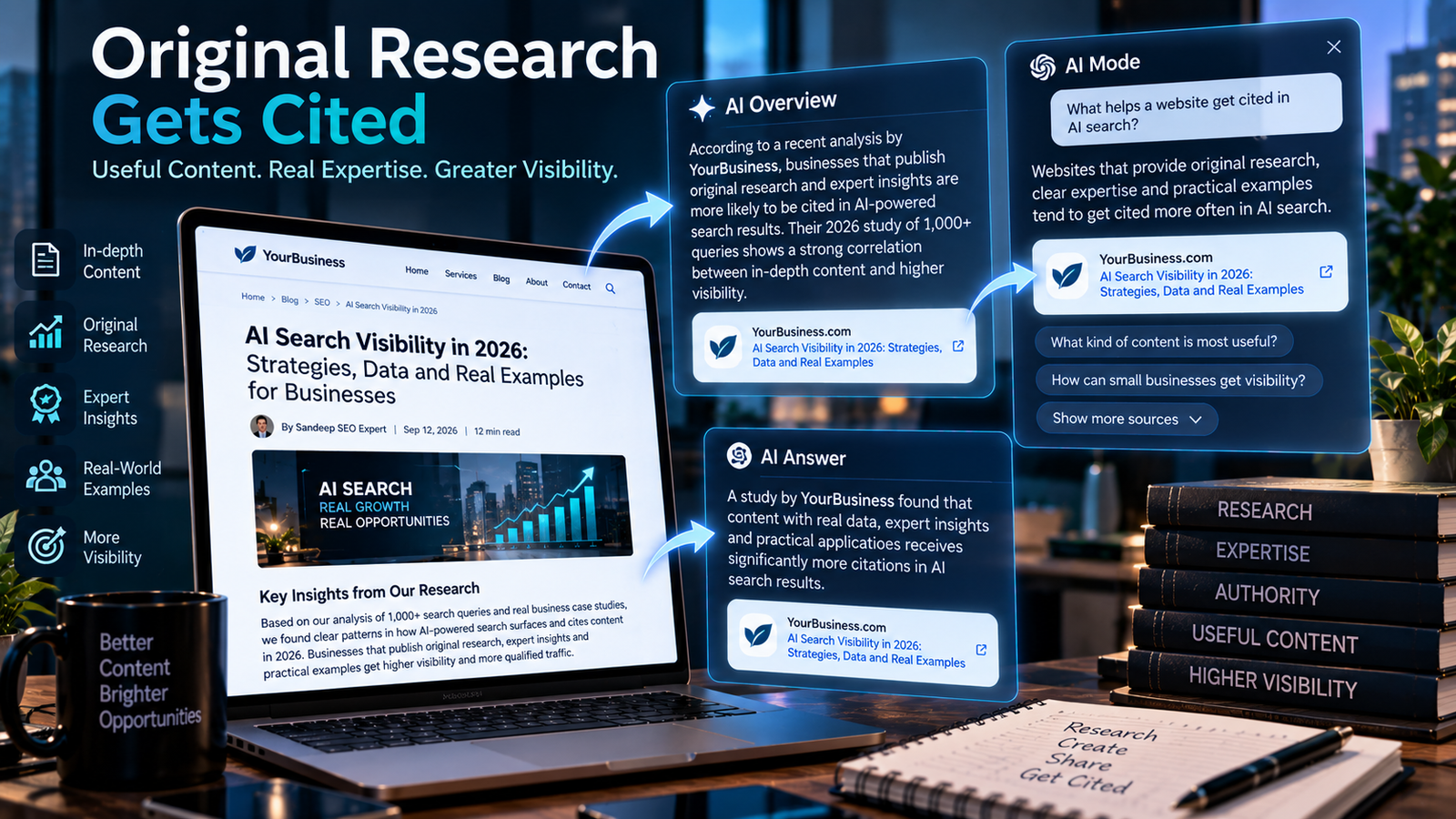
Google's current generative AI guidance emphasizes valuable, unique and non-commodity content. It specifically encourages original viewpoints and first-hand experience rather than simply recycling information already available elsewhere.
For example, imagine you are writing about:
“How much does SEO cost for a small business?”
A weak article may simply list:
Basic SEO: ₹10,000
Standard SEO: ₹20,000
Premium SEO: ₹50,000
That information is easy to reproduce.
A stronger article could explain:
What changes the price
How competition affects the scope
Why technical problems increase workload
What local businesses actually need
What an SEO audit includes
Which deliverables matter
How to evaluate a monthly package
What cheap SEO often leaves out
How to measure whether the investment is producing business value
The second article gives the reader something to understand and evaluate.
That is much harder to replace with a generic AI-generated summary.
3. Show First-Hand Experience Wherever It Is Relevant
One of the strongest ways to differentiate your content is to include genuine experience.
Instead of only explaining what SEO is, show how the work is actually done.
For example:
A website can have hundreds of indexed pages and still struggle to generate organic leads because the pages are targeting the wrong intent.
Then explain how that situation was diagnosed.
You can include:
Real examples
Screenshots where appropriate
Before-and-after observations
Original analysis
Practical workflows
Common implementation problems
Industry-specific considerations
Lessons learned from projects
Data from your own website
Experiments and their limitations
This gives the content a point of view.
It also prevents the website from becoming another collection of generic articles that could have been written for any company in any industry.
4. Stop Creating Pages for Every Tiny Keyword Variation
AI search has made this strategy even less useful.
Suppose you want to rank for:
SEO company in Jabalpur
SEO agency in Jabalpur
SEO services in Jabalpur
SEO consultant in Jabalpur
SEO expert in Jabalpur
Creating five nearly identical pages just to target each phrase does not automatically create more visibility.
The better approach depends on search intent and the actual differences between the pages.
A page can naturally cover several related searches when the underlying intent is the same.
Google's current AI optimization guidance also warns against creating large numbers of pages primarily to manipulate rankings or AI responses.
The question should not be:
“How many AI-search pages can we publish?”
It should be:
“Which pages genuinely deserve to exist?”
5. Build Topic Depth Instead of Isolated Blog Posts
AI search often involves complex questions.
A user may begin with:
What is SEO?
Then continue with:
How much does it cost?
Then:
Does SEO work for local businesses?
Then:
How long does it take?
Then:
Should I hire an SEO agency?
Your website becomes more useful when these subjects are connected.
Instead of publishing unrelated blog posts, build topical relationships.
For example, an SEO website could have:
Core service page
SEO Services
Supporting topics
Technical SEO
Local SEO
Google Business Profile SEO
E-commerce SEO
SEO audits
SEO pricing
Keyword research
Content strategy
Google algorithm updates
AI Search and SEO
Then connect these pages naturally.
This creates a stronger information architecture and helps users move from learning to evaluating a service.
6. Use Internal Links to Explain Relationships Between Topics
Internal linking is important for both users and search systems.
But internal links should not be added simply because a keyword appears on the page.
They should help answer the next logical question.
For example:
If your website has crawling, indexing or JavaScript problems, a technical SEO service can help identify and resolve those issues.
That link makes sense because the reader has just encountered a technical problem.
Similarly:
Businesses that depend on location-based searches should consider how their website and Google Business Profile optimization work together.
Again, the link has context.
A good internal linking structure helps create a path:
Information → deeper understanding → problem diagnosis → service → enquiry
For a larger website, an SEO audit can also help identify broken internal links, weak page relationships, indexing issues and other structural problems.
7. Write for Questions, Not Just Keywords
Traditional keyword research is still useful.
But the way people interact with AI search means businesses should think beyond exact-match phrases.
Instead of only asking:
What keyword has search volume?
Ask:
What does the customer actually need to know before taking action?
For example, a person searching for “best CRM for small business” may actually want answers to:
Which CRM is easy to use?
How much does it cost?
Does it integrate with WhatsApp?
Can a small sales team use it?
What are the limitations?
Which industries is it suitable for?
How difficult is migration?
Your content should address the decision behind the search.
This creates stronger coverage than repeatedly inserting the same keyword into headings.
8. Give Clear Answers Early, Then Add Depth
Long-form content does not mean hiding the answer until the tenth paragraph.
A strong page should make the main answer easy to find.
A useful structure is:
Direct answer → explanation → evidence → examples → practical steps → deeper details
For example:
Does SEO still matter for AI search?
Yes.
Google's AI search features use existing Search ranking and quality systems, so technical SEO, crawlability, indexing, useful content, internal links and other established SEO practices remain important.
Then explain the details.
This structure helps readers who want a quick answer while still giving serious readers enough depth.
9. Make Important Information Easy to Extract
AI systems need to understand the meaning of a page.
That does not mean breaking every paragraph into tiny pieces.
Google explicitly says there is no requirement to divide content into small “chunks” for AI systems, and there is no ideal page length specifically for generative AI search.
Instead, use sensible organization.
For example:
Descriptive H2 and H3 headings
Short, meaningful paragraphs
Tables when comparison genuinely helps
Lists for list-based information
Definitions where terminology may be unclear
Examples
Relevant statistics
Clear explanations
FAQs where they genuinely answer common questions
The objective is readability, not formatting for a machine.
10. Support Claims With Evidence
Trust becomes particularly important when AI systems are selecting sources to support an answer.
If you make a factual claim, ask whether you can support it.
Depending on the subject, that could mean:
Linking to official documentation
Citing original research
Referencing government data
Providing your methodology
Showing calculations
Explaining the source of statistics
Adding first-hand observations
Clearly distinguishing facts from opinions
For example, saying:
“Google changed its AI Search system.”
is vague.
A stronger article can explain what changed, when it changed, what Google officially documented and what remains uncertain.
This is especially important for SEO topics, where outdated claims spread quickly.
11. Keep Your Website Information Consistent
AI search is not limited to blog content.
For businesses, information about the company itself can matter.
Review your:
Business name
Address
Phone number
Service areas
Opening hours
Services
Product information
Company description
Author information
Contact details
About page
Google Business Profile
Relevant third-party business listings
If your website says one thing and your business profiles say something completely different, users can become confused.
For local businesses, maintaining an accurate Local SEO strategy is therefore part of broader AI-search readiness.
12. Local Businesses Need More Than Blog Content
Suppose someone asks an AI system:
“Which IVF centres offer fertility treatment in my city?”
Or:
“Which builders provide residential construction services near me?”
The answer may depend on much more than a blog post.
Local businesses should pay attention to:
Google Business Profile
Business category
Location information
Services
Reviews
Website service pages
Local relevance
Consistent business information
Location-specific content
Customer experience
Local authority
Your website and business profile should tell the same basic story.
For businesses that depend heavily on local enquiries, Google Business Profile optimization should therefore be treated as part of the wider search strategy rather than as an isolated task.
Your SEO Strategy Should Evolve With Search
AI Search is changing how people discover information, but strong technical SEO, useful content, local visibility and a clear website structure still form the foundation. Build the strategy around your business instead of chasing individual AI-search tricks.
Explore SEO Services →13. Do Not Ignore Product and Service Pages
Many companies invest heavily in blogs but neglect their commercial pages.
That is a mistake.
If an AI system needs to recommend a product or service, the supporting page needs to clearly explain what is actually being offered.
A good service page should communicate:
What the service is
Who it is for
Problems it solves
What is included
How the process works
What makes the service different
Important limitations
Relevant proof or experience
FAQs
How to enquire
For e-commerce websites, product pages should provide useful information about:
Product specifications
Ingredients or materials
Usage
Variants
Availability
Pricing
Shipping
Returns
FAQs
Original images
Relevant product information
Do not expect a generic blog post to replace a strong commercial page.
14. Use Structured Data Correctly, But Don't Treat It as an AI Shortcut
Structured data can help search engines understand a page and can make eligible pages available for certain rich-result features.
But there is an important distinction.
There is no special schema that guarantees inclusion in AI Overviews or AI Mode.
Google's current documentation specifically says there is no special schema.org markup required for generative AI search.
So use structured data where it genuinely applies.
Make sure:
The markup matches the visible page content.
It follows Google's guidelines.
It describes the actual page.
It is kept accurate when the page changes.
Do not add irrelevant schema simply because someone claims it is an “AI ranking trick.”
15. Don't Build Your Strategy Around llms.txt
llms.txt has received a lot of attention in SEO discussions.
But businesses should be careful about treating it as a requirement for Google AI Search.
Google's current AI optimization documentation says that maintaining llms.txt or similar files is optional for other services, but Google Search ignores them.
That means creating an llms.txt file is not a substitute for:
Crawlability
Indexing
Good content
Internal links
Technical SEO
Clear information architecture
Authority
User experience
If someone tells you that an llms.txt file is the secret to getting cited by Google AI Search, treat that claim cautiously.
16. Make Your Content Useful Beyond a Search Result
AI search can answer many basic questions without requiring the user to visit a website.
That means your website needs to offer a reason to continue the journey.
Think about what the visitor gets after clicking.
It could be:
Original research
A detailed comparison
A calculator
A downloadable resource
A product demonstration
A case study
A practical checklist
An expert explanation
First-hand experience
Examples
Tools
A consultation
A product or service
The website should not simply repeat the AI-generated answer.
It should give the user something more useful.
17. Improve Page Experience
A page can contain excellent information and still provide a poor experience.
Review:
Mobile usability
Page speed
Layout stability
Navigation
Readability
Intrusive pop-ups
Advertising
Font size
Content hierarchy
Accessibility
Visual clarity
Google has repeatedly emphasized the importance of providing a good page experience for people arriving from both traditional and AI-powered search.
The purpose is not to make a page “look optimized for AI.”
It is to make the page easier for a real person to use.
18. Use Images and Video When They Add Information
AI search is becoming increasingly multimodal.
People can search using images, files and other forms of input, while AI-powered search experiences can connect users with visual and video content.
That makes useful multimedia increasingly important.
But don't add images just to make a page longer.
A useful image could:
Demonstrate a product
Show a process
Explain a complex concept
Provide original evidence
Help compare options
Show a real location
Demonstrate a result
Support a tutorial
For important images, use accurate:
File names
Alt text
Captions where useful
Surrounding text
The image should reinforce the information on the page rather than replace it.
19. Make Your Authors and Business Identity Clear
For many subjects, readers want to know who is behind the information.
This is particularly important for:
Healthcare
Finance
Legal topics
Technology
Professional services
Product reviews
Industry analysis
A strong website can make expertise easier to understand through:
Author bios
Relevant credentials
Business information
Editorial policies
About pages
Original research
Case studies
First-hand experience
Do not invent expertise.
If a person has relevant experience, explain it accurately.
If a statistic comes from another organization, identify the source.
Transparency is more useful than manufactured authority.
20. Build Authority Outside Your Own Website
AI search does not necessarily understand your business by reading only one page.
The wider web can contribute to how a company, product, person or organization is understood.
Relevant signals may include:
Industry publications
Reputable directories
Business profiles
Editorial mentions
Reviews
Interviews
Partnerships
Original research
Community discussions
Genuine references from relevant websites
But there is an important distinction between earning legitimate visibility and manufacturing mentions.
Do not create hundreds of low-quality profiles simply because you heard AI systems “look for mentions.”
Do not buy fake references.
Do not create artificial discussions.
The quality and relevance of the source matter.
Your SEO Strategy Should Evolve With Search
AI Search is changing how people discover information, but strong technical SEO, useful content, local visibility and a clear website structure still form the foundation. Build the strategy around your business instead of chasing individual AI-search tricks.
Explore SEO Services →21. Keep Content Fresh When the Topic Requires It
Not every article needs monthly updates.
But information that changes frequently should not be treated as permanent.
Examples include:
SEO updates
Pricing
Software features
Product specifications
Government rules
Search guidelines
Platform policies
Statistics
Technology comparisons
When updating an article, don't just change the publication date.
Review the actual information.
Remove outdated claims.
Update statistics.
Check links.
Add meaningful new information.
Explain major changes where relevant.
Bing's AI Performance guidance also highlights freshness and accuracy as useful considerations when improving content that appears in AI-generated answers.
22. Measure AI Search Visibility Properly
This is where the conversation becomes much more practical.
Do not measure AI search only by asking:
“Did ChatGPT mention my company?”
AI responses can vary based on:
Query
Location
User context
Time
Search engine
Model
Available sources
Freshness
Personalization
A single manual search is not a reliable SEO measurement system.
Fortunately, measurement is becoming more sophisticated.
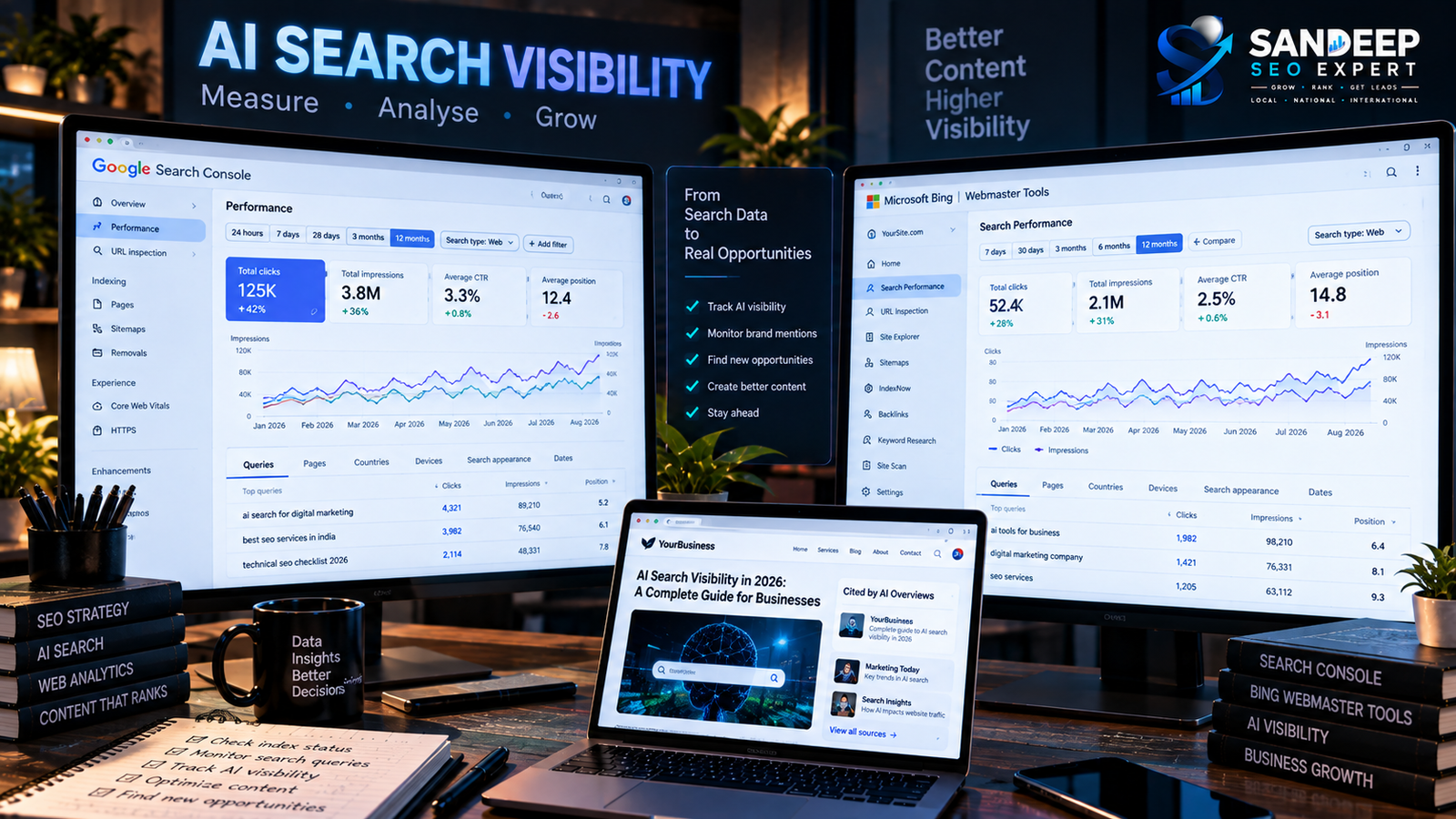
Google Search Console
Google introduced a dedicated Generative AI performance view in Search Console in June 2026. Google says the reporting includes visibility within generative AI features such as AI Overviews and AI Mode, with information including impressions, pages, countries, devices and dates. The rollout reached all websites worldwide by August 31, 2026.
This makes AI-search visibility much easier to study using first-party search data.
Bing Webmaster Tools
Microsoft's AI Performance report provides information about how website content is cited across supported AI experiences such as Microsoft Copilot and AI-generated summaries in Bing.
It can show:
Total citations
Cited pages
Grounding queries
Page-level citation activity
Visibility trends
This is particularly useful because it moves the discussion away from theoretical GEO tactics toward observable citation data.
23. Don't Confuse AI Citations With Traffic or Rankings
A citation is not the same thing as a visitor.
Bing explicitly notes that its AI Performance citation metrics do not represent clicks, traffic, authority or ranking position.
Similarly, a website appearing in an AI answer does not automatically mean that the user will visit the site.
That is why your measurement framework should include several layers:
Visibility
Organic impressions
AI-search impressions
AI citations
Search appearances
Engagement
Organic clicks
Engaged sessions
Time spent
Returning visitors
Business outcomes
Leads
Calls
Form submissions
Purchases
Bookings
Qualified enquiries
The final goal is not simply to collect AI mentions.
It is to build visibility that contributes to the business.
24. Create Content Around Real Customer Journeys
One of the strongest ways to prepare for AI search is to map content to the questions customers actually ask before making a decision.
For a service business, that could look like:
Problem
Why is my website traffic falling?
↓
Understanding
What causes an organic traffic drop?
↓
Diagnosis
How do I find the SEO problems?
↓
Evaluation
Do I need technical SEO or content improvements?
↓
Commercial research
How much does SEO cost?
↓
Decision
How do I choose an SEO provider?
↓
Action
Request an SEO audit or consultation.
This is much stronger than publishing 50 unrelated articles simply because 50 keywords have search volume.
25. What You Should Stop Doing for AI Search
The AI-search conversation has created a market for shortcuts.
Be careful with strategies built around claims such as:
“Add this special AI schema and get cited.”
“Publish 100 AI articles every month.”
“Create a separate page for every possible question.”
“Add an llms.txt file and Google will understand your website.”
“Put the answer in exactly 40 words.”
“Mention your brand 50 times.”
“Get thousands of AI mentions.”
“Use this secret GEO prompt.”
“There is a guaranteed method to appear in AI Overviews.”
There is no reliable formula like that.
Google's own 2026 guidance specifically pushes website owners back toward unique, useful, people-first content and established SEO fundamentals.
That is a much more sustainable approach.
26. A Practical AI Search Optimization Framework
If you want a practical process, use this framework.
Step 1: Audit technical accessibility
Check:
Crawlability
Indexing
Robots.txt
Noindex
Canonicals
Sitemaps
Status codes
Internal links
JavaScript rendering
Mobile experience
Step 2: Identify your important pages
Separate:
Service pages
Product pages
Category pages
Location pages
Educational resources
Supporting blog content
Not every page deserves equal attention.
Step 3: Map customer questions
Research the questions people ask before:
Understanding the problem
Comparing solutions
Choosing a provider
Buying a product
Contacting a business
Step 4: Improve content quality
For every important page, ask:
Is the information accurate?
Is it original?
Does it provide useful detail?
Does it answer the actual intent?
Is there first-hand experience?
Are claims supported?
Is anything important missing?
Step 5: Improve information architecture
Connect related pages using meaningful internal links.
Build clear relationships between:
Services
Products
Categories
Guides
FAQs
Location pages
Step 6: Strengthen trust
Add relevant:
Author information
Business details
Sources
Evidence
Case studies
Reviews
Original research
First-hand experience
Step 7: Improve multimodal content
Where appropriate, add:
Original images
Product photography
Demonstration videos
Charts
Diagrams
Screenshots
Captions
Transcripts
Step 8: Improve local and business information
For local businesses, review the website alongside:
Google Business Profile
Business information
Reviews
Services
Local relevance
Step 9: Measure
Use:
Google Search Console
Google Analytics
Bing Webmaster Tools
CRM data
Lead tracking
Conversion tracking
Step 10: Improve based on evidence
Don't redesign the entire strategy because one AI response didn't mention your website.
Look for patterns.
Which pages receive visibility?
Which topics generate impressions?
Which pages receive citations?
Which queries are associated with your content?
Which pages generate qualified visitors?
That is where useful optimization decisions come from.
27. Does AI Search Mean Traditional SEO Is Dead?
No.
The evidence points in the opposite direction.
Google's generative AI features are connected to its existing Search systems. Bing explicitly states that the same foundations around crawling, indexing, URL consolidation, content clarity and authority support AI experiences.
The interface is changing.
The underlying need for discoverable, understandable and useful information has not disappeared.
In fact, AI search makes the quality of the underlying information more important because AI systems need reliable sources from which to construct answers.
The SEO professional's job is therefore becoming broader.
It is not simply:
“Get this keyword to position #1.”
It increasingly involves:
technical accessibility + useful content + topical relevance + authority + business information + user experience + measurement
28. The Real Goal Is Not to Be Mentioned Everywhere
There is a temptation to think that the ultimate AI SEO objective is:
“Get my brand mentioned by ChatGPT, Gemini and Google AI.”
That is too narrow.
A better goal is to become a credible source for the subjects your business genuinely understands.
If your company sells accounting software, build strong resources around accounting workflows, integrations, pricing, implementation and common customer problems.
If you are a healthcare provider, build accurate service information, patient education and trustworthy business information appropriate to your field.
If you are an e-commerce brand, make product information clear, useful and easy to understand.
If you are a local service business, connect your website content with genuine local relevance and accurate business information.
When the underlying website is strong, AI visibility becomes a consequence you can measure rather than something you have to manufacture.
29. What Should Businesses Do in 2026?
A sensible 2026 strategy is not to abandon SEO and start chasing every new AI-search tactic.
Instead:
Keep the technical foundation strong.
Create content that is genuinely worth referencing.
Build topic depth around real customer needs.
Show experience instead of recycling generic information.
Make important pages easy to discover and understand.
Use internal links to connect related information.
Keep business information accurate.
Use structured data where it genuinely applies.
Strengthen local and commercial pages, not only blogs.
Measure AI visibility where reliable reporting exists.
Focus on leads, sales and qualified traffic rather than vanity metrics.
This approach can support both traditional organic search and the newer AI-powered search experiences.
Final Thoughts
AI search is changing how people discover websites, but it has not changed the basic reason a website becomes valuable.
A page needs to provide something worth finding.
Google's current guidance makes this clear: there is no separate technical formula that guarantees inclusion in AI Overviews or AI Mode. Existing SEO foundations still matter, while valuable, original and non-commodity content has an important role in generative AI search.
Microsoft is also making AI citation visibility measurable through Bing Webmaster Tools, and ChatGPT Search provides another path through which public websites can be discovered and cited.
The businesses that adapt well will not necessarily be the ones producing the most AI-focused content.
They will be the ones building websites that are technically accessible, genuinely useful, clearly structured, trustworthy and closely aligned with what their customers actually need to know.
That is the foundation of sustainable AI search visibility.
Want to Prepare Your Website for Modern Search?
From technical SEO and content structure to Local SEO and AI-search visibility, your strategy should be based on the actual condition of your website and business goals.
Contact Sandeep SEO Expert →Frequently Asked Questions
1. What is AI search visibility?
AI search visibility refers to how often and how prominently a website's content is discovered, referenced, linked or cited within AI-powered search experiences and generated answers.
2. How can I make my website appear in AI Overviews?
There is no guaranteed method for appearing in AI Overviews. Google says pages need to meet normal Search technical requirements, be indexed and be eligible to appear in Search. Strong SEO fundamentals and useful, original content remain important.
3. Is SEO still important for AI search?
Yes. Google says its generative AI search features are rooted in existing Search ranking and quality systems. Technical SEO, crawlability, indexing, useful content, internal links and other established SEO practices continue to matter.
4. Do I need special schema for AI Search?
No special schema is required specifically for Google's generative AI search features. Structured data can still be useful for eligible Search features when it accurately represents visible page content.
5. Does llms.txt help Google AI Search?
Google's current documentation says that llms.txt and similar files are not required for generative AI search and that Google Search ignores llms.txt.
Should I create separate pages for every AI-search question?
Not necessarily. Creating many pages simply to capture variations of questions can produce thin or repetitive content. Build pages when they serve a genuine user need and provide meaningful value.
6. How do I know whether my website is appearing in AI search?
Google Search Console now provides a Generative AI performance view for visibility in generative AI features such as AI Overviews and AI Mode. Bing Webmaster Tools also provides AI Performance data showing citation activity across supported Bing and Copilot experiences.
7. Does getting cited by an AI system mean I will receive traffic?
No. A citation means your content was referenced or shown as a source. It does not automatically represent a click, visitor, lead or sale.
8. What type of content works well for AI search?
Content that is useful, original, accurate, well-structured and relevant to the user's actual need is a strong foundation. First-hand experience, original analysis, evidence, examples and clear explanations can make a page more valuable than a generic rewrite.
9. Should businesses focus on AI SEO instead of traditional SEO?
AI search should be treated as part of a broader search strategy rather than a replacement for SEO. Strong technical foundations, useful content, internal linking, authority, local visibility and a good user experience continue to support modern search visibility.