
Hiring an SEO agency is easy. Knowing whether you are hiring the right one is much harder. Most agencies can show you a proposal, a keyword list, a monthly report and a few screenshots. None of those things, by themselves, tell you whether the agency has correctly diagnosed your website or whether the proposed work is likely to help your business.
That's why an SEO audit should happen before you commit to a long-term SEO engagement. The audit is not just about finding broken links or checking page speed. It should help answer a much more important question:
What is actually limiting this website's organic growth, and does the agency understand those problems?
Google's current guidance for businesses considering an SEO recommends interviewing potential SEOs, checking references, reviewing the proposed audit, asking how success will be measured, and being cautious about ranking guarantees, secretive practices and unexplained recommendations. Google also specifically recommends giving an SEO read-only Search Console access at the audit stage rather than write access.
This guide gives you a practical 20-point framework you can use before signing an SEO contract.
Why Audit Your Website Before Hiring an SEO Agency?
There is a simple reason. You should not outsource the diagnosis before understanding the problem. Imagine an agency tells you that your website needs:
50 new articles
100 backlinks every month
30 target keywords
technical fixes
local citations
AI search optimization
It may sound like a strategy. But what if the actual problem is that your most important service pages are not properly indexed? Or the website has weak search intent alignment? Or organic traffic is reaching pages that don't generate enquiries? Or the agency is recommending hundreds of links without explaining how those links will be earned?
Without an independent view of the website, it becomes difficult to distinguish a real strategy from a list of activities. A good pre-hiring audit gives you a baseline. It also gives you better questions to ask.
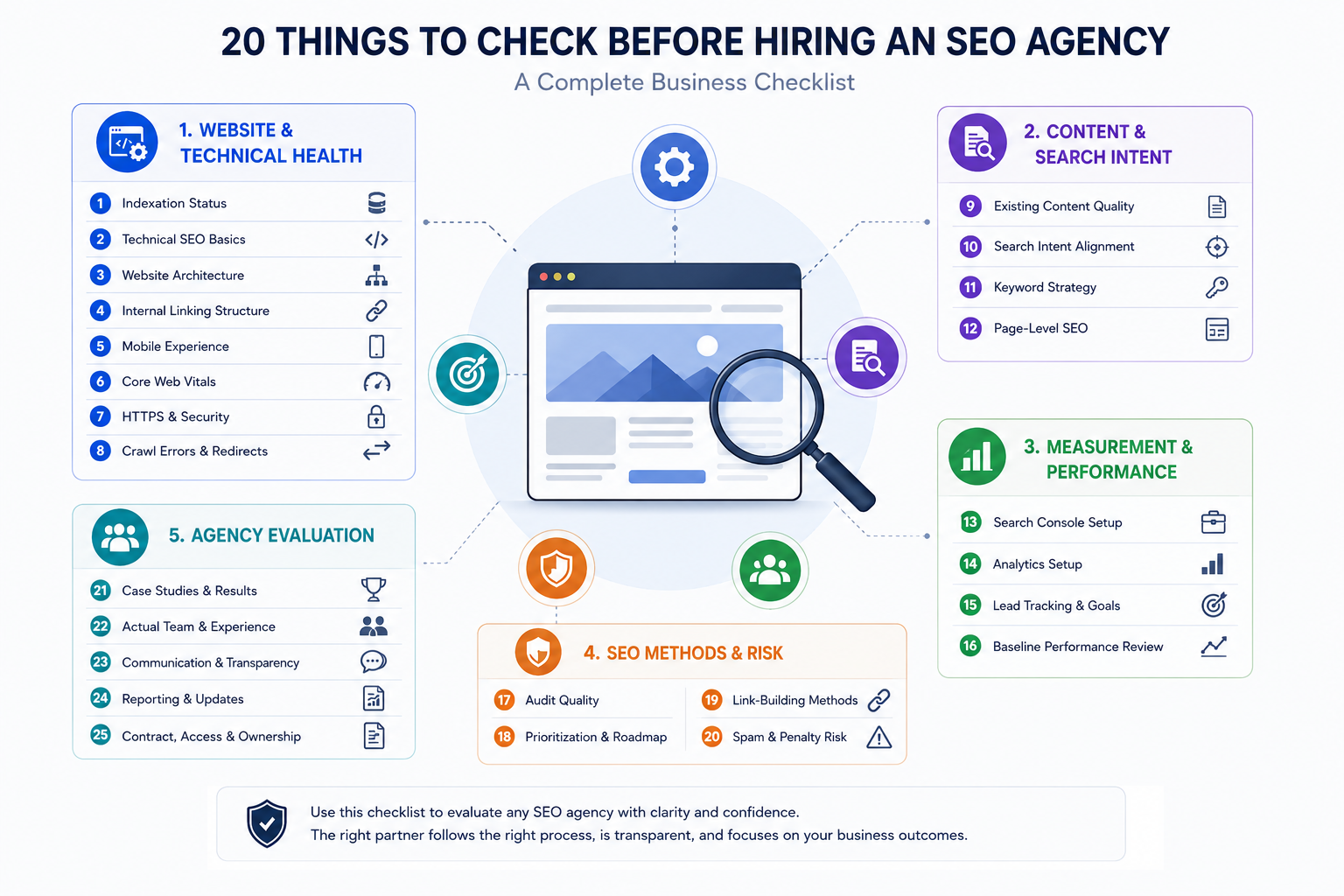
The 20 Things to Check Before Hiring an SEO Agency
1. Check Whether Your Important Pages Are Indexed
Start with the basics. Are the pages that matter to your business actually available in Google's index? Check important:
Service pages
Product pages
Category pages
Location pages
Industry pages
High-value blog posts
Contact and conversion pages where relevant
Google recommends using Search Console to understand how a site is performing and whether Google can index its pages. If an agency talks about improving rankings without first checking indexation, ask why. A page cannot perform organically if search engines cannot properly access and index it.
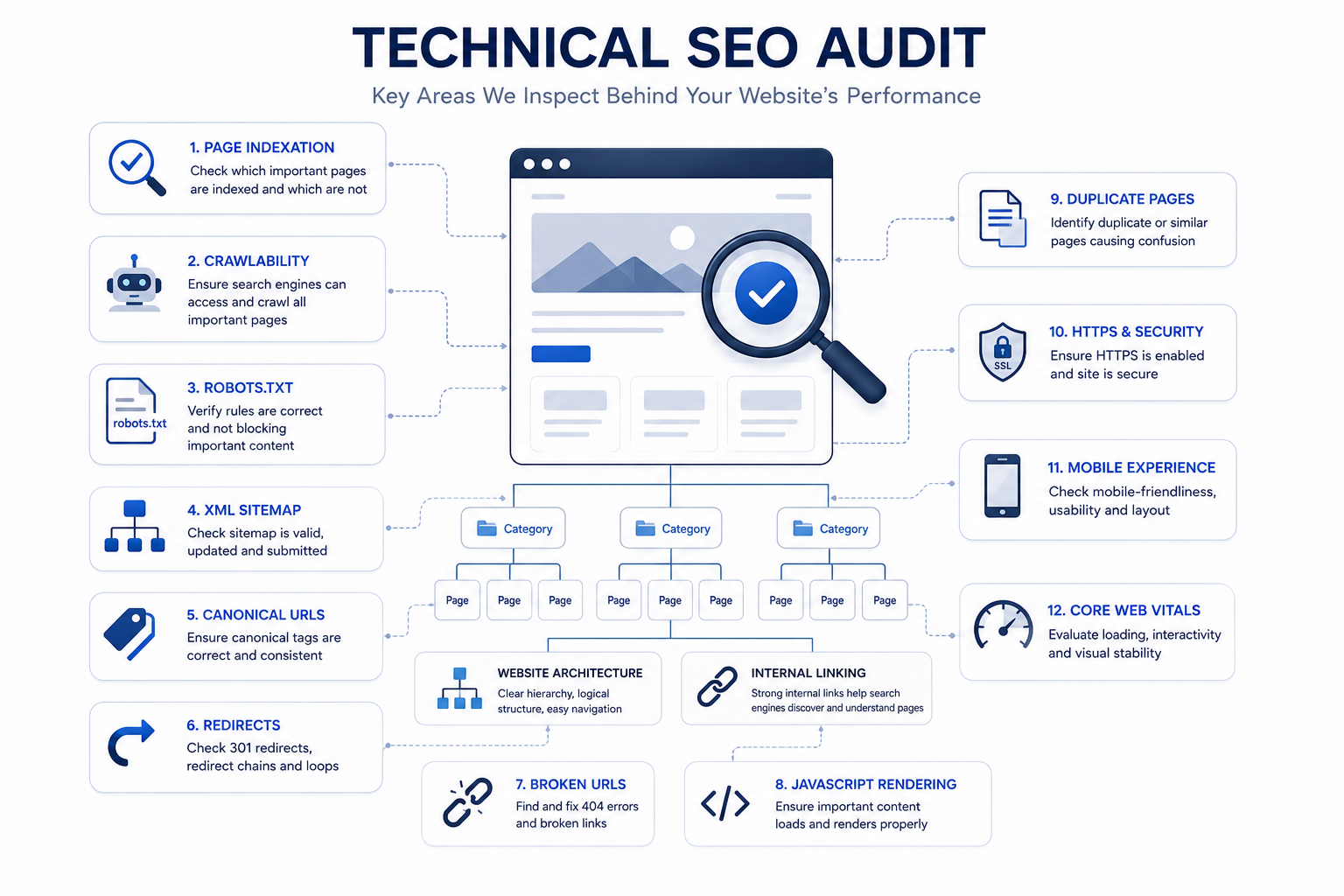
2. Check for Technical SEO Problems
Look beyond a simple site health score. A useful technical audit should investigate issues such as:
Crawlability
Indexation
Robots.txt
XML sitemaps
Canonicalization
Redirects
Broken URLs
Internal links
JavaScript rendering
Duplicate pages
HTTPS
Mobile usability
Page performance
Google's Search Essentials separate technical requirements, spam policies and SEO best practices, so technical health is only one part of the larger picture. This matters when evaluating an agency too. If an agency sends you a 100-page PDF full of technical warnings but cannot explain which issues actually matter to your business, the audit is not very useful.
The quality of prioritization matters more than the number of errors found.
3. Check Your Website Architecture
Look at how the important pages connect. Can a user move logically from:
Homepage → Service → Supporting content → Conversion
Or are important pages buried inside an unstructured collection of URLs? A good website architecture helps users understand the business and gives search engines crawlable paths between related pages. For example, a website offering SEO services might logically connect:
Technical SEO
Local SEO
Google Business Profile SEO
Ecommerce SEO
International SEO
SEO Audits
Supporting articles can then connect to the relevant service pages. The point is not to create a complicated silo for the sake of SEO. The point is to create a website where related information actually belongs together.
4. Check Internal Linking
Internal links are often overlooked because they don't look as impressive as backlink reports. They are still important. Check whether:
Important pages receive relevant internal links
Blog articles link to useful service pages
Related articles connect with each other
Anchor text explains the destination
Important pages are not isolated
Internal links make sense to users
Google's Search Essentials specifically recommends making links crawlable so Google can discover other pages on your site through those links. If an agency promises a major content campaign but cannot explain how the new content will strengthen the existing website structure, ask for more detail.
5. Check Your Existing Content Before Paying for New Content
This is one of the most important checks. An agency should not automatically recommend publishing more content. First ask:
What is already working?
Then:
What is missing?
And finally:
What should be improved, consolidated or removed?
Review:
Existing rankings
Organic traffic
Search queries
Search intent
Content quality
Duplicate topics
Outdated information
Thin pages
Underperforming pages
Pages competing for similar intent
Sometimes improving an existing page is a better investment than publishing another article targeting a slightly different keyword. Google's current guidance emphasizes helpful, reliable, people-first content rather than producing content primarily to attract search traffic.
6. Check Whether Pages Match Search Intent
Ranking a page for the wrong search intent does not necessarily create a useful business result. Suppose you sell SEO services. Someone searching:
What is technical SEO?
needs an explanation. Someone searching:
technical SEO consultant
is much closer to evaluating a provider. Someone searching:
technical SEO services
has commercial intent. These searches may share words, but they do not represent the same need. Your audit should therefore identify whether your existing pages are aligned with the intent behind the searches they are targeting.
7. Check Your Titles, Headings and Page-Level SEO
Review important pages for:
Page titles
Main headings
Subheadings
Meta descriptions
URLs
Content structure
Internal links
Image alt text where appropriate
But don't accept an audit that treats SEO as simply inserting keywords into every field. Google's Search Essentials recommends using words people would use to look for your content in prominent and descriptive locations, but that is part of a much broader set of practices. A good page should communicate what it is about without sounding like it was written for a crawler.
8. Check Your Website's Mobile Experience
Open your important pages on an actual phone. Don't just look at a desktop screenshot from an SEO tool. Check:
Navigation
Text readability
Buttons
Forms
Images
Pop-ups
Page layout
Content accessibility
Loading behavior
Google's guidance for getting a site into Search also recommends ensuring that content is fast and easy to access across devices. A technically optimized website that frustrates mobile users still has a business problem.
9. Check Core Web Vitals and Performance
Performance matters, but don't let an agency reduce your entire SEO strategy to a PageSpeed score. Review:
Largest Contentful Paint
Interaction to Next Paint
Cumulative Layout Shift
Server response
Image weight
JavaScript
CSS
Third-party scripts
Then ask the more useful question:
Which performance issues are actually affecting users and important templates?
An agency should be able to explain the business and user impact, not just show you a red number from a tool.
10. Check Google Search Console Data
Search Console is one of the most important sources of first-party SEO information available to a website owner. Look at:
Impressions
Clicks
Queries
Pages
Average position
Click-through rate
Indexing
Manual actions
Search performance trends
Google describes Search Console as a tool that helps website owners and SEO professionals understand how their sites perform on Google Search. Before hiring an agency, make sure you understand who owns the account and who will retain access. Google's current hiring guidance specifically recommends read-only Search Console access when an SEO is performing an initial audit.
11. Check Analytics and Lead Tracking
Traffic is not the same as business success. Your audit should establish whether you can measure:
Organic traffic
Leads
Forms
Calls
Sales
Revenue where appropriate
Qualified enquiries
Important conversion paths
If an agency promises to increase traffic but cannot explain how that traffic will be connected to business outcomes, ask for a better measurement plan. A website getting thousands of irrelevant visits may be performing worse commercially than one receiving a smaller amount of highly qualified traffic.
12. Check Whether Your Keyword Strategy Makes Business Sense
Don't evaluate a keyword list only by search volume. Ask:
Does the keyword match the business?
Does it attract the right audience?
Does it have commercial relevance?
Does the website have a page that can satisfy the intent?
Is the competition realistic?
What happens after someone clicks?
A keyword with 10,000 searches is not automatically more valuable than one with 500 searches. The right traffic matters more than impressive numbers.
13. Check the Agency's Proposed SEO Audit
If an agency is offering an audit before you hire them, examine the audit itself. Does it explain:
What was checked?
What was found?
Why does the issue matter?
Which pages are affected?
What should be done?
Who needs to implement it?
How urgent is it?
What is the expected business impact?
Google recommends evaluating what an SEO's audit actually involves and whether the recommendations provide realistic estimates of improvement and the work required. It also warns that third-party SEO tools are not endorsed by Google and do not have access to Google's internal ranking data.
A tool-generated score is not a strategy.
14. Check How the Agency Prioritizes Problems
This may be the most revealing part of an agency proposal. Suppose an audit finds 80 issues. Which five should be fixed first? A serious SEO should be able to prioritize based on factors such as:
Impact + relevance + effort + risk
For example, fixing a major indexation problem may be more important than rewriting 30 meta descriptions. Likewise, improving a revenue-generating service page may be more valuable than publishing ten low-intent articles. The agency should explain why the order of work makes sense.
15. Check the Agency's Link-Building Method
Ask directly:
How do you build backlinks?
Don't accept vague answers such as:
We have a private network
We have thousands of websites
We submit to directories
We guarantee 100 links per month
We use a proprietary authority system
Ask for the actual methodology. Google's current guidance warns against link popularity schemes and large-scale submission schemes, and its spam policies cover manipulative practices designed to influence Search rankings. A sustainable link strategy should have a defensible reason for why a relevant website would want to reference your content or business.
16. Check for SEO Spam Risks
Your agency will be working on your website, but the risk belongs to you too. Google explicitly states that site owners are responsible for the actions of companies they hire and warns that deceptive or misleading SEO practices can result in reduced visibility or even removal from the index.
Look for practices such as:
Hidden text
Manipulative links
Keyword stuffing
Scaled low-value content
Deceptive redirects
Doorway-style pages
Automatically generated pages created primarily to manipulate rankings
Other attempts to manipulate Search
Google's spam policies are designed specifically to prevent practices intended to manipulate Search systems. If an agency refuses to explain its methods, that's a risk in itself.
17. Check the Agency's Case Studies Properly
Don't stop at: We increased traffic by 300%. Ask:
What was the starting point?
What period does the result cover?
Which market?
Which pages?
Which search terms?
What actions were taken?
Was the traffic branded or non-branded?
Did leads increase?
Were there other major changes during the period?
Real case studies should provide enough context for you to understand what actually happened. Google itself recommends asking potential SEOs for examples of previous work and success stories, and checking business references with past clients. You can also review the agency's broader evidence through Sandeep SEO Expert case studies when evaluating an SEO provider.
18. Check Who Will Actually Do the Work
The person selling the SEO package may not be the person implementing it. Ask:
Who will manage the account?
Who handles technical SEO?
Who writes content?
Who builds links?
Who reviews strategy?
Who communicates with you?
Who approves major changes?
Also ask whether you will be informed about significant changes made to the website. Google specifically recommends asking an SEO how communication will work and whether they will share the changes they make and the reasoning behind their recommendations.
19. Check Reporting Before You Sign
Ask to see a sample monthly report. A useful report should help you understand:
What was done
What changed
What improved
What declined
What was learned
What will happen next
Which metrics matter to the business
Ranking positions can be useful. Traffic can be useful. Impressions and clicks can be useful. But none should automatically be treated as the final business KPI. The reporting system should connect SEO activity with meaningful outcomes wherever measurement allows.
20. Check the Contract, Access and Ownership
This is the part businesses often ignore until they want to leave. Before signing, clarify:
Contract length
Cancellation terms
Deliverables
Approval process
Reporting frequency
Website access
Search Console ownership
Analytics ownership
Content ownership
Website code ownership
Backlink ownership or removal responsibilities
Data access
What happens when the contract ends
Your website and business data should not become hostage to your SEO provider. Google also warns that business owners remain responsible for the actions of companies they hire, which is another reason to understand exactly what access an agency receives and what changes it is allowed to make.
What a Good SEO Agency Audit Should Look Like
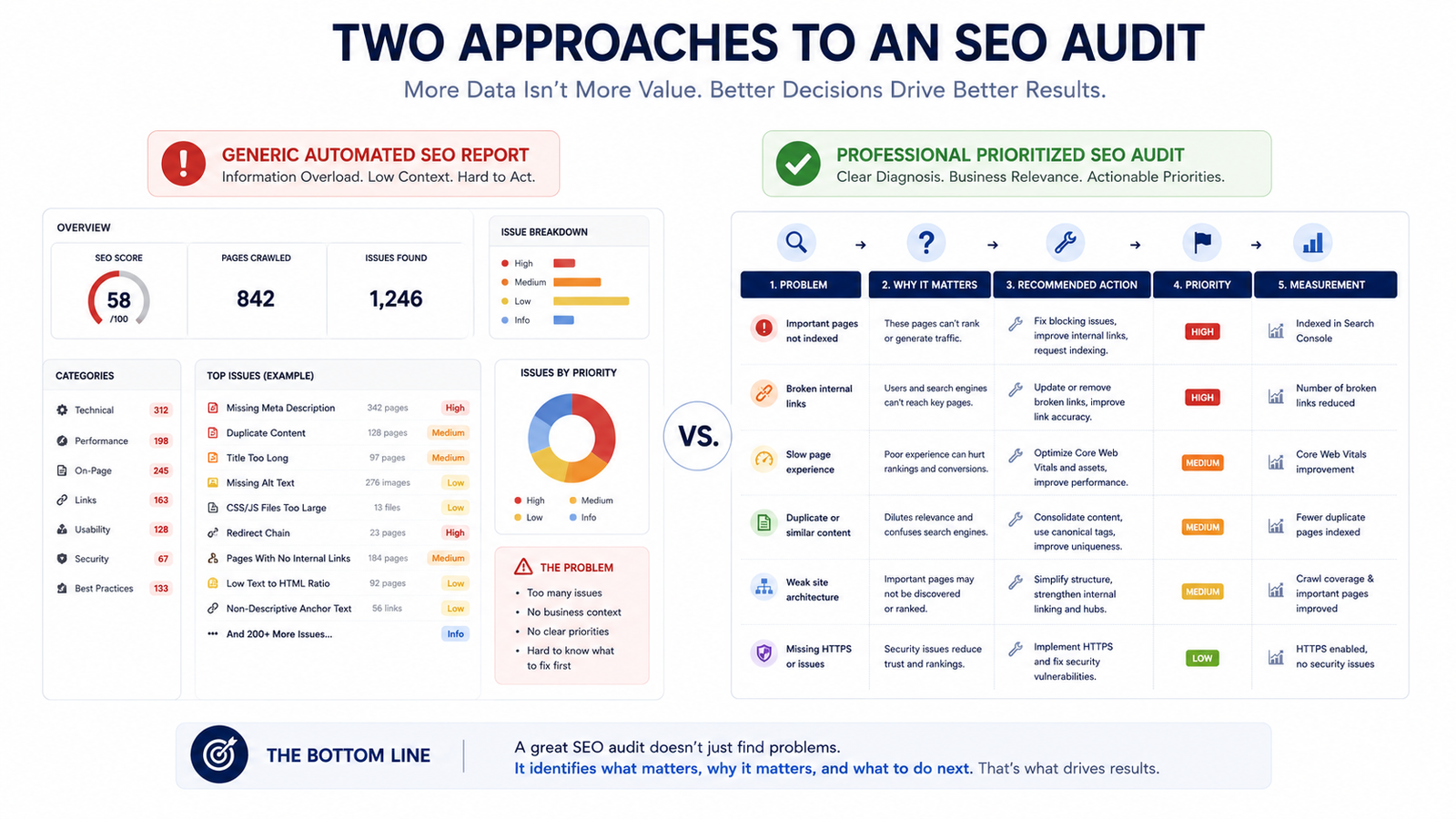
A good audit is not necessarily the longest audit. It should be useful. A strong audit usually answers five questions:
What is wrong?
Identify the actual problems.
Why does it matter?
Explain the likely impact.
What should be fixed?
Give a practical recommendation.
What should be fixed first?
Prioritize instead of dumping a list of warnings.
How will we know it worked?
Define measurable outcomes. This is where many automated SEO reports fall short. A tool can tell you that a page has a missing meta description. It cannot automatically determine whether rewriting that description is more valuable than fixing an indexing problem, improving a commercial landing page or restructuring internal links.
That requires judgment.
What Questions Should You Ask an SEO Agency?
Before signing, ask the agency questions that force them to explain their thinking.
What do you think is the biggest SEO problem on our website?
A good answer should be specific to your website.
What would you prioritize in the first three months?
You want priorities, not a generic monthly task list.
How will you measure success?
The answer should go beyond rankings alone.
How do you build links?
You should understand the methodology before approving it.
Who will actually work on our account?
Know who is responsible for execution.
What access do you need?
Access should be appropriate to the work being performed.
Can you show comparable case studies?
Look for evidence relevant to your industry, market and business model.
What happens if we stop working together?
Understand what remains yours and how the transition works.
Do you guarantee rankings?
The correct answer should not be a guaranteed #1 position. Google explicitly says no one can guarantee a #1 ranking, and it warns against SEOs making such claims.
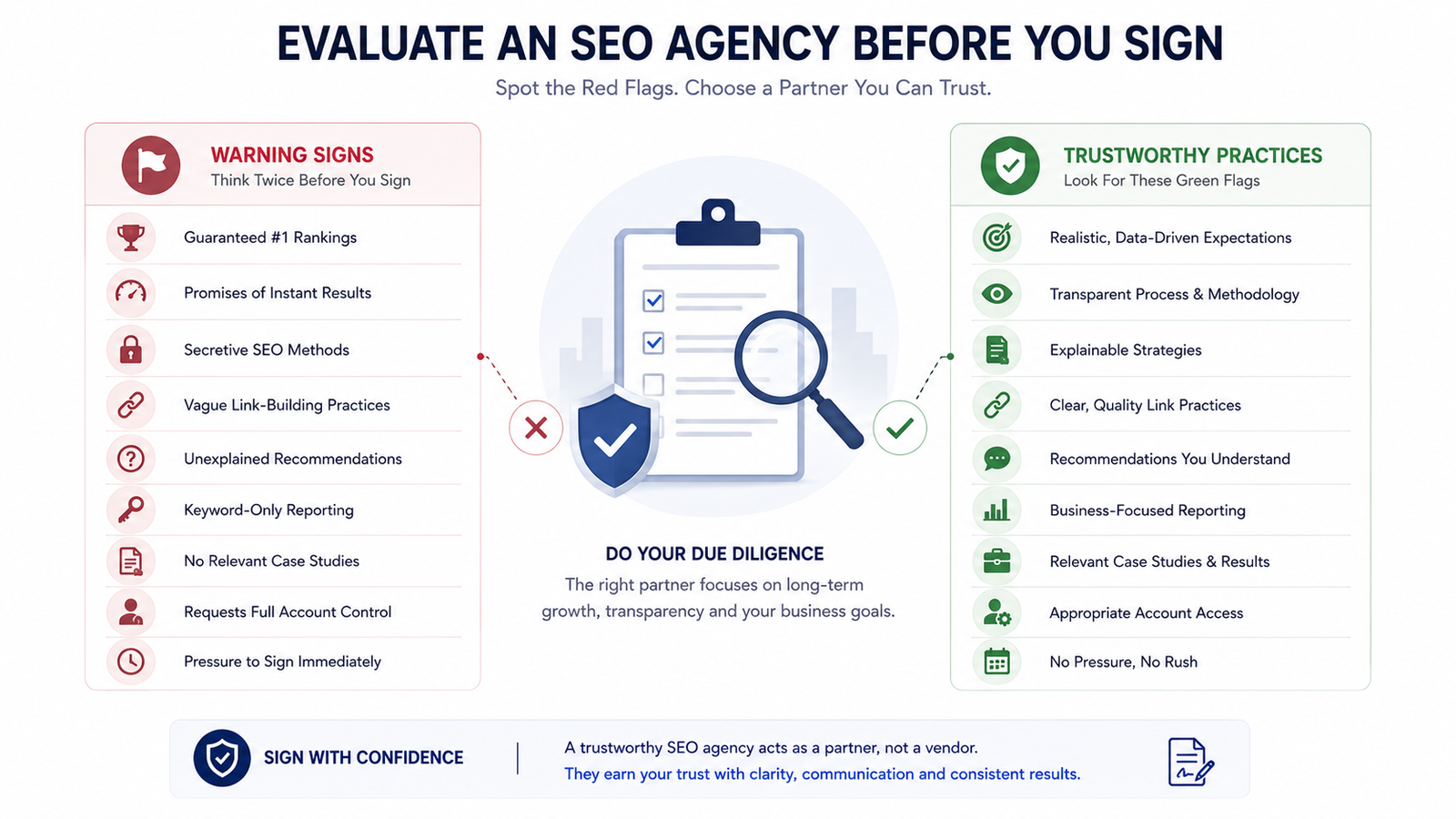
SEO Agency Red Flags to Watch For
Some warning signs are obvious. Others are hidden inside apparently professional proposals. Be careful if an agency:
Guarantees #1 rankings
Promises instant results
Refuses to explain its methodology
Talks about secret relationships with Google
Wants unnecessary account ownership
Pushes hundreds of backlinks without explaining quality
Focuses only on keyword positions
Cannot explain what it will actually do
Provides generic audits
Avoids discussing business goals
Cannot show relevant examples
Uses vague AI SEO claims
Wants to make major changes without explaining why
Pressures you to sign immediately
Google's current SEO hiring guidance specifically flags ranking guarantees, secretive practices, unsolicited SEO pitches, unexplained recommendations and questionable link schemes as reasons for caution.
What About AI Search and SEO Agencies in 2026?
AI search should be part of the conversation, but it should not become an excuse for vague promises. An agency may talk about:
AI Overviews
AI Mode
ChatGPT
AI citations
Generative Engine Optimization
Answer Engine Optimization
AI visibility
Those areas can matter. But ask the agency:
What exactly are you going to change?
And:
How will you measure whether the work helped?
Google's current hiring guidance says businesses should evaluate AI-search recommendations against Google's official guidance rather than accepting third-party claims at face value. That is a useful filter. If someone says: We have a secret GEO method that guarantees ChatGPT citations.
You should ask for evidence. AI search is evolving quickly, but that does not make traditional SEO fundamentals irrelevant. Technical accessibility, useful content, clear information architecture and trustworthy information remain important foundations.
Should You Get an SEO Audit From Every Agency You Interview?
Not necessarily. You don't need five agencies to perform five giant audits of the same website. Instead, give shortlisted agencies the same core information and ask each one to explain:
What they see
What they would prioritize
Why they would prioritize it
What they would measure
What they need from you
This makes comparison much easier. You are not trying to find the agency that produces the biggest spreadsheet. You're trying to find the agency that understands the business problem most clearly.
A Simple Way to Score SEO Agencies
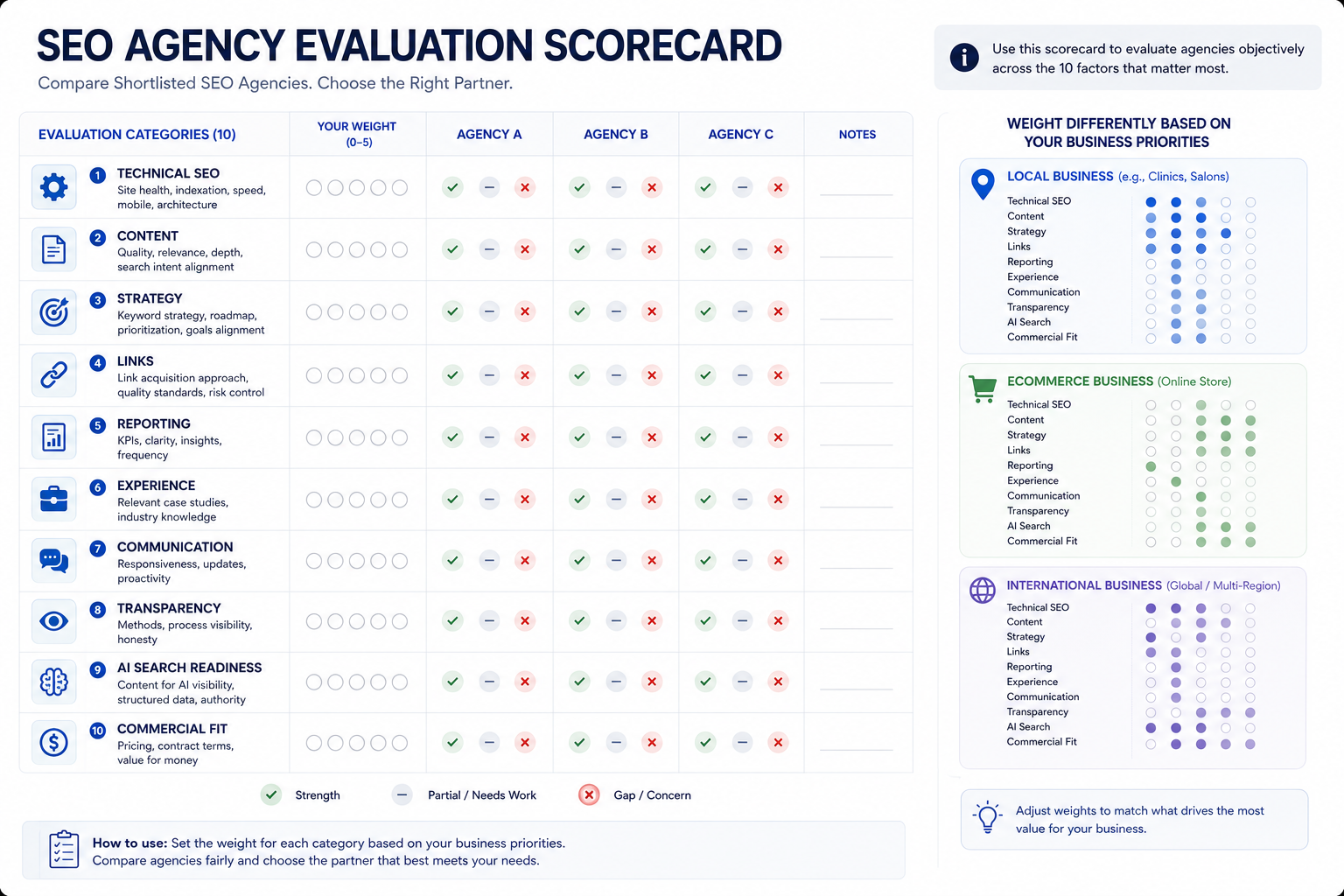
You can create your own evaluation framework.
| Area | What to Look For |
|---|---|
| Technical SEO | Can they identify and prioritize real technical problems? |
| Content | Do they understand search intent and content quality? |
| Strategy | Is the plan connected to business goals? |
| Links | Is the link-building method transparent and defensible? |
| Reporting | Does reporting connect activity to meaningful outcomes? |
| Experience | Do they have relevant examples? |
| Communication | Will they explain changes and reasoning? |
| Transparency | Are methods, access and deliverables clear? |
| AI Search | Do they have a practical, evidence-based approach? |
| Commercial Fit | Does the engagement make sense for your budget and goals? |
You don't need to give every category the same weight. For a local business, Local SEO and Google Business Profile expertise may matter more. For an ecommerce business, technical architecture, product/category SEO and ecommerce experience may matter more. For a multinational company, international SEO and localization may be critical.
The right agency depends on the actual business.
What If Your Website Is Already in Bad Shape?
Don't assume that hiring an agency automatically means starting with content and backlinks. If the website has serious technical or structural problems, those may need to be addressed first. A proper SEO audit can help determine whether the priority should be:
Technical SEO
Content improvement
Search intent
Internal linking
Local SEO
International SEO
Ecommerce SEO
Authority building
Conversion optimization
Measurement
If the diagnosis is unclear, a dedicated SEO audit can provide a more useful starting point than immediately committing to a large monthly SEO package.
The Biggest Mistake: Hiring the Proposal, Not the Strategy
A polished proposal can contain:
Beautiful charts
Keyword tables
Monthly deliverables
Traffic projections
Technical scores
Backlink targets
But none of those automatically make the strategy good. The real test is whether the agency can connect:
Business goal → Search opportunity → Website problem → Recommended action → Measurement → Business outcome
That's the chain you should look for. If the agency cannot explain that chain clearly, keep asking questions.
Final Checklist Before Signing an SEO Contract
Before you sign, make sure you can answer yes to most of these:
Do I understand the main problems with my website?
Has the agency explained why those problems matter?
Are the priorities clear?
Does the strategy match my business goals?
Does the keyword strategy match real search intent?
Have existing pages been evaluated before recommending lots of new content?
Is the technical work clearly explained?
Is the link-building methodology transparent?
Are the agency's case studies specific enough to evaluate?
Can I speak to references if appropriate?
Do I know who will actually work on my account?
Do I understand how reporting works?
Do I retain ownership of my accounts and data?
Are access requirements reasonable?
Are contract terms clear?
Are there no ranking guarantees?
Does the agency explain what it will and will not do?
Is its AI-search approach evidence-based?
Do I know how success will be measured?
Do I feel comfortable with the agency's level of transparency?
If several answers are no, slow down before signing.
The Right SEO Agency Should Make the Website Clearer, Not the Process More Mysterious
You don't need to become an SEO expert before hiring an SEO agency. But you should understand enough to recognize a sensible strategy, question vague recommendations and protect your website from risky practices. A proper audit gives you that starting point. It shows where the website stands today, what problems deserve attention and which opportunities are actually worth pursuing.
Then the agency conversation becomes much more useful. Instead of: How many keywords will you rank? you can ask: What is limiting our organic growth, what should we fix first, and how will we know the work is producing a business result? That's a much better SEO conversation. If you want to understand the current condition of your website before choosing an SEO strategy, the next logical step is a structured SEO audit rather than blindly committing to a monthly package.
Get an SEO audit and identify your highest-priority opportunities
Frequently Asked Questions
1. What should I check before hiring an SEO agency?
Start with technical health, indexation, website architecture, existing content, search intent, internal linking, Search Console data, analytics, backlink practices, reporting, case studies, access, ownership and contract terms.
2. Should I get an SEO audit before hiring an SEO agency?
In many cases, yes. An audit can help establish the website's current condition and give both sides a clearer starting point. Google also recommends reviewing what an SEO audit actually includes and whether the recommendations provide realistic estimates of improvement and required work.
3. What should an SEO audit include?
It depends on the website, but a useful audit can cover technical SEO, crawling and indexing, site architecture, content, search intent, internal linking, performance, analytics, search visibility, links, local or international considerations and business priorities.
4. Can an SEO agency guarantee first-page rankings?
No legitimate agency can guarantee a #1 Google ranking. Google explicitly warns businesses to be cautious of SEOs making ranking guarantees.
5. What should an SEO agency report every month?
Reporting should normally explain work completed, organic visibility, traffic, important search queries and pages, changes in performance, conversions where tracked, and the next priorities. The exact metrics should depend on the business.
6. Should I give an SEO agency access to Google Search Console?
An agency may need access to perform its work, but Google specifically recommends giving read-only Search Console access at the initial audit stage rather than write access.
7. How do I know if an SEO agency's backlinks are safe?
Ask exactly how the links are acquired, why relevant sites would link to your website, what types of sites are targeted and whether the agency uses link schemes or networks. Avoid agencies that cannot explain their methodology.
8. What is the biggest SEO agency red flag?
A guaranteed #1 ranking is one of the clearest red flags. Other concerns include secretive methods, unexplained recommendations, manipulative link schemes and pressure to give unnecessary control over your website or accounts.
9. Should I choose an SEO agency based on price?
Price should be considered, but it should not be the only deciding factor. Compare scope, expertise, strategy, implementation capability, reporting, communication, evidence and commercial fit.
10. Does an SEO agency need to specialize in my industry?
Not always, but relevant industry experience can be valuable, particularly where the search landscape, regulations, customer journey or competition are specialized. Google recommends asking potential SEOs about their experience in your industry and geography.
11. What should an SEO agency do in the first few months?
The exact work depends on the audit. A sensible early phase might include measurement setup, technical fixes, search-intent analysis, priority page improvements, internal linking, content work and establishing a clear baseline for future measurement.
12. Should an SEO agency explain every change it makes?
Major changes should be explainable. Google specifically recommends asking how an SEO will communicate changes and whether it will provide information about the recommendations and their reasoning.
13. Is an SEO audit just a technical report?
No. A useful audit should connect technical findings with content, search intent, website structure and business priorities. The goal is not to collect warnings but to identify what deserves attention first.
14. What if an agency gives me a very long SEO audit?
Length is not proof of quality. A shorter audit with clear evidence, prioritization and practical recommendations can be more valuable than a large automated report containing hundreds of low-priority issues.
15. Is AI SEO something I should ask an agency about in 2026?
Yes, but ask for specifics. Google now includes guidance on evaluating SEO recommendations related to generative AI features and recommends checking those recommendations against official