
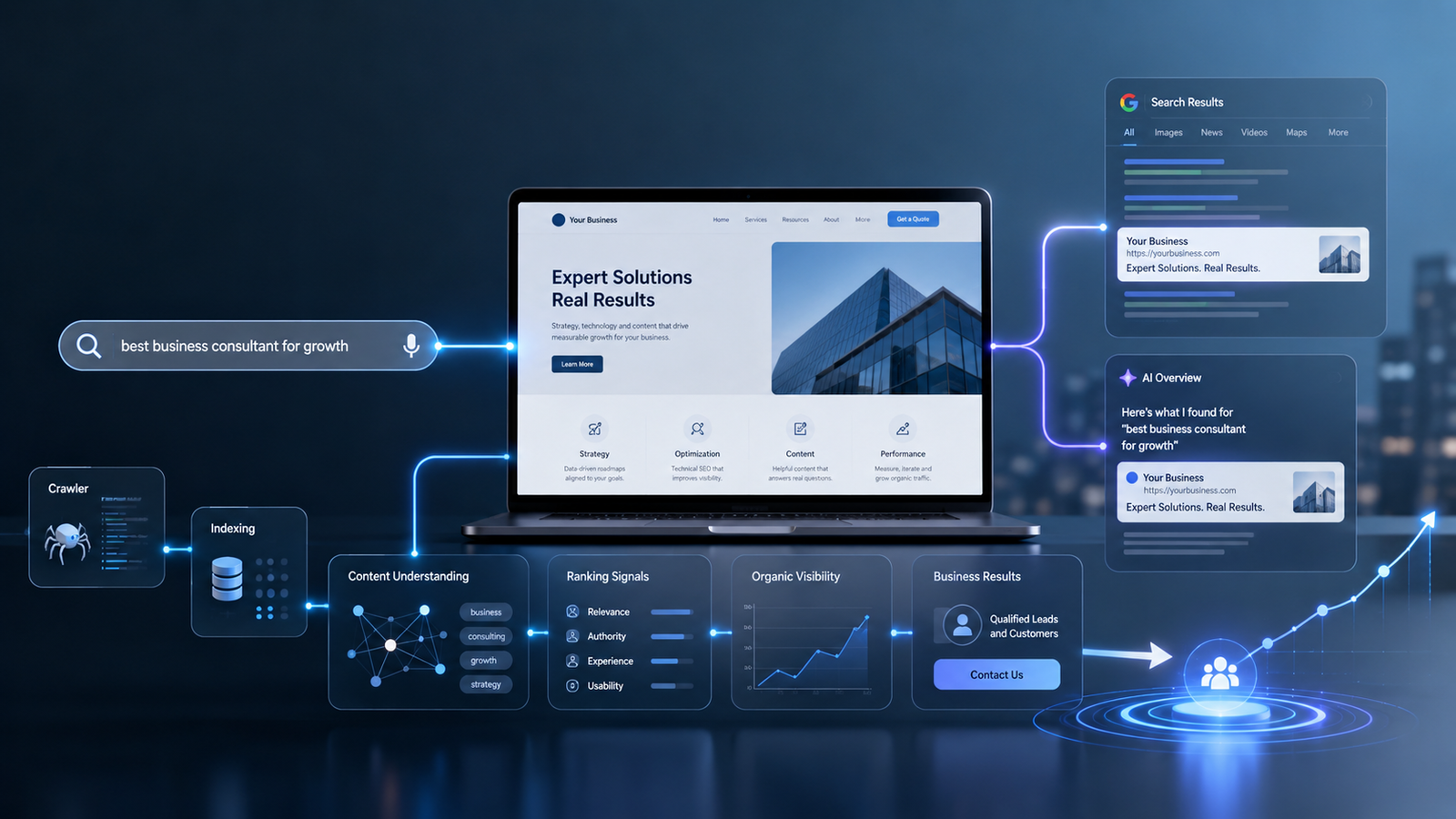
Search engine optimization, or SEO, is the process of improving a website so that search engines can discover, understand, evaluate and show its pages to people searching for relevant information, products or services.
That sounds simple. In practice, SEO involves several connected systems: technical accessibility, content, search intent, website structure, internal links, external references, user experience, local signals, and the overall usefulness and trustworthiness of a website.
And SEO in 2026 is broader than the traditional blue-link search results.
Google Search now includes AI-powered experiences such as AI Overviews and AI Mode, while users increasingly discover information through different search interfaces. Google's own 2026 guidance says that established SEO practices remain relevant for these generative AI features because they rely on content and pages that can be understood and retrieved from Search.
So what is SEO really doing?
At its simplest, SEO helps connect:
what people are searching for → the right page → the right business or source
This guide explains how that process works, what actually matters in 2026, and where SEO fits into a practical business growth strategy.
What Does SEO Stand For?
SEO stands for Search Engine Optimization.
It refers to the practices used to help search engines discover and understand web pages and to improve the likelihood that relevant pages will appear prominently when people search.
Google describes SEO as a collection of practices that can make it easier for search engines to crawl, index and understand your content.
The important word here is easier.
SEO does not mean telling Google:
Rank my website first.
There is no button that guarantees a ranking.
Instead, SEO removes obstacles and improves the signals around a website so search engines can better understand:
- What the website is about
- Which topics each page covers
- Which searches a page can satisfy
- Whether the page can be crawled and indexed
- How pages relate to one another
- Whether the content is useful and trustworthy
- Which pages deserve to be shown for particular searches
Google explicitly states that it does not guarantee that a page will be crawled, indexed or served in search results, even when the page follows its Search Essentials.
That distinction matters.
SEO improves your chances of being discovered and selected. It does not give you a guaranteed position.
How Does SEO Actually Work?
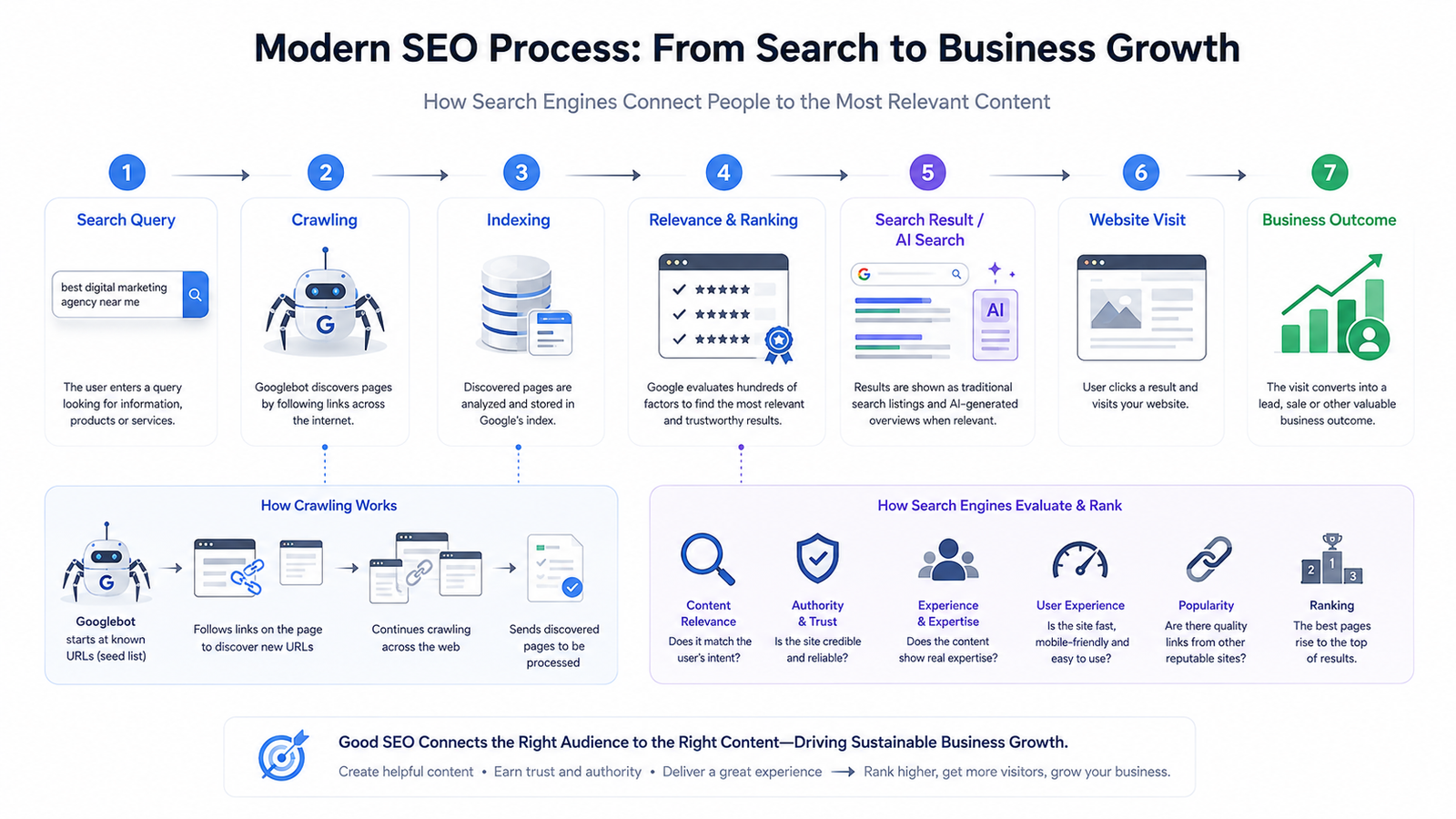
A useful way to understand SEO is to stop thinking about it as one ranking trick.
Think of it as a system:
Discovery → Crawling → Indexing → Understanding → Ranking → Search appearance → Click → Business outcome
Here's what happens.
1. Search engines discover your pages
Before Google can rank a page, it has to know that the page exists.
Google discovers URLs in several ways, including links from pages it already knows about and submitted sitemaps. Its crawlers then visit pages to understand what is there.
For example:
 Home
  ↓
Services
  ↓
Technical SEO
  ↓
Technical SEO guide
If a new article is linked from an established page, that internal link gives Google another path to discover it.
This is one reason website architecture and internal linking matter.
2. Google crawls the page
Crawling means Googlebot fetches a page and examines its content and resources.
Google may process:
- Text
- Images
- Videos
- Links
- HTML
- Metadata
- Structured data
- JavaScript-rendered content
Google also renders JavaScript when necessary to understand what the page contains.
A technically broken website can therefore create an SEO problem before content quality even becomes relevant.
If Google cannot properly access important content, it becomes harder for the search engine to understand and potentially serve that content.
This is where technical SEO becomes important.
Learn about Technical SEO services
Crawling Is Not the Same as Indexing
This distinction causes a lot of confusion.
A page can be:
- discovered but not crawled yet
- crawled but not indexed
- indexed but not ranking well
- indexed and ranking for some searches but not others
Crawling simply means Google accessed the page.
Indexing is the next step.
3. Google indexes the page
During indexing, Google analyzes the content it found and attempts to understand what the page is about.
It processes things such as:
- Main text
- Page title
- Images
- Alt attributes
- Videos
- Metadata
- Links
- Language
- Duplicate versions of content
Google may also determine which URL should be treated as the canonical version when similar or duplicate pages exist.
For example, imagine the same product is accessible through:
example.com/productexample.com/product?color=redexample.com/category/productIf these URLs contain substantially similar content, Google has to understand how they relate to one another.
That's why technical concepts such as canonicalization can matter.
4. Google matches pages to searches
Once pages are available in Google's index, the next question is:
Which page is relevant to this particular search?
Suppose someone searches:
SEO consultant for a small business
Google has to interpret the meaning and intent behind that query and find pages that may satisfy it.
The search engine does not simply look for a page containing those exact words.
Google's systems use many signals and systems to understand the relationship between queries and pages. Its documented ranking systems include systems related to language understanding, links, freshness, original content, neural matching and more.
This is why writing a page 100 times with the phrase SEO consultant is not a sensible SEO strategy.
The page needs to actually answer the searcher's need.
5. Google ranks relevant results
After identifying potentially relevant pages, Google's ranking systems determine which results are most useful for the query.
Google says its ranking systems use many factors and signals across hundreds of billions of web pages and other content in its index. Ranking happens programmatically and can vary according to factors such as the query, language, location and device.
This is why there is no universal list of:
The 10 Google ranking factors that guarantee #1.
SEO is not that mechanical.
Different searches require different things.
A person searching:
dentist near me
has a very different need from someone searching:
how does Google indexing work?
The search results need to reflect that difference.
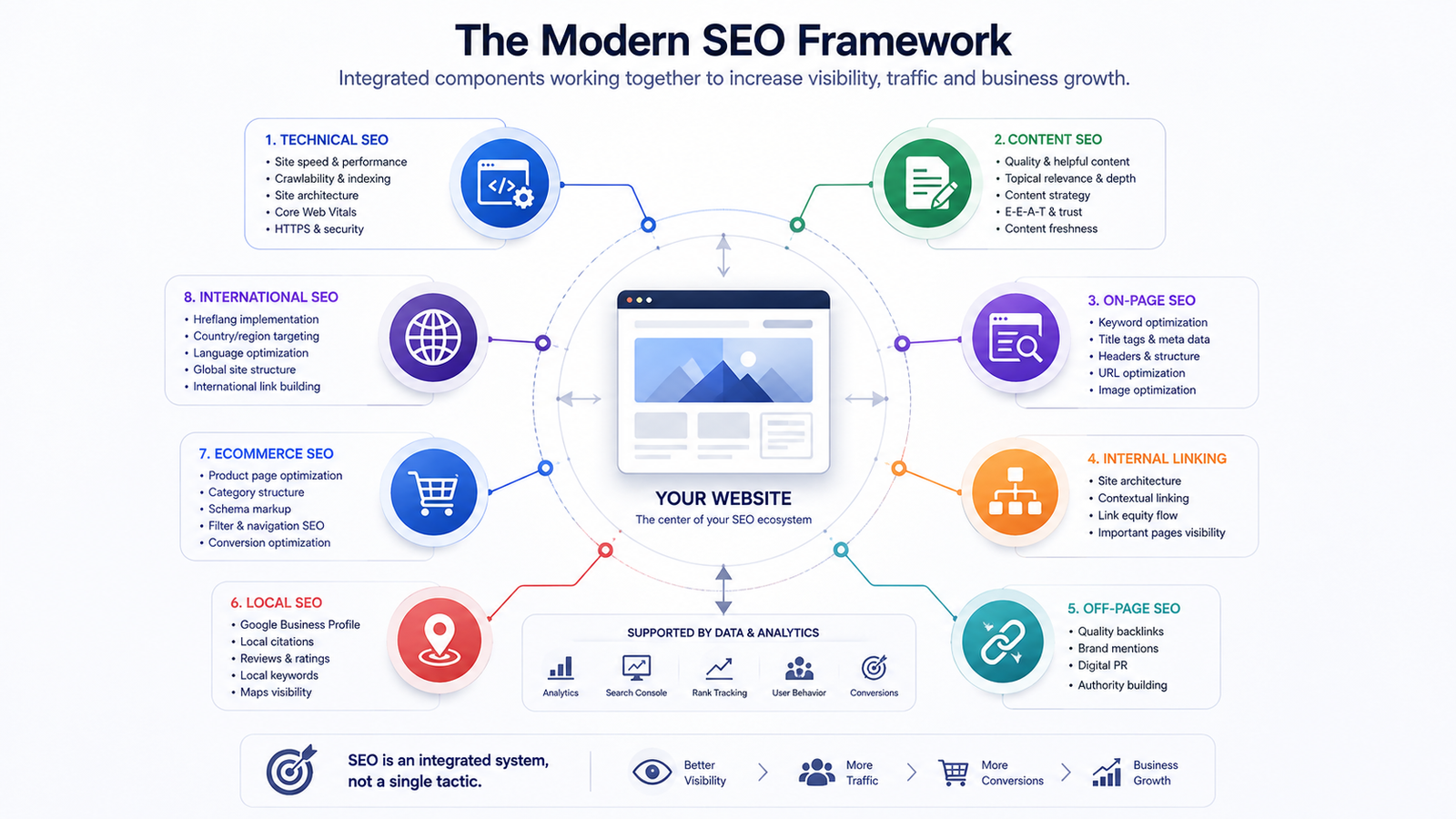
What Are the Main Parts of SEO?
SEO is often divided into several categories.
The boundaries aren't absolute, but the categories are useful for understanding the work.
1. Technical SEO
Technical SEO focuses on making a website accessible, understandable and technically sound for both search engines and users.
It can involve:
- Crawling
- Indexing
- Robots.txt
- XML sitemaps
- Canonical URLs
- Redirects
- Site architecture
- JavaScript SEO
- Internal linking
- Page performance
- Core Web Vitals
- Mobile usability
- Duplicate content
- HTTPS
- Structured data
- Rendering
Technical SEO is not about making a website look impressive to Google.
It is about removing technical barriers and building a structure that works.
For example, if a site's important pages are buried several clicks deep, internally disconnected, blocked from crawling or accidentally marked noindex, creating another 50 blog posts will not solve the underlying problem.
2. On-Page SEO
On-page SEO focuses on the content and page-level elements that help users and search engines understand a page.
This can include:
- Page title
- Main heading
- Subheadings
- Content
- Search intent
- Topic coverage
- Internal links
- Images
- Alt text
- URLs
- Metadata
- Structured information
But on-page SEO is not simply placing a keyword in every possible location.
Google's SEO guidance recommends creating helpful, reliable, people-first content and anticipating the language users may search for, while noting that its language systems can understand related queries without requiring every exact keyword variation to appear on the page.
The better question is:
Does this page clearly and completely satisfy the user's need?
3. Content SEO
Content is where SEO becomes much more than technical optimization.
A page can be perfectly crawlable and still be a poor search result.
Useful content should:
- Address a real question or problem
- Match search intent
- Explain the subject clearly
- Provide enough depth
- Use reliable information
- Add something beyond generic summaries
- Be easy to navigate
- Give the reader a useful next step
Google's current people-first guidance specifically asks creators whether their content provides original information, research or analysis, whether it gives substantial value compared with other results, and whether readers would find it satisfying and trustworthy.
That is a much better content strategy than:
keyword → 2,000 words → publish
4. Internal Linking
Internal links connect pages on the same website.
They help users navigate and give search engines additional context about the relationships between pages.
For example:
 What Is SEO?
      ↓
Technical SEO Guide
      ↓
Technical SEO Service
      ↓
SEO Audit
      ↓
Contact
That structure makes sense from a user perspective.
It also creates a clear relationship between educational content and commercial pages.
Internal linking should therefore be based on relevance, not on hitting an arbitrary number of links.
5. Off-Page SEO
Off-page SEO refers broadly to signals and activities that happen beyond the page itself.
One major area is links from other websites.
Google's ranking documentation explains that its systems include link analysis systems and that PageRank remains part of its core ranking systems, although it has evolved significantly since Google's early days.
But earning links is not about collecting as many links as possible.
A link from a relevant, respected website can be far more meaningful than dozens of unrelated links.
This is why useful original research, strong resources, data, tools and genuinely reference-worthy content can contribute to SEO beyond the page itself.
What Is Local SEO?
Local SEO focuses on visibility when users search for businesses, services or places with geographic intent.
Examples include:
- SEO consultant in Gwalior
- dentist near me
- best restaurant in Delhi
- SEO agency in New York
Local SEO can involve:
- Google Business Profile
- Local landing pages
- Reviews
- Business information
- Local relevance
- Website content
- Local links and references
- Search intent
- Local conversion paths
For businesses that depend on calls, visits, directions or local enquiries, traditional organic SEO and local SEO can work together.
What Is Google Business Profile SEO?
Google Business Profile SEO is more specifically focused on improving the visibility and usefulness of a business's Google Business Profile in local search and Google Maps.
It can involve areas such as:
- Business categories
- Services
- Business information
- Reviews
- Profile completeness
- Local relevance
- Customer actions
- Supporting website signals
It overlaps with Local SEO but is not identical to it.
Explore Google Business Profile SEO
What Is Ecommerce SEO?
Ecommerce SEO applies SEO principles to online stores.
The focus can include:
- Product pages
- Category pages
- Collection pages
- Product discovery
- Ecommerce architecture
- Internal linking
- Faceted navigation
- Indexation
- Product-related structured data
- Transactional search intent
For example, ranking a product category for a commercial search requires a different approach from ranking an informational blog post.
Explore Ecommerce SEO services
What Is International SEO?
International SEO is used when a business wants organic visibility across multiple countries or regions.
It can involve:
- Country-specific pages
- Regional search intent
- Localization
- International keyword research
- Hreflang
- Website architecture
- Country-specific content
- Regional conversion strategies
A business targeting the USA and UK should not automatically assume that changing the country name on one page creates meaningful localization.
Different markets can have different:
- Search behavior
- Terminology
- Competition
- Regulations
- Expectations
- Buying patterns
Explore International SEO services
How Important Are Keywords in SEO?
Keywords still matter.
But the way SEO uses keywords has changed.
A keyword is essentially a representation of what someone may search for.
Suppose your target topic is:
technical SEO audit
Related searches might include:
- technical SEO audit
- website SEO audit
- technical website audit
- SEO technical issues
- how to audit a website
- technical SEO checklist
You don't need to force every variation into the article.
Google's language-matching systems can understand relationships between concepts and different ways people search for the same subject.
A better strategy is to understand the topic deeply enough that the relevant language naturally appears.
Search Intent Is More Important Than Keyword Repetition
Consider these searches:
What is SEO?
Likely informational.
How much does SEO cost?
Commercial investigation.
SEO consultant near me
Local and transactional.
Best SEO agency for ecommerce
Commercial investigation.
Why is my website not indexed by Google?
Problem-solving.
The same word, SEO, appears in all of them.
But the user needs something completely different each time.
That's why good SEO begins with search intent.
If someone wants to understand SEO, sending them immediately to a pricing page is a poor experience.
If someone is actively comparing SEO providers, giving them only a 2,000-word definition of SEO is equally unhelpful.
What Actually Helps a Website Rank in 2026?
There isn't one universal ranking checklist.
But a strong SEO strategy generally brings several areas together.
1. Make important pages accessible
Search engines need to be able to discover and crawl your important content.
Technical problems can prevent good content from reaching the index.
Google's documented Search process starts with crawling and indexing before ranking and serving results.
2. Create genuinely useful content
The page should solve the user's problem better than a generic summary.
Google's current guidance emphasizes original, useful, reliable, people-first content rather than content created primarily to manipulate rankings.
3. Match the search intent
A page about SEO pricing should actually discuss pricing.
A page about SEO basics should teach SEO.
A page targeting a local service should make its geographic relevance clear.
Intent mismatch can make otherwise well-written content ineffective.
4. Build a logical website
Your website should have a structure that makes sense.
For example:
SEO
├── Technical SEO
├── Local SEO
├── Google Business Profile SEO
├── Ecommerce SEO
├── International SEO
└── SEO Audits
Supporting articles can then connect to the relevant service pages.
This creates a topical ecosystem rather than a collection of disconnected URLs.
5. Earn credibility
Trust matters.
Google's people-first guidance discusses experience, expertise, authoritativeness and trustworthiness, commonly referred to as E-E-A-T. Google also makes clear that E-E-A-T itself is not a single ranking factor. Rather, its systems use multiple signals that help identify useful and trustworthy content.
That means you shouldn't add the phrase E-E-A-T to a page and expect an SEO benefit.
Instead, demonstrate credibility through:
- Accurate information
- Clear authorship
- Reliable sources
- Original analysis
- Genuine experience when available
- Transparent limitations
- Useful examples
- Consistent expertise
Does Website Speed Matter for SEO?
Yes, but it is important not to oversimplify this.
A fast website is better for users and forms part of a broader good page experience.
Google's page experience guidance points to factors including Core Web Vitals, secure pages, mobile usability, avoiding intrusive interstitials and ensuring that the main content is easy to distinguish. It also warns against focusing on only one or two aspects of page experience in isolation.
So:
SEO is not simply PageSpeed score optimization.
A website scoring 100 but offering poor content is not automatically going to outrank a useful competitor.
Technical performance and content quality need to work together.
Does Backlink Building Still Matter in 2026?
Links still matter.
Google continues to document link analysis and PageRank as part of its ranking systems.
But this does not mean:
More backlinks = higher rankings.
The quality, relevance and context of links matter.
A more sustainable approach is to create things worth referencing:
- Original research
- Useful data
- Detailed guides
- Tools
- Calculators
- Strong case studies
- Original analysis
- Industry resources
The goal should be to earn attention rather than manufacture link volume.
What About AI-Generated Content?
This is one of the biggest SEO questions in 2026.
The answer is more nuanced than:
AI content is bad.
Google's current guidance focuses on the purpose and quality of the content, not simply whether AI was involved in producing it. Content created primarily to manipulate rankings violates Google's spam policies, while useful content that serves people is the more important objective.
The practical problem with AI-generated content is usually not the existence of AI.
It's low-value output.
For example:
Generic AI summary
↓
No original insight
↓
No evidence↓No experience
↓
No useful examples
↓
Same information available everywhere
That kind of content gives users little reason to choose your page.
AI can assist with research, organization, analysis and drafting, but the finished content still needs human judgment, verification, originality and usefulness.
How Has SEO Changed With AI Search in 2026?
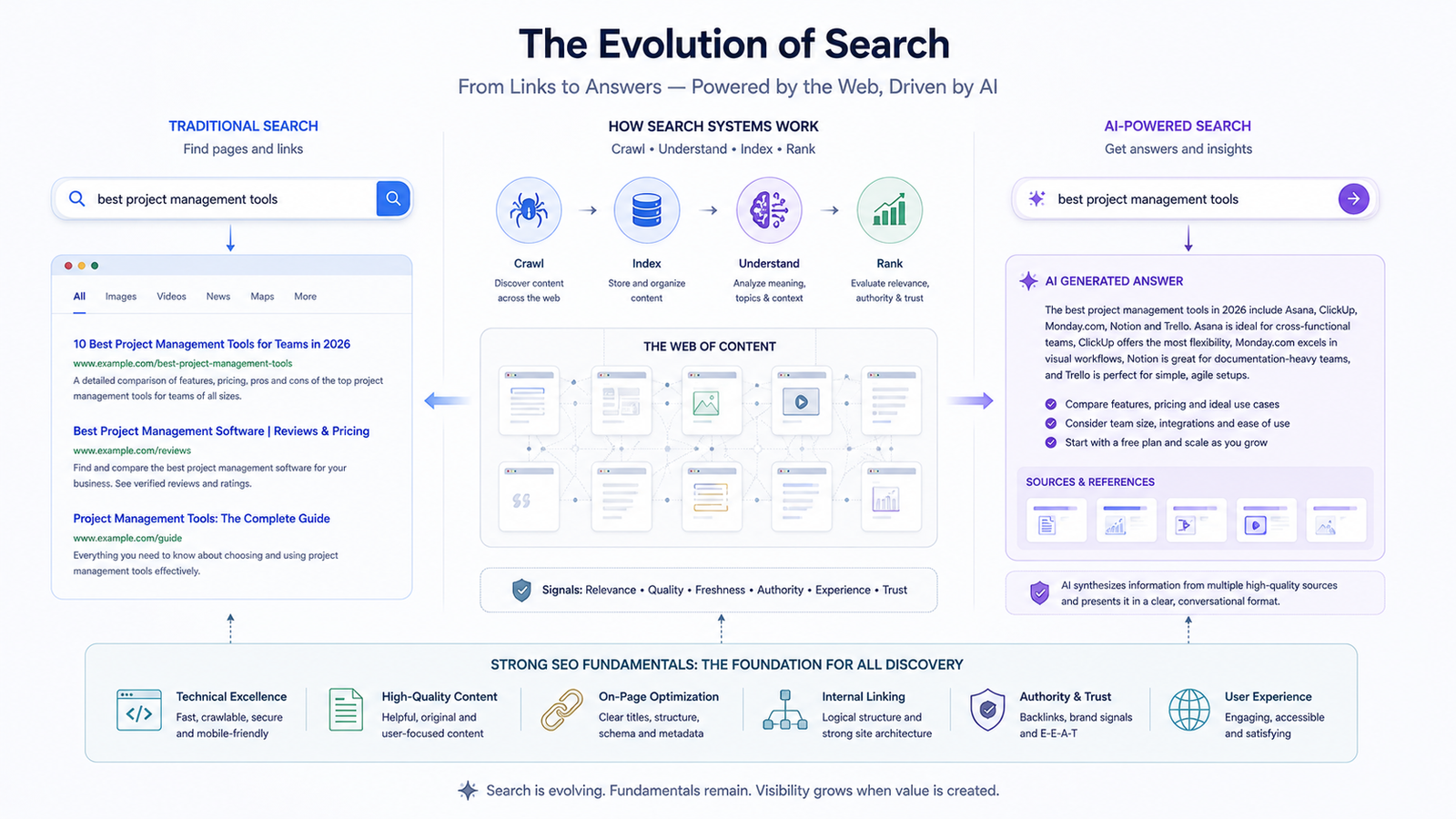
Search is no longer limited to a page of ten blue links.
Google now has generative AI experiences such as AI Overviews and AI Mode.
That changes how people may discover information, but it does not mean traditional SEO has become irrelevant.
Google's 2026 documentation specifically says that SEO practices remain relevant for generative AI features because these experiences use content from Google's Search index and depend on sites being technically accessible and providing unique, useful information.
Google's guidance also emphasizes creating unique, useful content rather than relying on supposed AEO or GEO hacks.
So the better strategy is not:
How do I trick AI into mentioning my website?
It's:
How do I make my website a genuinely useful, understandable and trustworthy source?
That means:
- Clear answers
- Strong topical coverage
- Original information
- Good technical accessibility
- Useful supporting details
- Descriptive headings
- Strong internal linking
- Relevant first-hand information where available
- Accurate sourcing
- Up-to-date content
These principles help both traditional search and AI-powered discovery.
Can SEO Get You Into Google's AI Overview?
There is no guaranteed formula for appearing in an AI Overview or AI Mode.
You should be suspicious of anyone promising:
- Guaranteed AI Overview placement
- Guaranteed ChatGPT citations
- Guaranteed AI search visibility
- Guaranteed #1 ranking
Search systems decide what to show based on their own processes.
The practical approach is to build content that is strong enough to be useful as a source.
Google's current generative AI guidance explicitly recommends focusing on established SEO practices and unique, useful content rather than supposed AI-search hacks.
What SEO Is Not
Understanding what SEO isn't can save a lot of wasted effort.
SEO is not keyword stuffing
Repeating a keyword does not turn a weak article into a useful one.
SEO is not buying rankings
Google states that it does not accept payment to rank pages higher in organic search.
SEO is not publishing as much content as possible
More pages do not automatically mean more organic traffic.
Google's people-first guidance specifically warns against producing lots of content primarily in the hope that some of it will attract search traffic.
SEO is not just backlinks
Links are one part of a much larger system.
SEO is not just technical optimization
A technically excellent website with weak content still has a problem.
SEO is not a one-time task
Search behavior, competitors, websites and search systems change.
Good SEO requires ongoing monitoring and improvement.
How Long Does SEO Take to Work?
There is no universal timeline.
SEO performance depends on factors such as:
- Existing website authority
- Competition
- Technical condition
- Content quality
- Search intent
- Industry
- Location
- Website history
- Links and references
- Existing rankings
- Search demand
- Implementation quality
A website with existing authority may see changes faster than a brand-new domain.
A highly competitive commercial keyword may take substantially longer than a low-competition informational query.
So promises like:
Guaranteed first-page rankings in 30 days
should be treated carefully.
SEO is better viewed as a compounding process than a fixed-duration campaign.
How Do You Measure SEO Success?
Rankings matter, but rankings alone aren't enough.
A business should look at several layers.
Visibility
- Impressions
- Search queries
- Ranking distribution
- Organic visibility
Traffic
- Organic sessions
- Landing pages
- New users
- Relevant traffic
Engagement
- Engagement quality
- Page behavior
- Returning users where relevant
Business outcomes
- Leads
- Calls
- Form submissions
- Sales
- Enquiries
- Qualified prospects
A website can increase traffic and still fail commercially.
For example:
100,000 organic visits
↓
Almost no enquiries
may be less valuable than:
5,000 highly relevant visit
↓
250 qualified enquiries
The real goal is not simply more traffic.
It is more useful visibility that contributes to business outcomes.
A Practical SEO Process for a Business Website
If you're starting SEO today, don't begin by publishing 100 articles.
Start by understanding the website.
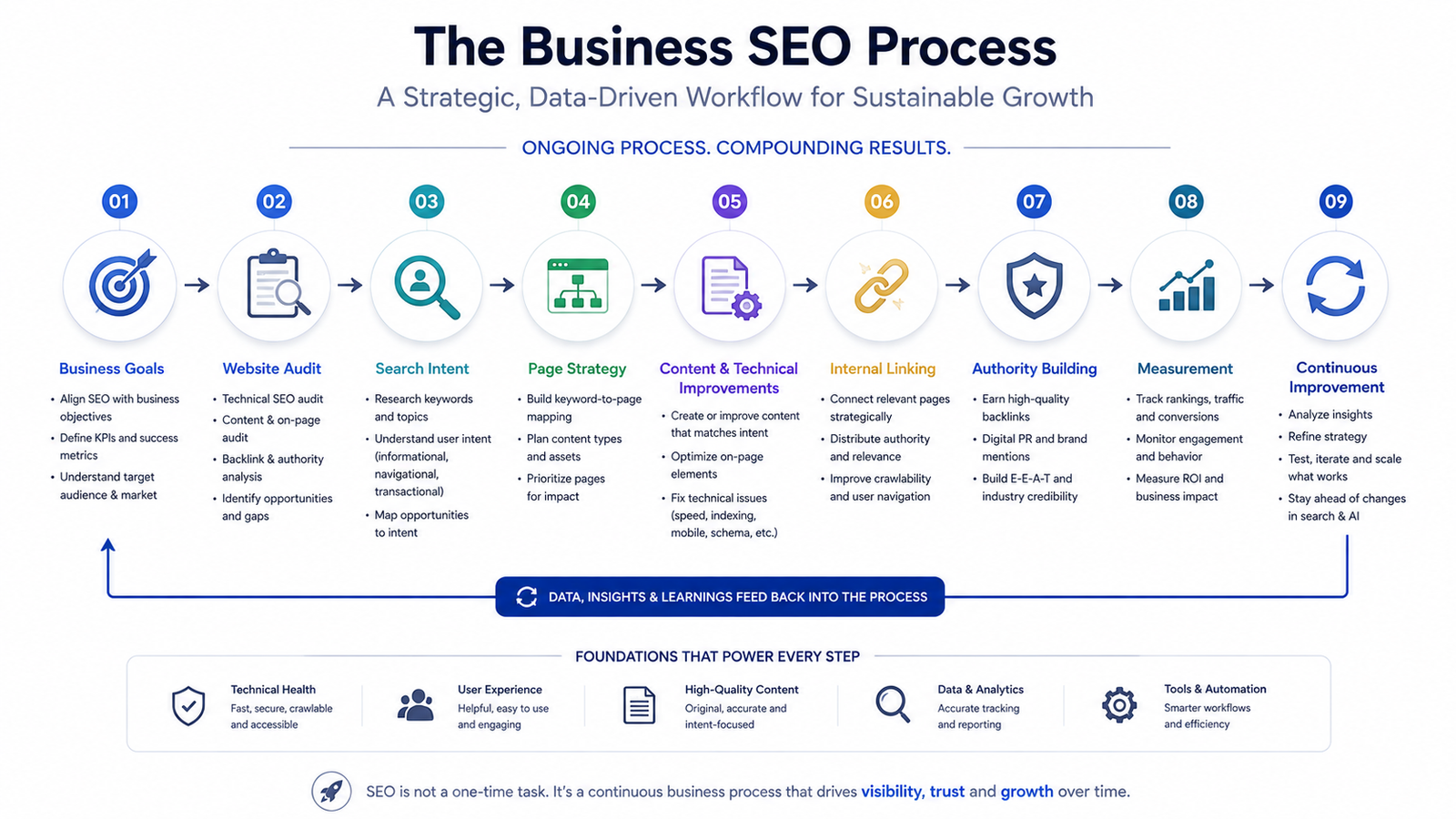
Step 1: Define the business
Understand:
- What does the business sell?
- Who is the ideal customer?
- Which locations matter?
- Which services or products are most valuable?
- What searches indicate buying intent?
Step 2: Audit the website
Check:
- Crawlability
- Indexation
- Technical problems
- Site architecture
- Existing content
- Internal links
- Page performance
- Duplicate content
- Metadata
- Search Console data
If the site has major technical or structural problems, fix those before scaling content.
Step 3: Map search intent
Create groups such as:
Informational
    ↓
Problem-solving
    ↓
Commercial investigation
    ↓
Transactional
Then map the appropriate pages to each group.
Step 4: Build the right pages
Not every keyword needs a separate page.
Create pages when there is a meaningful difference in:
- Search intent
- Topic
- Product
- Service
- Location
- Audience
Avoid creating near-duplicate pages simply to target tiny keyword variations.
Step 5: Improve existing content
Sometimes the best SEO opportunity is already on the website.
A page may need:
- Better search-intent alignment
- More useful information
- Better internal links
- Updated facts
- Stronger examples
- Better page structure
- Improved technical accessibility
Creating a new URL is not always the answer.
Step 6: Build topical relationships
Connect related pages.
For example:
What Is SEO?
     ↓
Technical SEO
     ↓
Crawling and Indexing
     ↓
SEO Audit
     ↓
Technical SEO Service
This helps users move from learning to solving a problem to evaluating professional help.
Step 7: Earn authority
Create genuinely useful resources that people may want to reference.
That could mean:
- Research
- Data
- Case studies
- Detailed guides
- Industry analysis
- Tools
- Original frameworks
The stronger the resource, the more reasons other websites have to reference it.
Step 8: Measure and improve
Use tools such as Google Search Console and analytics platforms to understand:
- What queries generate visibility?
- Which pages are gaining or losing traffic?
- Which pages generate leads?
- Which topics deserve expansion?
- Where are technical problems appearing?
SEO becomes much more effective when decisions are based on evidence rather than assumptions.
A Simple Example of How SEO Works
Imagine you own a dental clinic.
You could publish a page targeting:
dentist in Gwalior
But SEO doesn't stop at putting that phrase into the page.
You would need to consider:
Business information
        ↓
Google Business Profile
        ↓
Location relevance
        ↓
Service pages
        ↓
Useful dental content
        ↓
Reviews and reputation
        ↓
Internal linking
        ↓
Technical accessibility
        ↓
Local search visibility
        ↓
Calls / appointments
Now compare that with an ecommerce website.
Its SEO system might look more like:
Category pages
      ↓
Product pages
      ↓
Product information
      ↓
Internal linking
      ↓
Technical indexation
      ↓
Search intent
      ↓
Organic visibility
      ↓
Product discovery
      ↓
Purchase
Same discipline.
Different implementation.
That's why good SEO is strategy, not a checklist.
How SEO Fits Into a Modern Business Website
SEO should not exist separately from the rest of the website.
A strong structure might look like:
Homepage
   ↓
Services
   ↓
Industry pages
   ↓
Country / market pages
   ↓
Blog
   ↓
Case studies
   ↓
Pricing
   ↓
Contact
The blog attracts people with questions and problems.
Service pages explain what the business provides.
Industry pages add relevance for specific business sectors.
Country pages support market-specific commercial intent.
Case studies provide evidence.
Pricing helps commercial evaluation.
Contact provides the conversion path.
That is a much stronger model than treating SEO as:
Get traffic to blog posts.
The real objective is:
Relevant search visibility → useful experience → trust → qualified business action.
Does Every Business Need SEO?
Not necessarily.
SEO makes the most sense when people actually use search to discover information, products, services or businesses relevant to what you offer.
It can be particularly valuable when:
- Customers actively search for your services
- Search demand is persistent
- A purchase decision requires research
- Local visibility matters
- Your products are discoverable through search
- Your competitors already receive organic traffic
- You want a long-term acquisition channel
SEO may be less important if your business depends almost entirely on channels where search plays little role.
The right question isn't:
Does every business need SEO?
It's:
Does organic search represent a meaningful opportunity for this business?
Is SEO Still Worth It in 2026?
Yes, but the reason to invest in SEO has become more sophisticated.
SEO is no longer just:
rank → click → visit
Search now includes more ways for people to discover information, including AI-powered experiences.
That makes being understood and being useful even more important.
Google's 2026 guidance for generative AI search specifically continues to emphasize established SEO fundamentals, unique content and useful information rather than special AI-search hacks.
For businesses, the opportunity is broader than rankings.
A strong organic presence can help people:
- Discover the business
- Understand its expertise
- Compare options
- Research problems
- Find services
- Visit the website
- Contact the business
- Remember the brand
SEO therefore works best when it is treated as part of the overall digital growth strategy.
The Bottom Line: What Is SEO?
SEO is the practice of making a website easier for search engines to discover, crawl, understand and potentially show to people who are looking for what the website offers.
But that's only the technical definition.
In practical terms, SEO is about building the strongest connection between:
a person's search → their intent → the right information → the right page → the right business outcome
In 2026, that means paying attention to technical SEO, useful content, search intent, internal linking, site architecture, reputation, local or international relevance where applicable, and the growing role of AI-powered search.
The fundamentals have not disappeared.
The search experience has expanded.
And the websites most likely to benefit are not the ones trying to find the latest shortcut. They are the ones that make it easy for both people and search systems to understand what they offer and why it is useful.
If you want to understand where your own website currently stands, the next logical step is not publishing more content blindly. It is identifying the technical, content and search-intent gaps that are limiting its organic visibility.
Frequently Asked Questions
What is SEO in simple words?
SEO is the process of improving a website so search engines can understand it and users can find relevant pages when they search for information, products or services.
How does SEO work?
SEO works by helping search engines discover, crawl and understand pages, then improving their relevance, usefulness, technical accessibility and overall signals so they have a better chance of appearing for relevant searches.
What are the main types of SEO?
The major areas include technical SEO, on-page and content SEO, internal linking, off-page SEO, local SEO, ecommerce SEO and international SEO. The right mix depends on the website and its business model.
Is SEO still important in 2026?
Yes. Search has expanded to include AI-powered experiences, but Google continues to state that established SEO practices remain relevant for its generative AI search features.
Does SEO guarantee a #1 Google ranking?
No. Google does not guarantee that pages will be crawled, indexed or served, and rankings are determined by automated systems using many signals.
How long does SEO take to work?
There is no fixed timeline. Results depend on the website's current condition, competition, search demand, content quality, technical issues, authority and implementation.
Is SEO only about keywords?
No. Keywords help identify what people search for, but modern SEO also involves search intent, content quality, technical accessibility, site architecture, internal linking, reputation and many other signals.
Can AI-generated content rank on Google?
AI involvement by itself does not determine whether content is useful. The important issue is whether the content provides genuine value and follows Google's policies. Content created primarily to manipulate rankings can violate Google's spam policies.
What should a business do first when starting SEO?
Start with the business goals and search opportunity, then audit the website's technical condition, existing content, indexing, search intent and site architecture before deciding what new content or pages to create.
What is the difference between SEO and local SEO?
SEO covers organic search visibility broadly. Local SEO focuses specifically on searches with geographic or local business intent, such as searches for services or businesses in a particular area.
What is technical SEO?
Technical SEO focuses on the technical aspects that affect how search engines can access, crawl, render, understand and index a website.
Can a small business compete with larger websites in SEO?
Yes, depending on the search topic and market. Smaller businesses can compete by focusing on specific search intent, strong topical relevance, local expertise, useful content and areas where larger competitors provide weaker answers.
What is the most important part of SEO?
There is no single universal part. A technically accessible website with genuinely useful content, strong relevance to search intent and a trustworthy overall presence is a much stronger foundation than optimizing one isolated ranking signal.